News & Updates
[Interview] “I Want to Build Something Here for the Students Who Will Come After Us”
- Date2026.10.29
- Views728
“I Want to Build Something Here for the Students Who Will Come After Us”
— From Moscow and Dhaka to Pohang: Ekaterina and Fardin on Their Opening Semester as POSTECH’s First International Undergraduates
Written by | POSTECH Creators Emily Chi (Industrial and Management Engineering, entered 2024)
This fall, POSTECH welcomed a special group of freshmen: 19 international undergraduate students, the first in the university’s 40-year history. Among them are Ekaterina Paramonova from Moscow, Russia, and S M Fardin Bin Mosabbir from Dhaka, Bangladesh.
Ekaterina hopes to make everyday life easier for others through technology, while Fardin wants to turn his childhood fascination with the night sky into a career in engineering. Coming from different parts of the world, they arrived in Pohang with dreams of their own. As they navigate their first semester on a still-unfamiliar campus, we sat down with them to talk about why they chose POSTECH, what their experiences have been like so far, and what they hope to achieve in the years ahead.
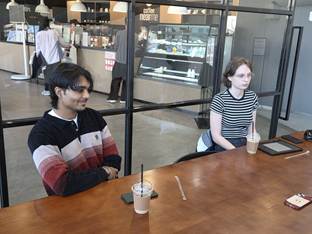
Fardin (left) and Ekaterina (right) at Coffee Near Me in the library on Oct. 2
Part 1. Being the First
Q1. How did you first hear about POSTECH in Pohang, South Korea? You must have considered universities in other countries as well. What ultimately made you choose POSTECH?
Ekaterina | I first came across POSTECH while looking into the Global Korea Scholarship (GKS) as I considered studying in Korea. Pohang is smaller than Seoul or Busan, but it’s right by the sea. I also liked the university’s small size and close-knit community. It reminded me so much of my high school. The greenery around campus and the coastal setting appealed to me, too.
Fardin | I first learned about POSTECH through the YouTube channel of Professor Jin Tae Kim from the Department of Mechanical Engineering. I heard a story about students who wanted to start a club, and the university readily provided them with a space. That really impressed me. It showed that when students want to start something, the university takes their ideas seriously. That was when I started looking into POSTECH in earnest.
Q2. You are among the first 19 international undergraduates in POSTECH’s 40-year history. How does that feel?
Fardin | It means we are pioneers, the ones paving the way. To be honest, that’s one of the reasons I came to POSTECH. I wanted to build something here for the students who will come after us, and I wanted to be part of things happening on campus for the very first time. I think it will be an incredibly meaningful experience for me.
Ekaterina | There will definitely be challenges that come with being the first. But I actually like that. We get to find our own way, and what we learn might help future international students. Being the first feels pretty special.
Q3. Does being “the first” also come with any particular difficulties?
Fardin | The hardest part is having to figure everything out from scratch in a completely different country, somewhere I’ve never been before. Back in Bangladesh, I used to hang out with a group of nearly 20 friends. I really love talking to people. Here, though, I hear Korean on one side and Russian on the other. Quite a few of the international students speak Russian. Sometimes I catch myself looking over and wondering, “What are they talking about?” Still, Korea is an incredibly convenient place to live, and I believe in myself. I think I’ll be able to get through it.
Ekaterina | For me, the hardest part is communicating with Korean students. I think some students still aren’t used to seeing international students in their classrooms. But I think that’s part of studying abroad. I just need to make an effort to reach out first.
Fardin | And that’s all part of growing, too.
Q4. From the day you arrived in Pohang until now, what moments have stayed with you the most? Was anything different from what you expected?
Fardin | I think I should start with something that happened before I even got to Pohang. On the train from Busan, I was struggling to figure out where to put my luggage. A woman I had never met, who I don’t think spoke much English, lifted her own bag to show me where it should go. My seat happened to be next to hers. Even though we barely shared a language, she kept talking to me and made me feel comfortable. It struck me that someone could be so thoughtful toward a complete stranger from another country.
Another moment that stayed with me was when I visited Pohang’s famous Jukdo Market with other international undergraduate students. We bought fresh seafood at the market, then gathered in the kitchen of the RC(Residential College) dormitory to cook and have dinner together. The whole experience of shopping for ingredients, cooking, and sharing a meal was really enjoyable. It was a special opportunity to make memories with friends I had met in a new place, and I think we’ll all remember it for a long time.
Ekaterina | I’m honestly amazed by Pohang itself. In Russia, when you hear about a city with a population of around 500,000, you imagine somewhere much smaller. I thought Pohang would be like that, too. But on the taxi ride from the bus terminal to my dorm, I saw lovely houses and apartment buildings, and greenery everywhere. There were birds and ponds, too. It was so different from what I had imagined, and I’m really happy to be here. I’m still getting used to the food, but I keep trying new things. I’m sure it’ll grow on me.
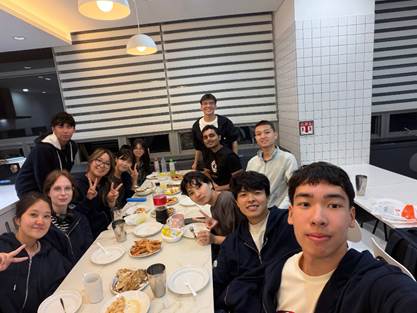
[Photo] One of Fardin’s most memorable moments in Pohang: cooking and sharing a meal with friends
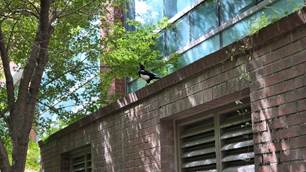
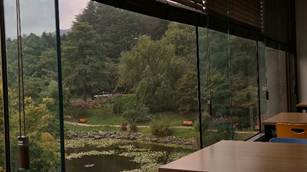
[Photo] Ekaterina, who loves the greenery of Pohang
Part 2. Ekaterina’s Story — Helping Everyone Live Life to the Fullest
Q1. You graduated at the top of your class from one of Russia’s leading STEM schools. What was studying there like?
Every day was incredibly busy. Classes were much harder than at other schools, and we had quizzes all the time. On top of that, my school was in northern Moscow and I lived in the south, so I spent a long time on the subway every day. Depending on the season, I was commuting for three and a half to four hours a day.
Even so, I really loved that school. I had so many talented classmates, and it was such a close-knit community that everyone knew each other. In fact, that’s one of the reasons I chose POSTECH. The atmosphere is very similar. The big difference is that now I live in a dorm, so I no longer have to spend hours on the subway every day.
Q2. Do you remember when you first became passionate about science and engineering?
It was a Python programming project I did in tenth grade. It was a huge assignment, the kind where you had to create a game or even invent an entirely new programming language. Instead of teaching us every little step, our teachers just gave us one enormous task, and we had to figure almost everything out for ourselves. It took an incredible amount of time and effort.
But I still vividly remember how it felt when I finally finished and saw something I had created actually work. I loved the sense of accomplishment that came from building something with my own hands, something that might one day help someone else. That’s what led me to biomedical engineering and 3D bioprinting, fields where I could really feel that I was helping people.
Q3. Before coming to POSTECH, you studied mechatronics and robotics at the National Research Nuclear University MEPhI in Russia. What was that experience like, and how did you decide to come to POSTECH?
MEPhI is one of Russia’s top universities. Even so, I felt restricted in a lot of ways. It was almost impossible for undergraduates to join a research lab, or even get a sense of what working in one was like. I couldn’t choose my courses, either, so sometimes I had to take classes that had nothing to do with my goals.
POSTECH is different. Even when there are required subjects, like humanities and social sciences, you still have options within those areas. I wanted to study in English in an international environment and have opportunities such as going on exchange programs. I’d heard that nearly every POSTECH student gets some kind of international experience. That surprised me in the best possible way. Because the student body is small, you can actually pursue the things you really want to do.
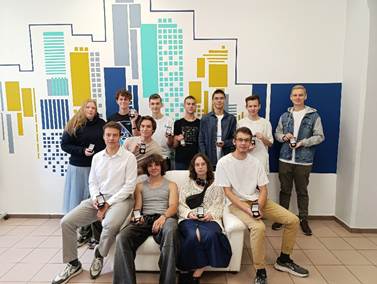
[Photo] Ekaterina with high school classmates who, like her, earned a perfect score on at least one of their graduation exams
Q4. Where did your goal of developing assistive and rehabilitation devices begin? Was there a particular person or experience that inspired you?
There have been several moments in my life when I’ve wanted to help people who face limitations in their everyday lives. When I was very young, before I even started school, I had a friend, a little boy who had only one arm. He wore a simple prosthetic arm, but the other children found it strange or even scary, so they didn’t really play with him. I remember wanting to help him.
My favorite movie growing up was Dolphin Tale. It’s about a dolphin that loses its tail and learns to swim again with a prosthetic tail made by the people in the story. And my father is hard of hearing.
My friend with the prosthetic arm, the dolphin in the movie, and my father all made me think about the same thing. It always felt unfair that some people couldn’t enjoy parts of everyday life that others take for granted. I want to help close that gap through technology.
Q5. Is there any research you particularly want to pursue at POSTECH, or a lab you hope to work with?
I’ve already joined the UGRP (Undergraduate Group Research Program) in Professor Jinah Jang’s lab in the Department of Mechanical Engineering. I’m not doing anything particularly advanced yet. Right now, on Professor Jang’s advice, I’m reading research papers to gain a better understanding of the field.
I had been following her research with interest even before coming to POSTECH. Actually, I had knee surgery in March this year, and part of my meniscus, the cartilage that absorbs shock in the knee joint, was removed. Since then, the meniscus has become a new area of interest for me. Her lab doesn’t study the meniscus directly, but I’d like to learn about her work on vascularization, the process of growing blood vessels within engineered tissues, and find a way to connect it to my own interests. Someday, I’d also like to make something myself using 3D printing.
Part 3. Fardin’s Story — From the Night Sky to Aerospace Engineering
Q1. You built your own equatorial tracking platform to overcome the limitations of your telescope. What problem were you trying to solve, and how did you build it?
When the sun moves from east to west, its path across the sky isn’t straight; it’s tilted. Because Earth’s axis points toward Polaris (the North Star), everything in the night sky — stars, planets, the moon, galaxies — appears to rotate around it.
To the naked eye, stars seem to move very slowly. But when you look through a telescope at 200x or 240x magnification, it’s a different story. A star can drift out of view in just 20 or 30 seconds.
So I built a device to counteract that apparent motion. Bangladesh lies at about 23 degrees north latitude, which corresponds to the angle of Polaris above the horizon. I calculated that angle and aligned the platform’s axis of rotation with Polaris, then installed bearings on the north and south sides. The platform slowly rotates in the opposite direction to Earth’s rotation. That let me keep a star centered in the telescope’s field of view for about five to ten minutes. From there, I started photographing planets like Saturn and Jupiter, as well as the Orion Nebula.
I actually had a lot of help from older students when building it. I showed them papers and videos I’d found online, and once they understood the principles, they helped me put it together.
Q2. A photograph of Saturn that you took was featured as the April 2024 “Astrophoto of the Month” by NASA Exoplanet Watch. How did that feel?
I couldn’t believe it. NASA Exoplanet Watch is a program for observing exoplanets, and it had a separate channel where participants could share astrophotography. Every month, a few photographs were selected for the newsletter as photos of the month.
One day, I got a message from someone involved with the program who was studying at Caltech. They asked whether they could feature my photo in a newsletter. Of course I said yes, and then asked which newsletter they meant. It turned out to be the NASA Exoplanet Watch newsletter! I called my mom right away to tell her the news.
I’m sure there were plenty of photographs that were technically far better than mine. But I think mine was chosen because of the effort I put into it and the story behind the image. I was so happy to see all that time and hard work pay off.

[Photo] Fardin’s photo of Saturn, featured as NASA Exoplanet Watch’s April 2024 “Astrophoto of the Month”
Q3. What first sparked your love of the night sky?
I can’t remember the exact moment. I just know that I’ve always looked up at the stars, ever since I was little. The sky was much darker back then. You know that illusion where the moon or the sun seems to follow you as you walk? I used to wonder why the stars didn’t follow me in the same way. That curiosity grew into an interest not only in the night sky, but also in the daytime sky, astronomy, and aerospace as a whole. The air in Pohang is clean, so I’m excited to see many more stars at night here.
Q4. At Eureka Fest 2023, a science fair in Bangladesh, you presented “Tesla’s City,” a model city combining a solar-tracking system, piezoelectric walkways, and wireless charging for electric vehicles. How did the idea come about?
Our team’s theme was renewable energy, and at first we just wrote down whatever ideas came to mind. Someone suggested building a solar tracker, inspired by my equatorial platform. Just as my platform follows stars, solar panels that follow the sun can improve their efficiency. We didn’t use the same device; we just borrowed the principle of tracking a celestial object.
Another teammate saw a social media post that was going around at the time about Japan turning people’s footsteps into electricity. That gave us the idea of a walkway that generates power when people walk on it. We also came up with a road that could automatically charge electric vehicles as they drive, based on a concept we’d learned in physics class.
Everyone was about to choose just one of those ideas, but I suggested putting them all together. What if we built a whole city with more efficient solar panels, roads that charge electric vehicles, and sidewalks that turn footsteps into electricity?
Q5. You love physics, earned the highest score in A Level Physics in Bangladesh, and have a deep interest in astronomy. Yet you chose mechanical engineering. How do these interests connect, and what kind of engineer do you hope to become?
I really love astronomy. But I don’t want to stop at simply enjoying it. I want to build something that can genuinely contribute to the field, tools like the Hubble Space Telescope or the James Webb Space Telescope that let us capture images of more distant galaxies. Taking pictures of stars and learning the theories aren’t enough to build those things. You need engineering to actually send them into space. After making my equatorial platform, I realized that if I learned engineering properly, I could do far more than pursue a hobby.
POSTECH doesn’t have a separate aerospace engineering department, but I can take relevant courses in mechanical engineering and specialize in aerospace. Mechanical engineering has such a wide range of applications. Whether it’s a submarine underwater, a car on the road, or a spacecraft in orbit, mechanical engineering is involved. So I want to keep my options open as an undergraduate and narrow my focus in graduate school, during my master’s and PhD studies. And someday, I hope to become someone who can represent both Bangladesh and POSTECH on the global stage.
Part 4. And 20 Years From Now
Q1. You’ve only just begun your first semester at POSTECH. What are you most looking forward to?
Fardin | Academically, the first thing I want is to get better at physics. The way we learn here is very different from what I’m used to, so I’m focusing more on physics right now. When I moved from O Levels to A Levels, it was difficult at first, too, but I gradually improved by studying consistently. I want to keep doing that here, making progress one step at a time.
I’ve also joined PSI (POSTECH aeroSpace Initiatives), the aerospace research club in the Department of Mechanical Engineering. So far, most of what I’ve done has been in astronomy, and my only real engineering experience was building the equatorial platform. Now it’s time for me to teach myself programming and CAD. Older students and our GAs (Global Student Advisors, who mentor new international undergraduates) once showed me photos of themselves staying up all night having fun at the beach during break. I want to make memories like that with my friends, too.
Ekaterina | I want to make Korean friends. After all, I’ll be here for at least four years. I’ve already studied Korean for about a year and a half, and I’d like to take a Korean course at PICL (POSTECH Institute of Culture and Language) next semester.
Fardin | Ekaterina is already really good at Korean. When a group of us international students went to Jukdo Market for seafood, she talked with the locals and led us all around.
Ekaterina | “한국어 잘 못해요.” (“My Korean isn’t very good,” she replies modestly in Korean.) Right now, I think settling into campus life should come first, so I’m planning to join clubs next semester. There are so many great options, like photography, dance, and business clubs. I also really love surfing. So far, I’ve only done it in Russia, but once my knee heals, I definitely want to surf here in Pohang.
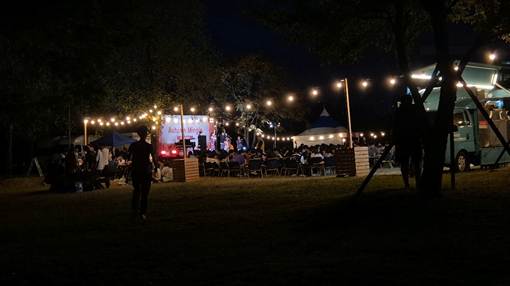
[Photo] 2026 POSTECH AutumnFest, captured by Ekaterina
Q2. POSTECH describes itself as a university dedicated to creating value. What does “creating value” mean to each of you?
Fardin | I can see the value POSTECH creates everywhere. As I mentioned earlier, when a few students wanted to start a club, the university made a new space for them. There’s also so much research infrastructure that students can access, including the Pohang Accelerator Laboratory (PAL). Older students have told me that you can join research projects you’re interested in during breaks and that professors welcome you when you come to see them. At many universities, undergraduates have to compete fiercely for lab positions, but that doesn’t seem to be the case here. I can try anything connected to my career goals, and POSTECH will be there to support me. To me, that’s the value of POSTECH.
Ekaterina | For me, creating value is closely connected to research. I contacted a professor even before I was admitted, and I applied for the UGRP. Being able to experience working in a lab while you’re still an undergraduate is incredibly valuable. There are so many opportunities here. You just have to make the most of them.
Q3. Is there anything you would like to say to the POSTECH community?
Ekaterina | First of all, I want to thank POSTECH for accepting me. Being able to study at an excellent university in Korea on a scholarship is an incredible opportunity. I can see the university making an effort to offer more classes in English and help international and Korean students take part in activities together. I’ve attended two other universities in Moscow, where I had to figure everything out on my own. Here, there are so many people I can turn to for help, including the GAs and staff members.
Fardin | I’m really grateful to the admissions team and all the GAs. They’ve never turned us away when we needed help. If I could make one small suggestion, it would be to create a short PDF or video guide for international students. It could cover things that seem minor but are unfamiliar to us, like using the dormitory washing machines or getting a SIM card. For those of us who are still minors, including me, setting up a phone plan is even more complicated. Some students have phones that don’t support eSIMs, while others bought SIM cards that couldn’t be activated with a Residence Card and had to buy another one. The GAs are students themselves, so they can’t always help immediately. A guide like that would let us solve these small problems on our own.
Q4. Applications are now open for POSTECH’s second cohort of international undergraduates. What advice would you give students considering POSTECH or studying in Korea?
Ekaterina | Learning even a little Korean before you arrive will help a lot. My Korean still isn’t that good, but when I was sick recently, I was able to go to a local clinic by myself and explain my symptoms. And definitely check the university website. I manage a Telegram group chat with around 150 applicants, and there are so many questions about things like scholarships. Most of the answers are already on the website.
Fardin | I wish I’d learned some Korean before coming, too. I’d also recommend getting familiar with how Korean students study math and physics. In the British A Level system, a lot of the work involves memorizing formulas and plugging in numbers. Here, it’s completely different. If you can learn even a little about how these subjects are taught in Korean high schools, especially science high schools, it’ll be much easier to keep up.
Ekaterina | There are fewer class hours here than in Moscow, but much more independent study. I’m actually enjoying that right now because I’m genuinely interested in what I’m learning.
Q5. One final question: If you return to POSTECH in 20 years, for its 60th anniversary, what kind of person would you like to have become?
Ekaterina | I’d like to start a deep-tech startup. Right now, my dream is to help people by making prosthetic arms and legs or artificial organs. And of course, I’d like to be rich, too! I hope I’ll be living and working abroad, maybe in Korea or Australia.
Fardin | I want to become a specialist researcher in aerospace and a leader in my field. And when I return to POSTECH, I don’t want younger students to know me only as “an alumnus who came back to visit.” I want them to know me as part of POSTECH’s story, someone who, as one of its first international undergraduates, as a researcher, and as a POSTECHian, accomplished something meaningful for the students who came after me.
What will Ekaterina and Fardin be like when they return to POSTECH 20 years from now? Ekaterina dreams of becoming an entrepreneur who develops technology to help people. Fardin hopes to grow into an aerospace researcher and an alumnus who leaves something behind for the students who follow. Their visions of the future may be different, but they share a desire to create something meaningful through the work they love.
For now, of course, they have only just taken their first steps toward those futures. They are adapting to new ways of learning, making friends, and getting used to unfamiliar parts of everyday life, one at a time. We look forward to seeing how their time at POSTECH unfolds and what stories they will create along the way.