Research Highlights
Same Atoms, Different Order: POSTECH Team Pushes Materials Beyond Their Limits
- Physics Materials Science & Engineering Convergence Semiconductor Engineering
- Date2026.10.27
- Views2028
[Professors Daesu Lee, Gil-Ho Lee, and Si-Young Choi uncover design principle for atomic-layer “gradients”; published in Science]
[Expected to serve as core technology for next-generation electronic devices, semiconductor insulating films, and thermal sensors]
Just as the same ingredients can taste different depending on how and in what order they are cooked, a material can take on new functions simply by changing the order in which its atoms are stacked. A joint research team led by Professors Daesu Lee, Gil-Ho Lee, and Si-Young Choi of POSTECH and Professor Se Young Park of Soongsil University has developed a new material design method. By precisely arranging the composition of atomic layers, the team added new functions to metals and ultrathin insulating materials without changing the kinds or amounts of atoms used. The study was published in Science on October 1.
To add new functions to a material, researchers have typically introduced new elements or changed the ratio of existing ones. However, this can alter or even eliminate the material’s original properties, so it has been difficult to add new functions while keeping the material’s strengths.
Metals are a good example. It has been difficult to give them polarity, an asymmetric arrangement of atoms in one direction, while keeping their high electrical conductivity. Ultrathin insulating materials face a similar problem: the thinner they become, the more easily electricity leaks through them. This makes it hard to achieve both thinness and strong insulation.
The team developed a “selective atomic gradient” design method. It leaves the atoms responsible for the material’s electronic properties unchanged. Instead, it gradually varies the proportion of a specific atom of a different size from one atomic layer to the next through the material’s thickness.
Like a color gradient that shifts gradually, this variation in atomic proportions caused the atoms to shift slightly in one direction, creating polarity inside the material. When the team reversed the order of the atomic layers, the direction of the polarity also reversed. No such directionality appeared in materials containing the same kinds and amounts of atoms mixed uniformly.
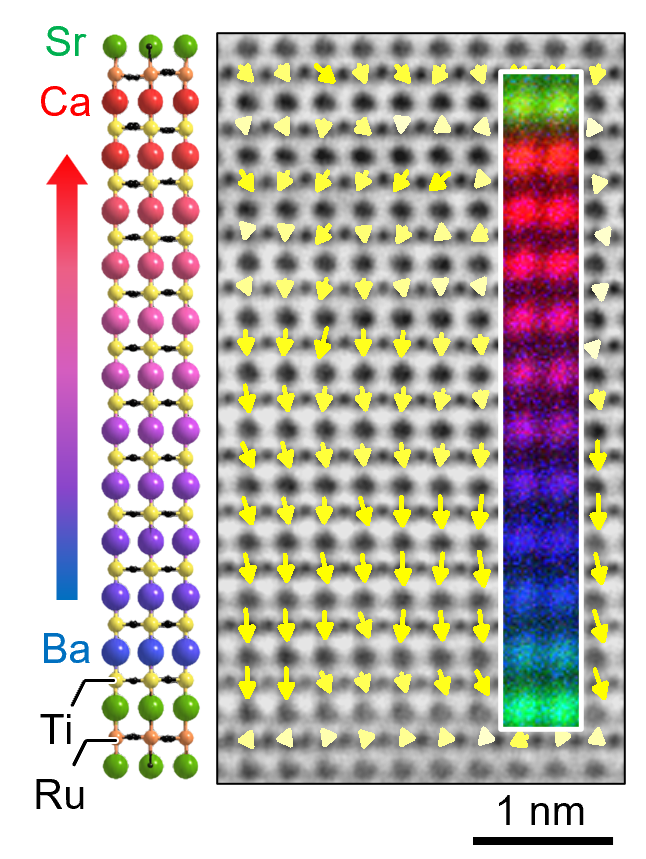
When the method was applied to a thin metal film, the film kept its high conductivity. However, its resistance differed depending on the direction in which current flowed. Reversing the layer order also reversed this difference in resistance. This showed that a material’s electrical directionality can be set during fabrication.
When applied to an ultrathin insulating film about 5.1 nanometers thick, the method greatly reduced leakage current, the unwanted flow of current through an insulator. The film also kept a high capacity to store electrical energy.
The film was also about 100 times better at converting temperature changes into electrical signals than a representative reference film of similar thickness. Reversing the layer order reversed the direction of the electrical signal generated by temperature changes.
The findings are expected to support the development of electronic devices that behave differently depending on the direction of current, ultrathin insulating films with reduced leakage for next-generation semiconductors, and infrared and thermal sensors that detect temperature changes.
“We have shown that a material can gain new functions while keeping its original strengths, without adding new elements, simply by changing the order in which atoms are stacked,” said Professor Daesu Lee, who led the study. “We plan to extend this method to a wider range of materials, such as magnetic materials and superconductors, and to carry out follow-up research to put it into real devices such as ultrathin insulating films and thermal sensors.”
Researcher
-

Lee Daesu Associate Professor
Dept. of Physics
View Profile -

Lee Gil-Ho Associate Professor
Dept. of Physics
View Profile -

Choi Si-Young Professor
Dept. of Materials Science & Eng.
View Profile -
김상현
통합과정
-
한기정
통합과정
-

황수윤
박사
-

노가희
박사