News & Updates
-
Professor Young Tae Chang Awarded Korea Toray Science and Technology Prize
[Professor Young Tae Chang Awarded Korea Toray Science and Technology Prize] - Prof. Hyunwoo Kim and Youn Soo Kim also awarded Korea Toray Fellowship - Professor Young Tae Chang from the Department of Chemistry and School of Convergence Science and Technology was recently honored as the recipient of the sixth Korea Toray Science and Technology Prize. Known as one of the world's leading experts in the field of bioimaging, Prof. Jang was honored for his contributions to disease diagnosis and treatment research through sensors and probes that identify cells with fluorescent materials. Prof. Jang has also recently published a book that explains the field of bioimaging to the general public so those not specializing in bioimaging can easily understand the concepts. The Korea Toray Science and Technology Prize is awarded by Korea Toray Science Foundation to scientists who have contributed to the advancement of science and technology through outstanding achievements in basic and applied research in the fields of chemistry and materials in Korea. Each winner receives a prize of 100 million won (USD 75,000) and a plaque. The Korea Toray Science Foundation, which identifies young researchers and supports their research projects, selected Professor Hyunwoo Kim of the Department of Chemistry and Professor Youn Soo Kim of the Department of Materials Science and Engineering at POSTECH as fellowship recipients. Prof. Hyunwoo Kim is working on catalyst-free electrochemical reactions to synthesize high-value pharmaceuticals while Prof. Youn Soo Kim is developing implantable gel electrodes that can be adhered to monitor physiological signals. The two professors will each receive a research grant of 150 million won (USD 113,000) over the next three years.
2023.09.18 2379 -
Dr. Seong Keun Kim Inaugurated as 9th President of POSTECH
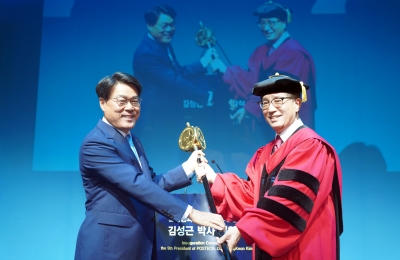
Dr. Seong Keun Kim assumed office as the 9th President of Pohang University of Science and Technology (POSTECH) at the official inauguration ceremony held at the POSCO International Center at 11:00 AM on September 5, 2023. The event was attended by guests from academia and government, both domestic and international. Notable attendees included Pohang city mayor Gang-deok Lee, Pohang city council chairman In-gyu Baek, President Dosoung Choi of Handong Global University and POSTECH Foundation Chairman Jeong-Woo Choi. Faculty, staff, and students also joined the event. In his inaugural address, President Seong Keun Kim remarked, “POSTECH has grown into a world-class institution in an impressively short period of time with outstanding leaders who had an incredible foresight, strong support from POSCO and its subsidiaries, and extraordinary passion from our members.” He further added, “I stand here with a profound sense of responsibility and a resolute commitment to take POSTECH to the next level of excellence.” He referred to an unoccupied pedestal located within the campus, intended for a future Nobel laureate from POSTECH, emphasizing: “The Nobel Prize honors not just academic success but also celebrates the spirit of adventurers who tread where no one has gone before.” To address the challenges that the university faces, such as rapid population decline and resource concentration in the metropolitan areas, he underscored the imperative to “forge a new path in education, research, and societal contributions.” President Kim added, “POSTECH should become a highly open university, fostering two-way exchange that empower students to chart their own destinies on the global stage.” He also pledged to introduce a range of policies benefiting students, faculty, researchers, and staff. In conclusion, he conveyed his determination, stating: “As we look forward to our 40th anniversary, POSTECH will embark on our voyage for a second leap onto the world stage from Pohang, the center of the pioneering spirit of Korea.” POSTECH Foundation Chairman Choi, in his appointment statement, extended congratulations to President Kim, affirming: “Our new president possesses a well-rounded set of leadership, drive, and communication skills. He exhibits the capacity and passion to properly embody POSTECH’s educational philosophy, making him the ideal candidate that POSTECH needs.” President Kim, a native of Daegu, holds a bachelor’s degree in chemistry from Seoul National University. He pursued postgraduate studies at Harvard University, obtaining both a master’s and a Ph.D. in chemical physics. He joined the Seoul National University faculty in 1989, serving as a professor in the Department of Chemistry until 2022. Additionally, in 2014, he assumed the role of dean of SNU’s College of Natural Sciences. He has also chaired the Samsung Science and Technology Foundation since 2019, contributing significantly to the discovery of exceptional emerging researchers. Renowned for his outstanding research achievements in physics and chemistry, President Kim was honored as the inaugural national scholar (Star Faculty) by the Ministry of Education in 2006. In 2013, he was inducted as Fellow of the Royal Society of Chemistry (FRSC) and in 2015, he became the first non-European editor-in-chief of Physical Chemistry Chemical Physics (PCCP), one of the world’s top three journals on physical chemistry.
2023.09.12 3193 -
POSTECH Opens Graduate Institute of Ferrous & Eco Materials Technology
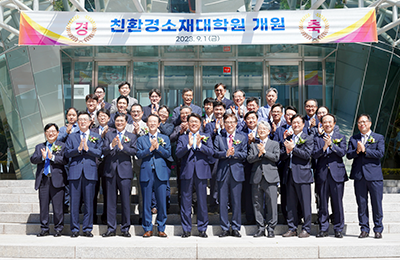
Pohang University of Science and Technology (POSTECH)’s Graduate Institute of Ferrous & Energy Materials Technology (GIFT), the world’s only institution dedicated to steel studies, has undergone a transformation into the Graduate Institute of Ferrous & Eco Materials Technology (GIFT), focused on the education and exploration of eco-conscious future materials technologies. The official unveiling ceremony, which took place on September 5, was attended by Jeong-woo Choi, CEO of POSCO Group and chairman of POSTECH Foundation, Ji-yong Kim, Director of POSCO N.EX.T Hub, Byung-ok Yoo, Leader of Green Materials Team at POSCO Holdings, Se-don Joo, Director of POSCO R&D Center, Soo-Hee Nam, Head of Research Institute of Industrial Science and Technology (RIST), Jun Hyung Kim, President of POSCO Future M, and Seong Keun Kim, President of POSTECH. Not only will the graduate school’s name be changed, but the Energy Materials program within it will also be renamed as Secondary Battery. These changes reflect POSTECH’s firm commitment to actively advancing research in eco-friendly material technologies such as second batteries and hydrogen alongside eco-friendly steel production. In the upcoming year, POSTECH will admit new students majoring in hydrogen-related fields. Jeong-woo Choi, Chairman of POSTECH Foundation, remarked, “Over the past 37 years, POSTECH’s dedication to educational patriotism and POSCO’s commitment to the iron and steel industry have together transformed Pohang into a world-class city.” He added, “In the future, the Graduate School of Ferrous & Eco Materials Technology will evolve into a central hub, further strengthening the connection between POSTECH and POSCO Group, ultimately serving as a center for eco-friendly future materials and a representative institution for education and research.” Seong Keun Kim, President of POSTECH stated, “POSTECH will achieve significant milestones through collaborations with leading domestic and international companies including POSCO Group, focusing on Graduate School of Ferrous & Eco Materials Technology. We aim to pave the way toward a sustainable future for humanity through industry-academia-research cooperation. POSTECH Graduate Institute of Ferrous & Eco Materials Technology was initially established as Graduate Institute of Ferrous Technology in 2005 with full support from POSCO. It underwent expansion and restructuring in 2020, becoming Graduate Institute of Ferrous & Energy Materials Technology. This graduate school was the first in Korea to publish a steel-related paper in Nature, one of the world’s most prestigious academic journals. It has also received numerous academic awards from the Korean Institute of Metals and Materials. To date, it has trained a total of 900 master’s and doctoral students, and its graduates have gone on to excel in various domestic and international industries and universities including the POSCO Group, contributing significantly to the advancement of steel and energy technology.
2023.09.12 2694 -
POSTECH Ranks No.2 on 2023 World's Best Small Universities List by THE
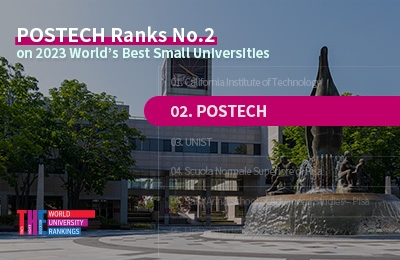
[POSTECH is second best small university in the world after Caltech, with strength in academia-industry collaboration.] POSTECH has ranked second in the world on the 2023 World’s Best Small Universities list by Times Higher Education (THE), a global university rankings organization. POSTECH has ranked second in the world on the 2023 World’s Best Small Universities list by Times Higher Education (THE), a global university rankings organization. THE publishes an annual global ranking of universities with fewer than 5,000 students. The Small World University Ranking uses the same indicators as the World University Ranking (13 performance indicators across five categories, including teaching, research, citations, industry income, and international outlook), but only focuses on small universities, given that the characteristics of small universities, which prioritize quality over quantity and aim for customized education, are not well reflected in conventional university evaluations. Caltech (U.S.) placed first on the list, followed by POSTECH in second place. This is the first time POSTECH has ranked second the rankings began. POSTECH’s ranking is attributed to its strong performance in research grant income and industry-academia collaboration compared to other universities, as well as its steady progress in education and research. Caltech, a top-ranked U.S. engineering school founded in California in 1891, has produced outstanding scientists and engineers such as Charles Richter, who developed the Richter scale, as well as faculty members such as Albert Einstein, Linus Pauling, and Richard Feynman. In addition, UNIST in South Korea is ranked third. [Top 10 small universities in the world 2023] Ranking Institution Country No. of Students 1 California Institute of Technology United States 2,237 2 POSTECH South Korea 3,260 3 UNIST South Korea 3,896 4 Scuola Normale Superiore di Pisa Italy 629 5 Sant’Anna School of Advanced Studies – Pisa Italy 1,100 6 Università della Svizzera Italiana Switzerland 3,266 7 École des Ponts ParisTech France 1,959 8 Bond University Australia 3,214 9 Brighton and Sussex Medical School UK 1,013 10 Indian Institute of Science India 3,990
2023.09.07 4383 -
Professor Hyoung Seop Kim Receives THERMEC’ 2023 Distinguished Award
Professor Hyoung Seop Kim, a faculty member in the Department of Materials Science & Engineering and Graduate Institute of Ferrous & Energy Materials Technology (GIFT) at Pohang University of Science and Technology (POSTECH) was recently honored with Distinguished Award at THERMEC’2023, a renowned international conference held in Austria. This award, presented to scholars who have made substantial international contributions in the field of materials and processing, holds a special place in academic community. Professor Kim's recognition stands as a testament to his visionary research spanning three decades, which has significantly advanced the metallurgical engineering industry. Professor Kim began his academic journey at Seoul National University, earning his bachelor's, master's, and doctoral degrees in Metallurgical Engineering. Since 2008, he has been guiding students at POSTECH. He is Fellow of the Korean Academy of Science and Technology and the National Academy of Engineering of Korea, and is the academic vice president of the Korean Institute of Metals and Materials. The THERMEC conference provides a forum dedicated to exploring the frontiers of advanced materials, manufacturing techniques, and their far-reaching applications. Having its roots dating back to 1988, this event is held every two to three years and spans the globe. The 2023 gathering had approximately 1,500 global scholars engaged in discussions covering a diverse range of subjects, including steel, biomaterials, aerospace structural materials, fuel cells, and hydrogen storage technology. Continuing the path paved by professors emeritus Hae-Geon Lee and Chong Soo Lee, Professor Hyoung Seop Kim marks the third recipient from POSTECH to receive this award. This achievement brings the count of Korean awardees of the THERMEC Distinguish Award to six.
2023.09.04 2366 -
POSTECH – Tel Aviv University Joint Workshop Held to Strengthen Collaboration in Cutting-Edge Research
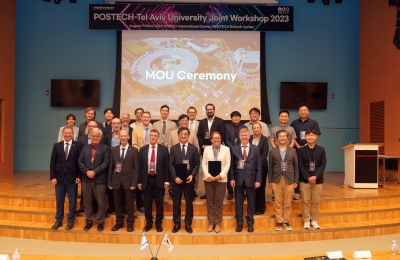
POSTECH hosted a joint research workshop with Tel Aviv University, the largest university in Israel, from August 7 – 8, 2023. 13 scholars from Tel Aviv University, including Professor Milette Shamir, Vice President of Academic International Affairs and Professor Noam Eliaz, Dean of Faculty of Engineering, as well as 14 professors representing POSTECH, including President Moo Hwan Kim, Professor Hyung Joon Cha, Dean of Engineering, and Professor Sin-Hyeog Im of the Department of Life Sciences, participated in the conference held on the POSTECH campus. After the opening ceremony, which included welcoming remarks from President Moo Hwan Kim and congratulatory remarks from H.E. Akiva Tor, the Israeli Ambassador to Republic of Korea, an MOU was signed between POSTECH and Tel Aviv University for student exchange and research cooperation. The workshop focused on the following topics: Photonics/Light-Matter Interaction, Biomaterials and Biomedicine, Machine Learning, AI and Smart Cities/Grids, Electrochemistry, Energy and Electrokinetics, and Immunology & Plant Biology. The joint conference was initiated by Ambassador Akiva Tor from his visit to POSTECH in 2021. He is deeply interested in cooperation between the two countries and has expressed his support for facilitating increased collaboration between POSTECH and Israeli research institutions. Through this joint conference, POSTECH hopes to establish a closer working relationship with Tel Aviv University, and to pursue more high-impact research in cutting-edge fields together. Tel Aviv University, founded in 1956, is the largest university in Israel and is also known for creating an entrepreneurship curriculum in Israel, a country known as a startup paradise. The university, which is strong in medicine and biochemistry, has been conducting joint research with POSTECH in fields such as optics and AI.
2023.08.23 1823 -
POSTECH Professor Seungmoon Choi Receives Prestigious IEEE Paper Award
Professor Seungmoon Choi (Department of Computer Science & Engineering, Department of Convergence IT Engineering) at Pohang University of Science and Technology (POSTECH) has recently been honored with the IEEE Transactions on Haptics Best Paper Award at the IEEE World Haptics Conference in the Netherlands in July. The Institute of Electrical and Electronics Engineers (IEEE) is renowned for organizing some of the world’s largest conferences across the electrical, electronic, and computer engineering domains. In his award-winning paper, “Perceived Intensity Model of Dual-Frequency Superimposed Vibration: Pythagorean Sum,” the professor elucidated that when combining two vibrations of different frequencies, the square of the resultant vibration’s magnitude equals the sum of the squares of the magnitudes of each perceived vibration. This revelation was among 76 studies in the 2022 edition of the IEEE Transactions on Haptics, distinguished itself for its academic brilliance and impact. After acquiring degrees in Control and Instrumentation Engineering at Seoul National University, Professor Choi went on to earn his Ph.D. in Electrical and Computer Engineering from Purdue University, USA. Since joining POSTECH in 2005, he has consistently served as a guiding light for many students. Haptics, a technology bridging tactile interactions between humans and computers, can be observed in everyday instances such as the vibration feedback when tapping an app on a smartphone or the lifelike sensation a digital pen imparts, akin to traditional writing on paper. Professor Choi is one of the most prolific contributors to the internationally authoritative IEEE Transactions on Haptics journal. His expertise was previously recognized with the 2011 Early Career Award from the IEEE Technical Committee on Haptics. Beyond his research, Professor Choi has played a prominent role as an Associate Editor-in-Chief for IEEE Transactions on Haptics. He co-chaired the IEEE Haptics Symposium in 2014 and 2016 and has secured the hosting rights for the upcoming IEEE World Haptics Conference in Suwon, where he’s slated to serve as a general co-chair.
2023.08.14 2138 -
Professor Ara Koh Named Associate Editor of Biofilms and Microbiomes
Professor Ara Koh from the Department of Life Sciences at Pohang University of Science and Technology (POSTECH) has been appointed as the associate editor of npj Biofilms and Microbiomes, an international journal published by Springer Nature, that ranks in the upper 4.49% within the field of applied microbiology with an impact factor of 9.2. Her tenure in this role extends until December 31 of next year. Professor Koh earned her bachelor’s degree from Sogang University and her master’s and PhD in life sciences from POSTECH. She pursued a post-doctoral course at the University of Gothenburg at Sweden and held the position of Assistant Professor at Sungkyunkwan University’s School of Medicine before joining the faculty at POSTECH in 2021. The term microbiome is a combination of microbe and biome, encompassing the complete set of microbes and their genetic information. Microbes’ genetic information within the body is approximately 100 to 1,000 times larger than that of a human, and their influence on human health and diseases is well-established. Professor Koh is actively involved in research on the prevention and treatment of various diseases through the study of the microbiome. Since September of last year, she has also served as the Deputy Ambassador of Korea to the Federation of European Microbiological Societies. The journal npj Biofilms and Microbiomes is a publication by Springer Nature, the publisher responsible for the scientific journal Nature. This journal is included in Nature’s portfolio and is directly managed by Nature.
2023.08.11 1942 -
Renowned Bioimaging Scholar, Professor Young Tae Chang Publishes Textbook
[The book is acclaimed for its accessibility to the general public, presenting the history and the mechanism of probes and sensors] Professor Young Tae Chang from the Department of Chemistry and School of Convergence Science and Technology and Professor Nam-Young Kang from the Department of Convergence IT Engineering at Pohang University of Science and Technology (POSTECH) have co-authored a textbook titled “Sensors and Probes for Bioimaging.” The book was published by Wiley, a renowned global publisher. Bioimaging, a technology employed in disease diagnosis and new drug development experiments, utilizes a probe to stain specific cells and employs a sensor to detect material concentrations, thus revealing the hidden internal structures of the body and various biochemical reactions. Notably, Professor Young Tae Chang, a world-renowned scholar in this field, has recently achieved remarkable success in tracking disease-causing cells such as those associated with cancer and Alzheimer’s, using fluorescent materials. Professor Chang and Professor Kang have developed 30 types of probes and conducted research on the aging process. While most bioimaging books tend to be arid and challenging due to their compilation of different papers, the book written by these two professors from POSTECH stands out by providing a presentation of the history of sensors and probes, the dyeing mechanism, and case studies. This approach makes the content accessible and informative not only to college students but also to the general public. Furthermore, the book contains the authors’ latest research findings. By utilizing the fluorescent probes developed by the two authors, readers can witness dynamic videos of living cells in motion, surpassing the static image. Moreover, the book offers valuable insights into the future of research in the field, unveiling novel mechanisms such as transporters for probes and exploiting differences in lipid structures of cells. Professor Chang, one of the authors, expressed his hope for the book’s impact by stating, “I aspire for this book to be not only beneficial to researchers like chemical biologists, analytical chemists, and biochemists but also accessible to undergraduates, graduate students, and professionals within the bioimaging industry.”
2023.08.02 1884 -
Professor Chang Yun Son Receives FACS Distinguished Young Chemist Award
Professor Chang Yun Son from the Department of Chemistry at Pohang University of Science and Technology (POSTECH) was presented the FACS Distinguished Young Chemist Award at the Asian Chemistry Congress held in Istanbul, Turkey, from July 9 to 14, 2023. Professor Son received this distinguished honor in recognition of his research on interface charge transfer using molecule simulation, which has significantly contributed to the advancement of materials for nano, energy, and bio applications. The FACS Distinguished Young Chemist Award is a biennial award given to outstanding researchers under the age of 40. Professor Son became the first Korean recipient of this award in 18 years since 2005. Professor Son obtained his bachelor’s and master’s degrees in chemistry from Seoul National University and went onto complete his Ph.D. in theoretical chemistry from the University of Wisconsin-Madison. After working at California Institute of Technology, he joined the faculty of POSTECH as a professor of chemistry. Recently, Professor Son achieved a feat as the world’s first researcher to unveil the principles behind the creation of metastable palladium hydride, a component in supplying hydrogen to metal palladium for hydrogen fuel cell catalysis. These findings were published in Nature. Additionally, his noteworthy research on bio and secondary cell materials was featured in Nature Communications and Proceedings of the National Academy of Science (PNAS). FACS, a federation representing chemical societies from Asia, serves as a platform for collaboration and communication to foster the development of research and education.
2023.07.27 1762