News & Updates
-
POSTECH Professor Jongsik Yi Receives F. Hilary Conroy Award
[Recognized at 2023 AAS for advancing East Asian studies] Jongsik Christian Yi, a professor in the Division of Humanities and Social Sciences at POSTECH, recently won the F. Hilary Conroy Prize at the Association for Asian Studies (AAS) in the United States. Professor Yi received the award for his presentation titled, “Animal Eugenics for Maoism: Tensions between the State and Communes over Animal Breeding Skills in Socialist China,” for the panel, "Labor and Knowledge Production in Modern Northeast Asia," which he delivered at the AAS conference held in Boston from March 16 to 19, 2023. Professor Yi received his bachelor's and master's degrees from Korea University and completed his Ph.D. at Harvard University. He has been teaching courses on the history of science, Korean history, and East Asian studies at POSTECH's Division of Humanities and Social Sciences since August of last year. The F. Hilary Conroy Award is presented annually to the most outstanding panel presenters at the AAS conference. It was established in honor of Professor F. Hilary Conroy of University of Pennsylvania, for making significant contributions to the development of East Asian studies. The AAS was established in 1941 and now the world's largest Asian studies organization, with approximately 3,000 researchers studying Humanities, Social Sciences, and Economics in East Asia, Southeast Asia, South Asia, and Inner Asia.
2023.04.18 1630 -
[Photo Essay] First In-Person Matriculation Ceremony Held in 4 Years
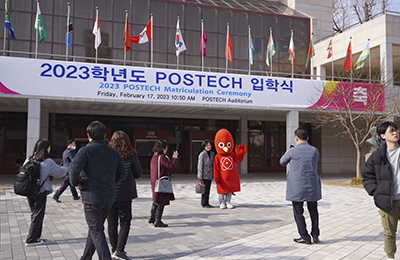
[First In-Person Matriculation Ceremony Held in 4 Years] The 2023 matriculation ceremony was held in-person for the first time in four years on February 17 at the POSTECH Auditorium. <Ponix mascot posing for pictures with family members> <New Postechians in gowns, waiting for the ceremony to begin> <Ms. Jeongha Yoon, entering class of 2021 (Department of Electrical Engineering), hosting the 2023 matriculation ceremony> <Distinguished guests enter the auditorium> At the 2023 matriculation ceremony, a total of 797 students were admitted, including 365 undergraduate, 192 master's, 72 doctoral, and 168 MS/PhD integrated program students. <Academic report by Professor Gyoo Yeol Jung, vice president of academic affairs> <President Moo Hwan Kim delivers the matriculation speech> As he began his matriculation speech, President Moo Hwan Kim asked the new Postechians for a moment to get up from their seats to thank their family who attended the ceremony. President Kim then congratulated and welcomed the new Postechians, emphasizing the importance of community and understanding each other’s differences through a story about Kauri trees in New Zealand. View the matriculation speech (https://c11.kr/1c2x5) <Welcome speech by Professor Eunjin Oh from the Department of Computer Engineering> President Kim’s speech was followed by the welcome speech by Professor Eunjin Oh, a POSTECH alumnus and currently a POSTECH professor in the Department of Computer Engineering. Professor Oh gave a warm welcome to the new Postechians and encouraged them to experience a sense of achievement through new challenges in a new environment. <Talk show hosted by the President> A talk with the president, professors, upper classmen and new Postechians followed. It was hosted by President Moo Hwan Kim, Professor Eunjin Oh, student council president Uison Ju, and freshman representatives Hyunmo Gu (Mueunjae School of Undergraduate Studies) and Sehyeon Kim (Department of Semiconductor Engineering). They discussed the cycle of the college life, from admissions to graduation, including school life, choosing a major, finding a job, and clubs available on campus. <Group photo of the entering class of 2023> In the afternoon following the ceremony, a session was held for the parents of new students at the POSCO International Center. About 300 parents attended to learn about the vision and strategies of the university. <President Moo Hwan Kim delivers his welcome speech> The seminar was designed as a time to share POSTECH's educational goals, academic system, school life, scholarships, as well as the vision and values pursued by the university. In the Q&A session that followed, parents had time to directly address their questions to the POSTECH leadership. Ideas were freely exchanged on various topics, from questions related to students’ careers after graduation, curriculum, off-campus semester system, graduate school admissions, and employment, to special military service and POSTECH’s plans to establish a research-oriented medical school.
2023.03.21 1452 -
POSTECH Wins at the 2023 Humantech Paper Award
[A total of 28 winners from 12 teams from POSTECH, including three winners of Gold Awards, six winners of Silver Awards, thirteen winners of Bronze Awards, six winners of Participation Awards.] POSTECH produced a total of 23 winners at the 29th Humantech Paper Award, hosted by Samsung Electronics. This year, 28 students in total from POSTECH received awards— Gold Award (3 winners from 2 teams), Silver Award (6 winners from 2 teams), Bronze Award (13 winners from 5 teams), and Participation Award (6 winners from 3 teams). Gold Award winner Geonhu Lee from the Department of Life Sciences (Academic advisor Jongmin Kim) presented a paper titled, ‘Dynamic Quantity Control of DNA Interacting with Proteins in a Living Cell’, which captivated the audience. Youngno Yoou and Chunga Lee from the Department of Electrical Engineering (Academic advisor Wonbin Hong) presented ‘Design and Evaluation of Reconfigurable Intelligent Surfaces with Meta-Devices,’ which is was part of joint research project with Yonsei University, and won the Gold Award, Two teams won the Silver Award— ‘Mass Production of Metasurfaces for Highly Efficient Visible Light to Create Virtual Reality’ presented by Joohoon Kim (Lead author) and Junhwa Sung (Co-author, with academic avisor Junsuk Rho) from the Department of Mechanical Engineering; and ‘Effective Defect Passivation with Phase Transition of Additives for Stable Perovskite Solar Cells with 25% Efficiency’ presented by Dohyun Kim (Lead author) as well as Hangyeol Kim, Dae Hwan Lee, and Haeryang Lim (Co-authors, with academic advisor Taiho Park) from the Department of Chemical Engineering. Bronze Award winners were Taeyoung Moon (Lead author), Min Gu Kang, Yeonjeong Koo, and Huitae Joo (Co-authors, academic advisor Kyoung-Duck Park) from the Department of Physics; Hyebin Yoo from the Department of Materials Science & Engineering (Academic advisor Seung Soo Oh); Byungki Kwon (Lead author) and Hyeon-Woo Nam (Co-author, academic advisor Tae-Hyun Oh) from the Department of Electrical Engineering; Haena Song (Lead author), Dohun Kim and Jongho Yoon (Co-authors, Advisor Tae-Hyun Oh), and Eun Ji Kwon (Co-authors, academic advisor Seokhyeong Kang) from the Department of Electrical Engineering; Hyuna Cho (Lead author) and Yubin Han (Co-authors, academic advisor Won Hwa Kim) from the Graduate School of Artificial Intelligence. Participation Awards were granted to Jinmin Kim (Academic advisor Seung Soo Oh) and Jongwon Lee (Lead author), Dongmin Kim (Co-authors, academic advisor Hyunsang Hwang) from the Department of Materials Science & Engineering; Yoonwoo Jeong (Lead author, academic advisor Minsu Cho) as well as Seungjoo Shin and Junha Lee (Co-authors, academic advisor Jaesik Park) from the Graduate School of Artificial Intelligence. The Humantech Paper Award was established in 1994 by Samsung Electronics to recognize and encourage students for their excellent work in science and technology with the purpose of securing the world’s best competitiveness and technologies. At this annual event, 118 papers were selected, written by students from universities and high schools.
2023.03.09 2157 -
Professor Moon Jeong Park Named Vice-Chair of APS DPOLY 2023
[Professor Park is the first non-U.S. university professor to hold the position in 30 years. She will serve a 3-year term from 2023.] Professor Moon Jeong Park from the Department of Physics at POSTECH has been named Vice-Chair of American Physical Society’s Division of Polymer Physics for 2023. This is the first time in the past 30 years that a professor from a non-U.S. university has been elected to the position. More than 2,000 members participated in the online election, and Park's election is seen as a reflection of the changes in international academic societies since the COVID-19 pandemic. Since joining the POSTECH faculty in 2009, Professor Park has made outstanding achievements in the field of polymer electrolyte synthesis, ion channel structure-conductance correlation, and polymer actuators. In 2017, Professor Park became the first Korean to receive the Dillon Medal, which is awarded by the American Physical Society to young scientists who show outstanding promise in the field of polymer physics and chemistry. In 2021, she became a Fellow of the American Physical Society, which is granted to less than 0.5% of its full members. Professor Park will serve a three-year term on the APS Executive Board as Vice-Chair in 2023, Chair-Elect in 2024, and Chair in 2025.
2023.03.02 1838 -
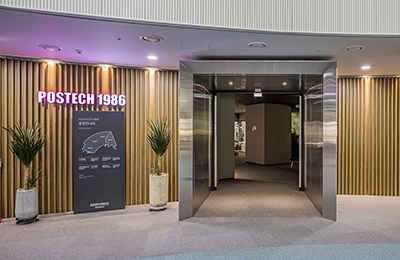
POSTECH1986 Opens at POSTECH
On January 26, POSTECH held an opening ceremony for POSTECH1986, a new museum that showcases POSTECH’s history and its future vision. The museum is located on the second floor of the Tae-Joon Park Digital Library and has a theme of “Great Spirit, POSTECH Value.” Tracking along a horizontal timeline, each milestone recalls POSTECH's founding spirit dedicated to human progress, identifies its remarkable achievements that have led the development of science and technology through innovation, and shares its ambition to create a future that extends beyond today's accomplishments. The exhibition hall is divided into four sections to allow the visitors to take in the progress from POSTECH’s official opening in 1986, major achievements over the past 37 years, and its future vision. Zone 1. POSTECH Pioneers Encountering the Spirit that Established POSTECH, Serving the Nation through Education Introducing the vision of the founding chairman, the late Tae-Joon Park, and POSTECH's first president, the late Hogil Kim, and their story of establishing POSTECH. Zone 2. POSTECH Pride Achieving 35 Years Together Highlighting the process of through which POSTECH has advanced and how Postechians have flourished over the last 35 years Zone 3. POSTECH Performance Experiencing the Engine of POSTECH Presenting POSTECH's excellent programs for education, research and academic-industrial collaboration, as well as research findings that have changed the lives of humanity Zone 4. POSTECH Potential Opening the Future Together with POSTECH Shedding light on the campus infrastructure as it expands beyond the limits of time and space and introducing the achievements of Postechians and POSTECH's vision Visitors can listen to an interview of the late founder Tae-Joon Park and the late Hogil Kim, POSTECH's first president, that were restored with the AI voice reproduction technology. The two giants tell the story from their first meeting to establishing POSTECH with the goal of creating a world-class science and technology university. The Latest Research Achievements section provides visitors with videos, exhibits, and hands-on experiences to present notable research findings from POSTECH’s labs. The Campus Infrastructure Panorama section features a mapping show on a white 3D campus model, giving shape to the university's vision beyond a physical campus to a virtual space – a Metaversity – that can transcend time and space. There is a section that introduces opportunities for on-site training, research, and overseas programs available to any Postechian, while another is dedicated to POSTECH alumni thriving around the world. Startup maps, videos, and exhibits present 220 companies founded by POSTECH students, faculty, and graduates since POSTECH’s founding.
2023.02.23 1893 -
POSTECH Professor Young-Tae Chang Wins Yoshida Prize
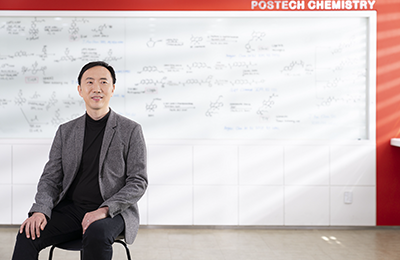
[Professor Chang is recognized for developing a method for live cell imaging with a fluorescent probe.] Professor Young-Tae Chang of POSTECH (Associate Director of IBS Center for Self-assembly and Complexity) has won the Yoshida Prize from the International Organic Chemistry Foundation (IOCF) of Japan. Professor Chang, who completed his undergraduate, graduate and doctoral studies at POSTECH, was appointed as faculty in the Department of Chemistry at POSTECH in 2017 after teaching at New York University in the U.S. and the National University of Singapore. He is also an advisory member of the Angewandte Chemie, one of the most authoritative journals in the field of chemistry. Professor Young-Tae Chang has made his mark by systematizing the findings of intracellular targeted proteins. He is also called a fluorescent alchemist for having built a fluorescence library with 10,000 fluorescent materials. This prize recognizes his contribution in developing and demonstrating the operational principles of a probe, capable of distinguishing living cells with organic fluorescent materials. The IOCF is a foundation established in 2012 to promote the development of international organic chemistry by the eminent organic chemist, Zenichi Yoshida, a professor emeritus at Kyoto University. The Yoshida Prize has been awarded to scholars who made a significant contribution to the development of organic chemistry since 2015. This marks the second time Korea is represented by the Yoshida Prize, as Professor Sukbok Chang of KAIST won the prize in 2016.
2023.02.15 1919 -
Everyone’s a Hero: No Valedictorian at POSTECH’s Commencement Ceremony
[POSTECH’s first in-person commencement ceremony since COVID-19 held on February 10, 2023 with 754 graduates in attendance.] [The first non-Korean students in POSTECH’s history to win the Kun Soo Chang Thesis Award and the POSTECH Alumni Association Chairman Award are a married couple.] The sight of a valedictorian stepping up to the stage to receive a diploma on behalf of the graduating class is a common sight at graduation ceremony held every February. At the commencement ceremony held for the class of 2022 at the POSTECH Gymnasium on Tuesday, February 10, POSTECH awarded blockchain diplomas through the metaverse to all graduates without a valedictorian. This was to celebrate all graduates who have completed their studies, regardless of their grades. Due to the declining school age population, elementary schools already hold such ceremonies, but it is an unusual decision for a university with a large graduating class. Since its inception, POSTECH has had a tradition of having all PhD degree recipients retrieve their diplomas on stage, while bachelor's and master's degree recipients were represented by a valedictorian. This year, 520 bachelor's and master's students received their diplomas simultaneously via the blockchain platform. POSTECH decided to keep the tradition of the Ph.D. degree recipients receive their diplomas on stage. The ceremony, which was held in-person for the first time since the COVID-19 pandemic, had a total of 754 graduates attending, including 256 bachelors, 264 masters, and 234 PhD degree recipients. The Founding Chairman's Award, which is given to the undergraduate student with the highest overall GPA, was awarded to Byeongjee Kang (GPA 4.26/4.3) from the Department of Computer Science and Engineering, while the Chairman's Award was awarded to Ji Woong Jeong of the Department of Life Sciences, who is the top graduate among science majors, as the Founding Chairman’s Award recipient was an engineering student. The Sung Kee Chung Thesis Award (science), which recognizes outstanding thesis paper, was awarded to Taejung Kim of the Department of Chemistry (academic advisor Won Jong Kim), and the Kun Soo Chang Thesis Award (engineering) was won by Ao Liu of the Department of Chemical Engineering (academic advisor Yong-Young Noh). Kim was recognized for his contributions to the development of a nitric oxide control system, while Liu, the first international student to receive the award since POSTECH was founded, contributed to the development of next-generation p-type semiconductor transistors. The two students had published their research in authoritative journals in their field. The awards were established with funds contributed by former President Sung Kee Chung and Professor Emeritus Kun Soo Chang, respectively. An award honoring the vision of POSTECH’s first president Mueunjae Hogil Kim, the Hogil Kim Award is given to the graduate who works toward the advancement or honor of the university. The award was given to Jun-Gill Kang of the Department of IT Convergence Engineering, who has been actively conducting research on robotics. Ms. Huihui Zhu of the Department of Chemical Engineering (academic advisor Yong-Young Noh) received The POSTECH Alumni Association Chairman Award, given to students who have demonstrated growth and advancement represented in the POSTECH’s founding tenet (a globally outstanding talent with knowledge and intellect). The first international student to receive the award, Ms. Zhu has published 17 papers in international journals and applied for five patents, while studying Korean and earning a level 2 on the Test of Proficiency in Korean (TOPIK) at the same time. Mr. Liu and Ms. Zhu are also a married couple. The School of Electrical Engineering, Computer Science and Convergence (EECS) Award, which recognizes outstanding achievements among graduates of the School of EECS and Graduate School of Artificial Intelligence (GSAI), was given to Junyong Lee of the Department of Computer Science and Engineering (academic advisor Seung Yong Lee). His deep learning-based restoration technology that improves network performance with auxiliary data for image and video resolution restoration was highly praised in the academic circles. At the ceremony, POSTECH President Moo Hwan Kim shared his own story of how he was a liberal arts student who decided to major in nuclear engineering at his university, commenting, “Diplomas and grades prove achievement, but they do not determine the future." He remarked, “all students who have completed the academic process should be congratulated, not just those with the best grades," explaining why he had made changes to the ceremony. "Don't limit your potential or capacity within confines of the POSTECH name or your major,” he explained, urging students to experience new things and be proactive and flexible in accepting them.
2023.02.14 1732 -
Photo Essay 2: POSTECH-POSCO Joint Booth
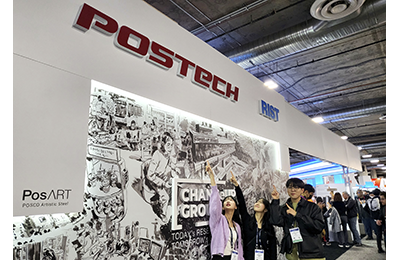
POSTECH participated in the Consumer Electronics Show (CES) for the second year in a row, operating a joint booth to promote the startups founded by POSTECH alumni at Eureka Park, an exhibition arena for global startups. A total of 21 startups, up 40%, exhibited their innovations in a space that was twice as large as last year’s. Let's explore the POSTECH startups that dazzled at CES, the center of cutting-edge technology! Startups at the POSTECH-POSCO Joint Booth 포스텍-포스코 산학연 공동관 주요 전시 참여 기업을 나타내는 표입니다. Name Product/Technology Graphene Square (Byung Hee Hong, Dept of Chemistry) Roll-to-roll CVD-graphene mass production, Graphene synthesis technology for EUV pellicles ONESOFTDIGM (Daeho Lee, Dept of Industrial & Management Engineering) Healthcare solution that collects biometric data with a portable body composition analyzer AI FOR PET (Euna Huh of School of IT) Total AI healthcare service for pets Narma (Kijung Kwon, Dept of Mechanical Engineering) Tilt-rotor drones for delivery services i-GEST (Professor Jeong-Soo Lee, Dept of Electrical Engineering) PR strip and a highly sensitive on-site diagnostic device platform hearDL (Professor Emeritus Hong June Park, Dept of Electrical Engineering) Deep learning-based noise suppression hearing assistant app MiDAS H&T (Professor Unyong Jeong and alumnus Seyun Steve Chang, Dept of Materials Science and Engineering) Stretchable electrodes and sensors for wearable devices for the metaverse EcoTect (Kihyun Kwon, Dept of Chemical Engineering) Environmentally friendly coated ocean buoys made of mushroom roots, sawdust, and used coffee grounds Lutra (Seon Jong-yeop, Dept of Electrical Engineering) CLAM, a mobile app to turn a photo into a non-fungible token (NFT) Asimula (DaeHyeon Na, Dept of Computer Science) VR concert platform BUBBLER (Do Hee Keum, Dept of Materials Science and Engineering) Fourth-generation smart catheter Among the 34 small and medium-sized Korean companies that won the Innovation Awards at CES 2023, Graphene Square, AI FOR PET, ONESOFTDIGM, and Lutra were founded by POSTECH students and alumni. Notably, Graphene Square was named a Best of Innovation Award honoree at CES 2023. 〈Graphene Square〉 The graphene radiator is a virtual fireplace that generates heat from graphene. Compared to conventional coil-type heaters, this game-changer uses the excellent heating property of graphene to lower energy consumption by up to 30% while generating virtually no electromagnetic radiation. The portable, folding unit produces a mix of 3D flames and crackling fire sounds, accentuating any décor style. 〈ONESOFTDIGM〉 Fitrus is a personalized health management smart device combined with solution. This easy-to-use device allows consumers to monitor their health in real time at their convenience. 〈Lutra〉 Lutra believes that ownership is the core value of non-fungible tokens. CLAM is a mobile app that turns a photo taken with a smartphone into an NFT. 〈MiDAS H&T〉 This company showcased a smart wearable device that can easily detect the movement or condition of the human body through the use of stretchable electrodes based on printing technology. The device can adjust the temperature of the apparel by releasing microcurrents and capture the movements of muscles and joints more accurately during sports activities. 〈BUBBLER〉 The stent designed by Bubbler uses calcium carbonate to produce tiny CO2 bubbles that unclog blocked blood vessels. 〈hearDL〉 HearDL exhibits a deep-learning-based, noise-canceling hearing aid application that operates with a smartphone. The app does not require any particular device. The only thing needed is a typical sound receiver – earphones or headphones. 〈EcoTect〉 EcoTect showcased environmentally friendly ocean buoys, EcoFoam, made of mushroom roots and used coffee grounds to replace plastic ones. EcoFoam attracted attention as it overcomes the limitations of conventional eco-friendly buoys that have short life spans and low durability.
2023.01.26 1856 -
Photo Essay 1: Student Participants at CES 2023
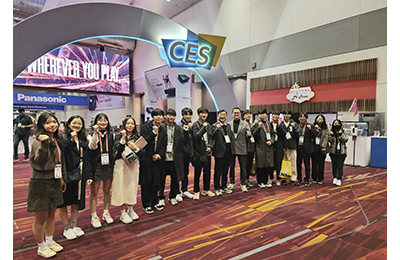
181 POSTECH students, each with different hopes and dreams, gathered on January 3 for a group check-in at the hotel. They kicked off their adventure on January 4 with a tour to the Valley of Fire State Park, Nevada’s largest and most historic state park. The day wrapped up with dinner hosted by President Moo Hwan Kim, adding to the anticipation and excitement for CES 2023. January 5 was the first day of CES 2023. POSTECH students wandered through the exhibition floor, engaging in different activities. They toured the joint exhibition booth of POSTECH startups located in the Eureka Park, participating in the stamp tour and the ‘Photogenic with PONIX’ event. A welcome dinner for the students was also held during the week. The dinner was hosted by the Association of POSTECH Crown Companies (APGC) and Professor Young Chul Sung (Department of Life Sciences) to celebrate the students’ visit to CES 2023. Those students who signed up in advance took a VIP tour of the booths at the Las Vegas Convention Center (LVCC). The tours broadened the students’ minds as they took in the latest technologies and trends of Korea’s leading tech giants, including Hyundai Mobis, LG Electronics, and SK Innovation.
2023.01.26 1835 -
Professor Wonbin Hong Selected as IEEE Fellow
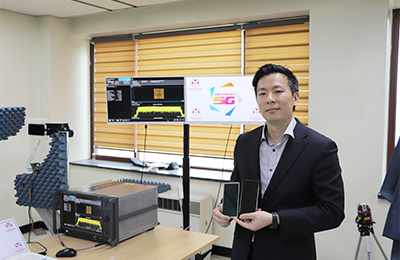
POSTECH professor Wonbin Hong (Department of Electrical Engineering) has been selected as a Fellow of the International Society of Electrical and Electronics Engineers (IEEE), the world's largest academic organization. He is the first Korean scholar to be named IEEE Fellow in the antennas category. Professor Wonbin Hong received his Ph.D. at the University of Michigan and was with Samsung Electronics as a principal and senior engineer before joining POSTECH faculty in 2016. He has been selected as IEEE Fellow for his contribution to the development of millimeter-wave mobile and base station antennas. Since 2020, Dr. Hong has been leading the way in millimeter-wave antenna technology as co-president of Kreemo, a start-up company in the field of millimeter-wave 5G and satellite antennas. IEEE is the world's largest academic society in the field of electricity, electronics and computers. IEEE Fellow is a distinction reserved for select IEEE members who have significantly contributed to the advancement in any of the IEEE fields of interest through their research accomplishment via a strict selection process. The number of Fellows selected each year is does not exceed 0.1% of the voting membership.
2022.12.21 1785