News & Updates
-
Professor Chulhong Kim Elected as an Optica Fellow
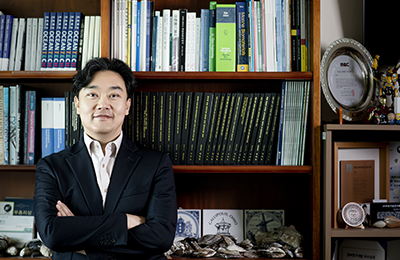
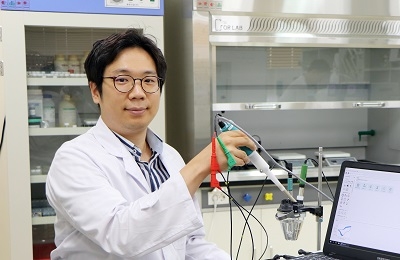
POSTECH Professor Chulhong Kim (Department of Convergence IT Engineering, Department of Electrical Engineering, Department of Mechanical Engineering, Medical Science and Engineering Program) has been elected as 2023 Optica Fellow. He is among the 109 members from 24 countries selected to Optica’s 2023 Fellow Class. Professor Kim was selected as the Fellow for his contributions to multi-parametric photoacoustic imaging from super-resolution microscopy to clinical imaging system, and multi-modal optical imaging via transparent ultrasound sensor. After completing his Ph.D. at Washington University in St. Louis and working as an assistant professor at the State University of New York Buffalo, Professor Kim joined POSTECH in 2013. His research focus is on the development and commercialization of the next-generation medical imaging technology using optics and ultrasound. He has been highly regarded as a leading optics scholar through his convergence research in chemistry, materials, and medicine. In 2018, Professor Kim founded Opticho Inc. and successfully developed the next-generation photoacoustic microscopy and clinical systems. He was elected as the Fellow of SPIE and won the first place in the LINA+50 Creative Innovation Award in 2021. He was also named as the Scientist of the Month by the Korean Ministry of Science and ICT in the same year. In 2022, Professor Kim was inducted into the National Academy of Engineering of Korea (NAEK). Founded in 1916, Optica (formerly OSA, Optical Society of America) is the most authoritative international academic organization in the field of optics with more than 22,000 members worldwide. Each year, about 5 percent of Optica members are elected to the Fellow Class and the total number of Fellows in the past has not exceeded 10 percent of the total membership. The election process is highly competitive and is based on several factors, including outstanding contributions to business, education, research, engineering, and service to Optica and to its community.
2022.12.13 1894 -
Prof. Hyung Joon Cha Inducted into the Korean Academy of Science and Technology
Professor Hyung Joon Cha (Department of Chemical Engineering) of POSTECH has been inducted into the Korean Academy of Science and Technology (KAST), which is one of the most prestigious science and technology societies in Korea. Professor Hyung Joon Cha, who was selected as a fellow in the field of medical sciences, has conducted outstanding research in the field of biomaterials. His research focuses on redesigning at the biomolecular level to produce and develop biomaterials necessary for mankind. In particular, he is globally recognized for mussel-derived bioadhesive proteins and has even succeeded in commercializing this technology. The Korean Academy of Science and Technology (KAST) is the authoritative academic organization of science and technology in Korea and selects scientists and engineers who have been active in the field for over 20 years, produced leading research results, and contributed to the development of the field, via a strict three-step selection process. At the 2nd General Meeting of 2022 held on November 17, 28 new fellows were announced for the year 2023. The induction ceremony will be held on January 13, 2023.
2022.11.29 1840 -
Graduate Students Jinhyeok Park and Dain Kim Win at International Algorithm Contest
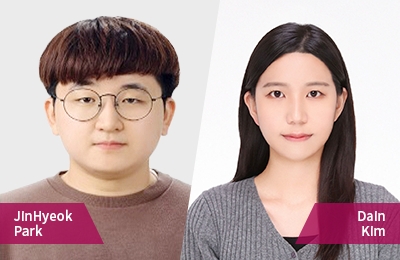
[Students win second prize at an algorithm contest for eliminating AI bias, and the best paper award] While artificial intelligence is utilized in analyzing judicial precedents as well as in hiring processes, AI bias on gender, nationality and race remains one of the biggest issues. Recently, two POSTECH graduate students have won a prize at a contest designed to tackle these specific AI analysis issues, called the CIKM 2022 Recommendation System Evaluation Challenge held by one of the most prestigious international conferences in the data mining field. Jinhyeok Park and Dain Kim (advisor: Professor Dongwoo Kim) in the master’s program at POSTECH’s Graduate School of Artificial Intelligence have won the second place and the best paper award at the Recommendation System Evaluation Challenge sponsored by the International Conference on Information & Knowledge Management (CIKM) and hosted by an open-source community, RecList. The task of the contest was to develop an algorithm that provides an impartial recommendation to users by removing various biases in the given data. The two students developed and proposed an algorithm after efficiently removing the bias with variational autoencoder technology. Jinhyeok Park and Dain Kim will further develop the technology published in the paper and stated, “It is already well-known that artificial intelligence has a bias against specific groups.” They added, “If an issue of bias is resolved, we believe artificial intelligence will be utilized in broader fields.” The competition was fierce with 50 teams from 14 countries that participated in the contest over a two-month period from August to October of 2022.
2022.11.16 2018 -
Professor Seokhwan Hwang Wins Excellence Award at Hyundai E&C Technology Competition
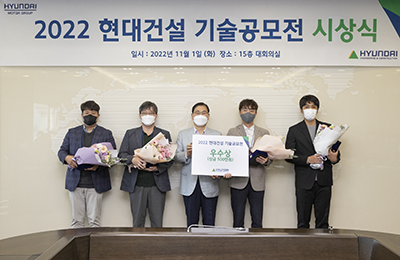
Professor Seokhwan Hwang and Ph.D. candidate Soojin Choi from the Department of Environmental Science & Engineering at POSTECH have won the Excellence Award at the 2022 Hyundai E&C Technology Competition. The awards ceremony took place on November 1 at the Hyundai E&C headquarters. Professor Hwang’s research team won the prize for the category of future new business for proposing the development of a self-regulated artificial intelligence-based platform to enhance the stability of biogas plants. Biogas technology is a green technology that transforms carbon sources of organic waste into methane and other high-value-added resources. However, processing them was unstable as prompt monitoring technology has not been developed and the conditions and properties of waste dramatically fluctuate. To tackle these limitation, Professor Hwang and his team proposed an AI-based self-regulated platform that predicts the stability and signs of abnormalities of a plant by combining data of images along with the properties and conditions of entering substances to establish a regulating system accordingly. With this platform, it is expected that biogas production could be maximized to 670,000m3 per year by improving the efficiency of the process. The research team plans to focus on building big data and developing a platform built on this technological concept. Hyundai E&C has been hosting technology competitions to collaborate with businesses, universities, and research institutes with outstanding technological ideas in Korea and to advance construction technology for the future. A total of 16 teams were selected as the winner of the grand prize, excellence prize, participation prize and others across three categories, including cost-reducing technology, differentiating construction technology and new business for the future.
2022.11.16 1717 -
POSTECH Partners with Facebook after Samsung and Apple
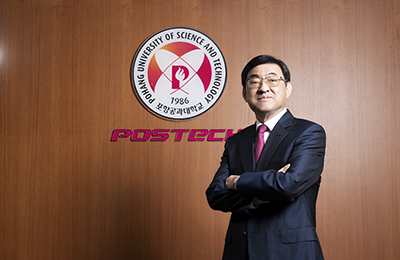
POSTECH has become the first university in Korea to partner with Meta (formerly Facebook). As the two parties agreed to develop new virtual educational content using metaverse, POSTECH has begun to transform itself into a Metaversity (metaverse + university). Classrooms and every corner of the campus are being digitalized in to a metaverse. The university offers contactless experiments and practical training courses in the metaverse as if they are on campus by providing VR devices to 320 freshmen. Other global companies are seeking partnership with POSTECH as well. Samsung launched a department of semiconductor engineering to raise highly skilled experts for research, and Apple has established the Apple Developer Academy and the Apple Manufacturing R&D Accelerator on the POSTECH campus. We ask President Moo Hwan Kim about POSTECH’s Metaversity in this interview. - The term Metaversity sounds unfamiliar. “It is a term coined by POSTECH. It means a university that exists in the real world as well as the virtual world. Our library and various other sites on the POSTECH campus are being realized in the metaverse. We are the only university in the world that has a mixed reality (MR) classroom where the real and virtual world coexist. In the MR classroom, students wear VR headsets to see a nuclear power plant right in front of their eyes or to bring a helicopter and see a 3D anatomical diagram of the body in the VR environment.” - When did the metaverse course start? “Due to the COVID-19 pandemic, POSTECH has been offering remote classes since 2020. However, it has been difficult to operate experiments and practical training courses in physics, chemistry, or others through an online platform, such as Zoom. We discussed finding a new way of teaching remotely with the faculty members. As a result, we came up with the idea of metaverse courses. We believed we could provide practical training courses in the metaverse as if they are in the real world if we use digitalized tools for experiments and practical training. After developing educational content to materialize this idea, we were able to successfully launch the metaverse classes by offering VR devices to all freshmen.” - What was the feedback from students to an unfamiliar way of learning? “They said it felt almost the same as in-person experiments and practical training. So we have established a committee for metaversity education that develops and manages educational content in a more sophisticated manner. A faculty member from the department of Electrical Engineering who previously worked for LG Display is leading the group. Universities should change to follow the digitalized world. POSTECH plans to actively share our digital educational content with neighboring local universities to help strengthen their competitiveness.” Regardless of COVID-19, POSTECH will expand remote metaverse courses in the name of ‘Off-Campus.” From next year, all 1,200 POSTECH undergraduates in 11 departments will take one semester out of the eight semesters in the metaverse. President Kim explained, “Since students can take courses on the metaverse virtually, they can take language courses at partner universities abroad or invest more time in launching a startup.“ - How did POSTECH and Meta become partners? “Fortunately, the VR devices we gave to freshmen were made by Meta, formerly Facebook. After Meta heard about the way we use their devices, they asked us to develop educational content for metaverse together.” - What are your new goals as a Metaversity? “It’s defense science and technology. Like the Internet, many sciences and technologies originally designed for military purposes have turned into technology for humanity. By utilizing educational content for metaverse, we can simulate military tactics or train virtually through VR. We already signed an MOU for the advancement of military science and technology with the Korean Army. Next year, we will establish a graduate school for defense science and technology to nurture defense experts and technology.” - I heard that POSTECH plans to build a school of medicine. “We aim to establish a program in medical science that is different from other medical schools. Our goal is not to educate clinical physicians but to raise physician-scientists (MD-Ph.D.) in an engineering-based medical school. The role that physician-scientists play is to create artificial organs and use big data to predict and prevent diseases. We plan to select students among college graduates. Building a smart hospital by applying advanced informational technology is also in the works. I believe that establishing a hospital for patients suffering from intractable diseases would help local economies as well as the nation as a whole.” POSTECH puts more emphasis on research than the employment rate of students. The top 1 percent of students in the nation enter POSTECH. President Kim stated, “POSTECH is a university that helps students to decide what to do after graduation or how to contribute to the nation with research, instead of our students and university focusing on finding a job after graduation.” How do you envision POSTECH in the future? - “Within just three decades since its foundation, POSTECH has grown into one of the most prestigious engineering universities in Asia. After a stagnating period during a generational change, POSTECH has jumped dozens of places in the World University Rankings from last year, making its second leap. Compared to the previous year, the university ranked 71st from 81st in the QS World University Rankings and 163rd from 185th in the Times Higher Education (THE) Rankings. I hope POSTECH is remembered as a university that a father recommends to his son and as a top-notch university that even prevents the extinction of regional cities with its high level of education.” ◇ President Moo Hwan Kim President Kim received his Ph.D. in nuclear engineering from the University of Wisconsin, a master’s and bachelor’s degree in nuclear engineering from the College of Engineering at Seoul National University. He was a member of the Ministry of Knowledge Economy Energy Committee, Nuclear Safety and Security Commission, a representative of Korea in the International Nuclear Safety Advisory Group (INSAG) of the Director General of the International Atomic Energy Agency (IAEA) as well as the President of the Korea Institute of Nuclear Safety (KINS). He was appointed as the President of POSTECH in September 2019.
2022.11.16 2519 -
Korea’s First Fields Medalist June Huh to Meet with POSTECH
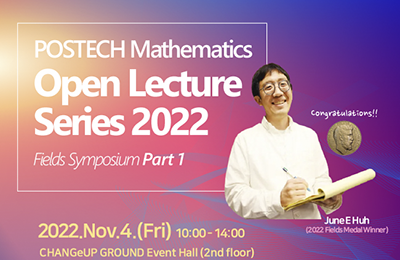
[POSTECH to hold Fields Symposium at Pohang’s CHANGeUP GROUND on November 4 and December 9] Professor June Huh from Princeton University, the first Korean mathematician to receive the Fields Medal, will meet with members of POSTECH on November 4, 2022. The Department of Mathematics at POSTECH has invited Professor June Huh to the ‘POSTECH Mathematics Open Lecture Series 2022: Fields Symposium’ to be held at Pohang’s CHANGeUP GROUND on November 4th. The symposium will be held as an online meeting with Professor Huh, followed by Professor Sang-il Oum of KAIST and Professor Yoonbok Lee of Incheon National University who will introduce the achievements of Fields Medalists Professor June Huh and Professor James Maynard (University of Oxford of U.K.) Professor June Huh, who was awarded the Fields Medal in July 2022, rose to stardom for "bringing the ideas of Hodge theory to combinatorics, the proof of the Dowling–Wilson conjecture for geometric lattices, the proof of the Heron–Rota–Welsh conjecture for matroids, the development of the theory of Lorentzian polynomials, and the proof of the strong Mason conjecture." Considered as the Nobel Prize in mathematics, the Fields Medal is the most prestigious prize in mathematics awarded to a mathematician under the age of 40 for outstanding achievement. The second part of the Fields Symposium will be held on December 9 online with Professor Maryna Viazovska (Federal Institute of Technology Lausanne, Switzerland), one of the Fields Medalist of 2022. POSTECH Mathematics professors Sungmun Cho and Kunwoo Kim will introduce the achievements of the two Fields Medalists, professors Marina Viazovska and Hugo Duminil-Copin of the French Academy of Sciences. At the symposium, a general lecture will provide the opportunity to interact with the Fields Medalists and to help the general public to understand the outstanding research achievements in mathematics. 50 high school students from the city of Pohang as well as member of POSTECH will be given the opportunity to attend the lecture on a first-come, first-served basis. Registration is available online at https://forms.gle/MrdS2qSqhcwmFKR6A.
2022.10.31 1914 -
Signature Conference 2022 Successfully Held at POSTECH
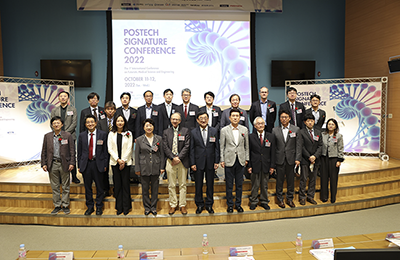
POSTECH successfully hosted the Signature Conference 2022 on the theme of future of medical science and engineering held at the POSCO International Center on October 11-12. Held in a hybrid mode – both in-person and online – the conference was attended by special guests including Mayor Kang-deok Lee of Pohang, Deputy Governor of Economy Dal-hee Lee of Gyeongsanbuk-do Province, Minister Yu Kyoung Oh of Food and Drug Safety, and President Moo Hwan Kim of POSTECH. The conference kicked off with the plenary session titled 'Controlling of viral infections by natural killer cell inhibitory receptors’ by Wayne M. Yokoyama, the associate dean of Washington University in St. Louis. The session was followed by lectures from global authorities, including Professor Zhenan Bao (Stanford University), Professor Jonathan L. Sessler (University of Texas at Austin), Professor Kam W. Leong (Columbia University), and Professor Taeghwan Hyeon (Seoul National University), who are experts in the field of medical science, biomedical engineering, and regenerative medicine. Close to 200 participants, who are active in medical science and engineering, were presented with the latest studies and trends in engineering-based medical education and research, and engaged in in-depth discussions following each lecture.
2022.10.14 1989 -
Collaborations Between POSTECH Faculty and Google on the Rise
The number of research collaborations between POSTECH’s Department of Computer Science and Engineering faculty and Google is on the rise. Google has been supporting the research activities, academic development, and technological innovation at universities around the world, and provides various support programs, including the Google Research Grant and PhD Fellowship Program for faculty members and students. In July 2021, Professor Seungmoon Choi was selected as the recipient of the Google Research Grant program. With this support, Professor Choi successfully conducted the study on improving algorithms for sound-to-haptics conversion. In March of this year, Professor Jaesik Park was selected for the Google Cloud research credits program and gained access to Google Cloud Computing (GCP). Selected as the winner of Google’s 2022 exploreCSR award in August, Professor Hyojin Sung will receive support for a research and career exploration workshop for female students in the computing field. Professor Sung plans to develop the workshop into a larger community of participants in the future with continued interaction. Since May 2022, Professor Namhoon Lee has been conducting a collaborative research through a visiting researcher program at Google’s Core ML team. In October, Professor Minsu Cho – who is taking a sabbatical year – will work at Google France as a visiting researcher on video analysis with the research team led by Dr. Cordelia Schmid, a world-renowned scholar in computer vision and machine learning. The study will be an extension of the recent research on video understanding techniques conducted by Professor Cho’s research team, focusing on addressing the structural weakness and inefficacy of conventional transformer neural networks. Professor Eunhyeok Park, who has been partnering with Google since 2021, has been working to optimize the performance of neural networks based on quantization, keeping the accuracy and improving the quality of the networks under the theme of studying the quality degradation from quantization. The findings from the study will be presented at the European Conference on Computer Vision (ECCV) in October, one of the three major conferences in the field of computer vision. PhD candidate Juhong Min (advisor Minsu Cho) was selected as the only Korean in the 2020 Google PhD Fellowship in the division of Machine Perception, Speech Technology, and Computer Vision. Since 2009, Google has conducted a PhD Fellowship Program, which selects outstanding graduate students conducting exceptional and innovative research in areas relevant to computer science and related fields. The awarded students are provided with scholarship as well as networking opportunities with Google Research Mentor. Meanwhile, Professor Jaehoon Jeong of the Graduate School of Artificial Intelligence (GSAI) and Department of Mathematics was selected for the Google Conference Sponsorship Program. With Professor Bokwang Jeon (Department of Mathematics), Professor Moo K. Chung of the University of Wisconsin–Madison in the United States, and Professor Shizuo Kaji of the Kyushu University in Japan, Professor Jeong held a four-day conference from the September 26 on the theme of ‘Topological Data Analysis and Machine Learning’ and presented the study findings on the combination of topological data analysis (TDA) and machine learning.
2022.10.14 2033 -
Professor Jeong Woo Han Selected as Scientist of the Month
[Professor Han has developed an original technology of nanocatalyst synthesis that is superior in performance and stability] Professor Jeong Woo Han of the Department of Chemical Engineering at POSTECH has won the Scientist of the Month for the month of October from the Ministry of Science and ICT and the National Research Foundation of Korea. Along with the development of high-performance nanocatalyst synthesis, Professor Han’s contributions to advanced research in energy materials design are well-recognized. High-performing and stable nanocatalyst is a vital material that enhances the efficiency of the process in advanced chemical industry. However, the efficiency of the process slows over time due to environmental factors in the reaction conditions and interactions among reactants. Various studies have been conducted to address this weakness. Exsolution*1 is a phenomenon in which nanocatalysts high in performance and stability are created on the surface of the metallic oxide material when reduction conditions are met without needing to have a more specialized process. Developing a nanocatalyst through controlling the exsolution is considered a clean energy technology for the future. However, there has been a challenge in the energy material design as the process that forms high-performance nanocatalysts was unknown. The research team led by Professor Han proved that high-performance nanocatalysts can be synthesized by adjusting the exsolution of positive ions inside the perovskite*2 structure, a metallic oxide material, while also discovering that this method of synthesis increases the activation of catalysts up to four times. The research also proposed a new methodology for developing materials after a successful demonstration through theoretical verification with computer simulation-based experiments and thin film experiments. The findings from the study were highlighted on the front cover of the 10th edition of Energy & Environmental Science in 2020. Professor Jeong Woo Han commented, “High-performance nanocatalysts can be used to reduce exhaust gas and to extend fuel-cell life, as well as to produce, store and utilize hydrogen energy.” He added, “I hope that the research would be broadly applied to the academics and industrial fields.” Scientist of the Month is an award granted from the Ministry of Science and ICT.each month to one researcher whose research has contributed to the advancement of science and technology. The prize is 10 million won (USD 7,000). 1.Exsolution A process that heats metal mixtures to separate the components. 2. Perovskite A material with a tetrahedral, octahedral, or cubical crystal structure and a metallic oxide that can be nonconductive, semiconductive, conductive, or even superconductive according to the composition of atoms.
2022.10.13 1581 -
Dr. Young Dae Yoon of PAL Wins the AAPPS Young Researcher Award
[Dr. Yoon is the only Korean winner among the recipients this year and is recognized for his research achievement in basic plasma physics.] Dr. Young Dae Yoon of Pohang Accelerator Laboratory (PAL) has won the Young Researcher Award from the Association of Asia Pacific Physical Societies (AAPPS) in the Division of Plasma Physics. He is the only Korean among the scientists selected for the award this year. This award is given to the scientist in the Asia Pacific region who has conducted outstanding research in the field of plasma physics. There are two categories of below 30 age group and below 40 age group. Recognized for his research accomplishments, Dr. Yoon has been selected as one of the six winners in the under 30 group. Dr. Yoon completed his PhD degree at California Institute of Technology (Caltech) and is currently working as a post-doc fellow at the PAL. His research focuses on two main areas, including high-temperature magnetized plasma related to nuclear fusion and astronomical physics, and electron beam instability related to accelerator physics. In his recent collaboration with POSTECH professor Gunsu Yoon (Department of Physics and Division of Advanced Nuclear Engineering), Dr. Yoon verified the process of non-collision equilibration of current sheets and explained the origin of diverged current sheets to solve a long-standing problem in plasma physics, causing quite a stir in academic circles. This study has attracted attention for compiling analytical theories, particle simulation using the KAIROS super computer from the Korean Institute of Fusion Energy (KFE), and the MMS satellite data from NASA. Thanks to his prolific research and recognized internationally, Dr. Yoon has published 12 papers over five years in authoritative academic journals such as Nature Communications, and was twice invited to present at the American Physical Society. He was previously the recipient of the POSCO Science Fellowship (2022) from the POSCO TJ Park Foundation and the POSTECH PIURI Postdoctoral Fellowship (2021). The Association of Asia Pacific Physical Societies (AAPPS) has been awarding the Young Researcher Award to scholars under the age of 30 and under 40 who have been active in the field of plasma physics since 2018 by comprehensively evaluating the research accomplishments of the candidates. The award is recognized for its authority as it plays a pivotal role in discovering talented plasma physicists and the award ceremony will be held at the 5th Asia-Pacific Conference on Plasma Physics taking place this month.
2022.10.11 1733