News & Updates
-
POSTECH-ETRI-AMC Win 2nd Place at World’s Top Medical AI Competition
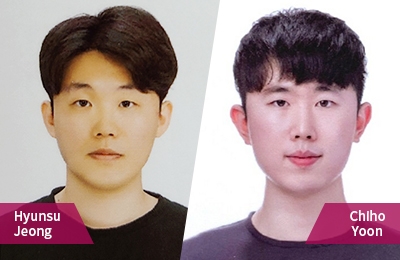
[The team won 2nd place out of 18 teams from around the world at the MICCAI’s ATLAS challenge] A Korean research team recently placed second among 18 teams from around the world in the Anatomical Tracings of Lesions After Stroke (ATLAS) Challenge. This challenge was hosted by the Brain Lesion Workshop and sponsored by Amazon Web Services (AWS) and Medical Image Computing and Computer Assisted Intervention (MICCAI). The joint team of researchers are: PhD candidate Hyunsu Jeong from the Graduate School of Artificial Intelligence and Chiho Yoon from the Department of Electrical Engineering (in the Master’s program) at POSTECH; Dr. Kwang-Ju Kim from the Electronics and Telecommunications Research Institute (ETRI); and Professor Bum Joon Kim and Soo Jeong (fellow) from the Department of Neurology, and Won-jung Chung (researcher, advisor Namkug Kim) at the Asan Medical Center (AMC). The competition challenged the participants to develop new automated stroke lesion segmentation algorithms. The condition was to use only T1-weighted (T1w) MRIs, which are commonly used with stroke patients in rehabilitation research. It is not easy to conduct accurate lesion segmentation with the limited information from T1w MRI images alone. The team focused on pre- and post-interventions by making the most of the T1w stroke MRIs with the help from the most basic model, U-Net, in deep learning segmentation, instead of the latest deep learning models. When it comes to medical data, the key is to design pre- and post-intervention methods to read all data set types, considering that various imaging machines are used in hospitals overseas. Going forward, the researchers plan to take one step further by improving the deep learning model based on the medical imaging technology they built during this challenge. MICCAI is a globally renowned conference in the field of medical artificial intelligence, serving as a venue for researchers and doctors worldwide. MICCAI 2022, which was held in Singapore, attracted leading scientists, engineers, and businesses from around the world, including NVIDIA (the US), University of Toronto (Canada), King’s College London (the UK), Catholic University of Leuven (KU Leuven, Belgium), and National University of Singapore (Singapore). The top three prizes were awarded to King's College London (1st place), POSTECH (2nd place), and KU Leuven (3rd place).
2022.10.04 1940 -
Juhong Min Selected as Recipient of Google PhD Fellowship
[Min was selected for the field of Machine Perception, Speech Technology and Computer Vision] PhD candidate Juhong Min in the Department of Computer Science and Engineering at POSTECH (advisor Minsu Cho) was selected as the recipient of the 2022 Google PhD Fellowship Program. Google has been running a PhD program since 2009 and supports graduate students from all over the world who excel in areas relevant to computer science and related fields. This year, 61 PhD candidates around the world, including five from Korea, were selected. The Fellowships are awarded to students in 24 fields, including Algorithms, Machine Learning, and Mobile Computing. Min was recognized for proposing a variety of methodologies for image matching and conducting research in applied fields. Image matching is considered to be a key component in various computer vision areas such as object recognition, image search, 3D reconstruction, object detection, and motion estimation. Going forward, Min plans to explore core problems affecting computer vision fields and conduct research to solve these issues. The Google PhD Fellowship Program directly supports graduate students as they pursue their PhD, as well as connect them to Google Research Mentors.
2022.09.27 1918 -
POSTECH-KAIST Science War is Back After 3 Years
[POSTECH hosts the 19th POSTECH-KAIST Science War on September 23-24] POSTECH and KAIST – Korea’s two leading science and engineering universities - will compete for the championship title of the POSTECH-KAIST Science War, hosted this year on the POSTECH campus on September 23-24, 2022. The event, which had been held virtually for the last two years due to the COVID-19 pandemic, will finally be held in-person this year, raising anticipation and excitement from students. In its 19th year, the POSTECH-KAIST Science War (POKA War) is an annual competitive event held every year between POSTECH and KAIST to promote an active exchange of students. The two schools have taken turns hosting the event every year since 2002, but as in-person events became impossible for the past two years, all matches were replaced by the Cyber Science and Engineering Student Exchange, which was held online. This year, the competition is expected to be even fiercer. The best science and engineering brains of Korea will compete in hacking competitions, science quizzes, artificial intelligence (AI) programming, and League of Legends, and in sporting events including baseball, basketball, and soccer. In the hacking competition, points are earned depending on the level of difficulty and time taken to solve each problem. The team with the highest total score over a period of 12 hours wins. In the AI programming competition, the winner is determined according to the AI program designed by each university based on the Quoridor game (a game where the team whose pawn advances to the opposite camp first wins). In the case of the E-sports competition, the matches will be held at POSTECH’s E-sports Colosseum, where students can play and watch the games, and enjoy light food. The school that wins 4 or more events out of the total 7 will win the championship and so far, KAIST has been slightly ahead with 9 wins and 8 losses over the years. This year, the events will be even better thanks to the support from Autocrypt (CEO: Eui-seok Kim), an autonomous driving security company founded by a POSTECH alumnus, and POSTECH Holdings (CEO: Ju-Hyun Yoo), who each donated 20 million won (USD 14,000) and 5 million won (USD 3,500), respectively. Kyung-Min Lee (Department of Computer Engineering), the Chairman of the POKA War Organizing Committee, explained, “We are doing our best to prepare for the events so that the students, who have missed out on campus life due to COVID-19 pandemic, can fully enjoy this in-person event after a long hiatus.” He added, “I look forward to resuming the culture of exchange that was put on hold through this event.” Through this event, POSTECH and KAIST promote a friendly exchange between students of the two leading universities in science and engineering in Korea, while providing students with the opportunity to network with each other. The POKA War is held annually in mid-September, and the name of the competition changes according to the host university. This year’s competition, which is being held at POSTECH, is officially called the KAPO War, according to the rule that puts the name of the host university at the end.
2022.09.22 2542 -
Medical Science and Biomedical Engineering Experts to Meet at POSTECH
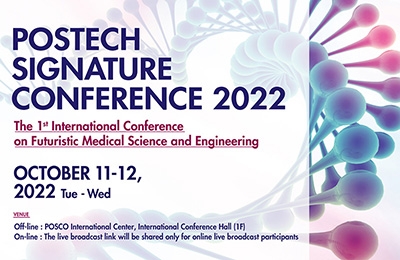
[POSTECH Signature Conference 2022 will be held on October 11 – 12 at POSTECH] [The conference invites top medical scientists and engineers around the world to exchange ideas across different fields] The POSTECH Signature Conference 2022, an international conference on medical science and engineering, will be held at the POSCO International Center next month on October 11-12. This is the first conference that POSTECH is hosting on the future of biomedical science and engineering since announcing its vision for fostering future medical scientists. The conference provides a venue to meet with world-leading experts from around the world. Innovative research from top scientists, including Korea's sole nominee for the Nobel Prize in Chemistry, will be presented along with the latest research trends. Most notably, Wayne M. Yokoyama, the associate dean of Washington University in St. Louis, and Professor Jonathan L. Sessler of the University of Texas at Austin will speak during the plenary session. Dr. Yokoyama is an outstanding medical scientist who plays a key role in educating physician-scientists, and Professor Sessler leads the convergence research on medicine and science. In addition, Professor Zhenan Bao of Stanford University, who is one of the world's best scientists in the field of bioelectronic materials and devices, Professor Kam W. Leong of Columbia University, a scholar in regenerative medicine, and Taeghwan Hyeon, a chair professor at Seoul National University and Korea's sole nominee for the Nobel Prize in Chemistry, will also present during the plenary session. For the two days of the conference, the world's best researchers and scholars are expected to hold in-depth discussions on new drug development, medical engineering, and regenerative medicine. Those who wish to participate in the conference can register on the POSTECH Conference Organizer (PCO) website at https://pco.postech.ac.kr/. In consideration of the COVID-19 pandemic, the conference will be held in a hybrid mode – both in-person and online. The POSTECH Signature Conference 2022 is supported by Gyeongsangbuk-do Province, city of Pohang, and Changwon Hanmaeum Hospital, among others.
2022.09.22 1675 -
POSTECH Students Win Multiple Awards at IMID 2022
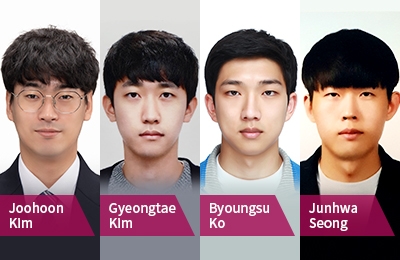
[POSTECH students Joohoon Kim, Gyeongtae Kim, Byoungsu Ko, and Junhwa Seong of the Department of Mechanical Engineering receive 4 awards at IMID 2022 including the KIDS Award (Gold prize).] POSTECH students in the Department of Mechanical Engineering recently won four awards, including the top prize, at the 22nd International Meeting on Information Displays (IMID 2022) held at BEXCO in Busan. Joohoon Kim and Gyeongtae Kim (advisor Junsuk Rho) of the Mechanical Engineering Department received the gold and silver prizes in the KIDS Award sponsored by LG Display. The KIDS Award is an award given to the six most excellent papers (two papers each for gold, silver, and bronze) among 740 papers presented at IMID 2022. LG Display and Samsung Display sponsor one gold, one silver and one bronze prize each. Gold prize winner Joohoon Kim was recognized for his contribution to overcoming process limitations and increasing the possibility of commercialization of metasurfaces by grafting mass-produced metasurfaces to virtual reality (VR) displays. Gyeongtae Kim received the silver prize as his work was evaluated to open the way for future micro-liDAR sensors by demonstrating a metasurface with a viewing angle of 180 degrees. Additionally, the silver prize for the Best Paper Award and the Best Poster Award went to Byoungsu Ko and Junhwa Seong in the Department of Mechanical Engineering (advisor Junsuk Rho), respectively. Byoungsu Ko received the award for his research on anti-counterfeiting technology based on double-security metasurface printing technology combined with humidity-variable hydrogel and Junhwa Seong, for his research on improving the robustness of metasurface using multifunctional protective coating. IMID, one of the world's top three information display conferences, is jointly hosted by the Korea Information Display Society (KIDS), the Society for Information Display (SID), and the Korea Display Industry Association (KDIA). The conference was held with 2,500 attendees from 15 countries around the world.
2022.09.16 1828 -
Dr. Augustine Choi, Dean of Cornell School of Medicine, Speaks at POSTECH
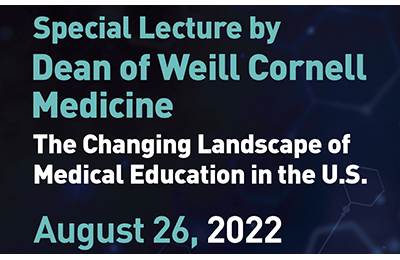
[A special lecture on ‘Changes in American Medical Education’ by Augustine Choi, the dean of Weill Cornell Medical College, held on August 26 at POSTECH] POSTECH held an invited talk by Dr. Augustine M.K. Choi, the dean of Cornell University’s medical college on August 26 at the POSCO International Center. In 2017, Dr. Augustine Choi drew attention as the first Korean to be appointed as the dean of a medical school at an Ivy League university (Cornell University). In this lecture, Dean Choi delivered vivid cases in US medical education and future strategies to POSTECH members in a lecture titled, ‘Changes in American medical education for nurturing the next generation of medical personnel.” The lecture given by Dean Choi, who has been dedicated to fostering medical scientists for many years, provided an opportunity to reach POSTECH's dream to conduct convergence research on engineering or science combined with medicine in the future. Augustine Choi, who immigrated to the U.S. in his first year of middle school and graduated from Louisville Medical School, went on to become a professor at Johns Hopkins, Yale, Pittsburgh, and Harvard medical schools. In 2013, he became the head of internal medicine at Cornell University and the medical director of New York Presbyterian Hospital and Cornell University Hospital. . Dr. Choi’s research focus has been on the occurrence of chronic and acute lung diseases caused by molecular, cellular, or genetic factors. His paper proving the effectiveness of cell protection by injecting low concentrations of carbon monoxide into the body has attracted attention from academic circles. Based on his outstanding research achievements, he was awarded the 2011 Ho-Am Prize (medical category) in Korea.
2022.09.16 1786 -
Seungsik Moon Receives the IEEE CASS Pre-Doctoral Grant
[The grants are awarded to only a handful of nominees among PhD candidates around the world.] [Moon is the first Korean winner to receive the grant in digital circuit design.] PhD candidate Seungsik Moon (advisor: Professor Youngjoo Lee) of the Department of Electrical Engineering at POSTECH was awarded the 2022 IEEE Circuits and Systems Society (CASS) Pre-Doctoral Grant. These grants are awarded annually to the most outstanding Ph.D. candidates conducting research on circuit design of system semiconductors and granted to only a small number of students around the world. Notably, Moon is the first Korean to receive the grant in the field of digital circuit design. Moon was highly acclaimed for his contribution to ultra-efficient digital system-on-chip designs for next-generation communications technology and artificial intelligence solutions. His multiple proposals were based on various optimization technologies encompassing algorithms, system structure and circuit design. This is a great achievement that takes Korea’s competitiveness to the next level in the field of system semiconductor circuit design, which is the center of global competition for technology. Established in 1963, the IEEE (Institute for Electrical and Electronics Engineers) is the world’s largest organization for electronic, electric and computing technologies. The CASS is a society belonging to IEEE, acknowledged worldwide for its excellence in the field of circuits and systems.
2022.09.14 1744 -
POSTECH Opens the Center for Heterogenic Metal Additive Manufacturing Material and Parts
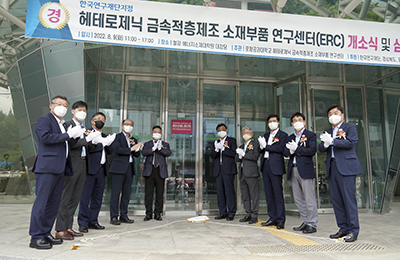
[A symposium was held with Director General Lee Chang-Yoon of Basic Research Policy of the Ministry of Science and ICT (MSIT) and Director Jang Sang-gil of the Provincial Science and Industry Bureau of Gyeongsangbuk-do Province in attendance.] POSTECH opened the Center for Heterogenic Metal Additive Manufacturing Material and Parts (Director: Professor Hyoung Seop Kim of the Graduate Institute of Ferrous & Energy Materials Technology) on August 9, 2022 at the Graduate Institute of Ferrous & Energy Materials Technology(GIFT) on the POSTECH campus. The center was established after POSTECH was selected for the Engineering Research Center project for the Basic Research Project of the Ministry of Science and ICT in May 2022. The center aims to develop new metal material processes to prepare for the Fourth Industrial Revolution and to carry out missions for metal manufacturing to add even more value to major industries. Metal additive manufacturing is a process that melts powder layers locally according to a given pattern and stacks them together layer by layer. As this manufacturing process finishes the production at once, it does not require separate manufacturing and assembling of multiple parts. As such, it can be applied to steel, aviation and small-module nuclear power plants. In particular, its importance is reinforced by the excellent environmental friendliness in terms of energy saving and reduction in carbon dioxide emissions that incur during the manufacturing process, and recycling of waste resources in the form of powder. Director Lee Chang-Yoon of Basic Research Policy at the Ministry of Science and ICT, Director Jang Sang-gil of the Provincial Science and Industry Bureau of Gyeongsangbuk-do Province, Director Son Jeong-ho of the Jobs and Economy Bureau of Pohang City, and President Moo Hwan Kim of POSTECH took part in the opening ceremony. Along with the opening ceremony for the Center for Heterogenic Metal Additive Manufacturing Material and Parts, POSTECH also hosted a symposium.
2022.09.14 1813 -
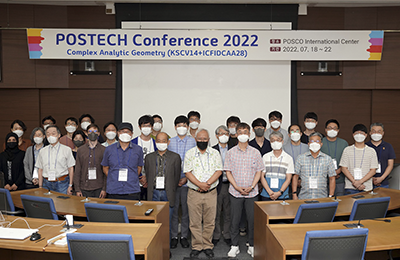
POSTECH Conference 2022 on Complex Analytic Geometry Held
[KSCV14 and ICFIDCAA28 joint international academic conference held on July 18~22, 2022] POSTECH’s Department of Mathematics successfully hosted the POSTECH Conference 2022 on Complex Analytic Geometry on the POSTECH campus. This academic conference, held online and offline from July 18- 22, is an international academic conference in the field of complex function theory and complex geometry. It was held through the alliance of the 14th Korean Conference on Several Complex Variables (KSCV14) and the 28th International Conference on Finite and Infinite Dimensional Complex Analysis and Applications (ICFIDCAA28). About 60 experts from Korea and abroad who specialize in complex analysis and complex geometry discussed and shared about the latest research trends in related fields. The conference was held with the support from the POSTECH conference program and from the Institute for Basic Science.
2022.08.11 1707 -
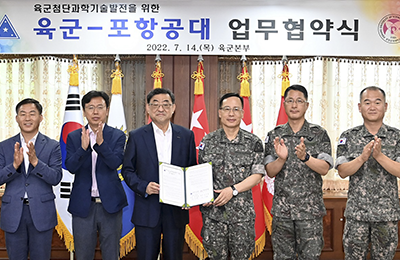
POSTECH and ROK Army to Join Forces
POSTECH and the Korean Army sign an agreement to advance military science and technology in artificial intelligence, drone bots and lasers. The agreement signing ceremony between POSTECH and the ROK Army was held on July 14th at the Gyeryongdae Complex of the Republic of Korea Armed Forces in South Chungcheong Province. Army Chief of Staff Jeong-Hwan Park, President Moo Hwan Kim POSTECH and about ten officials from both organizations participated in the ceremony. The agreement will enable the Korean Army to collaborate with POSTECH’s research institutes that focus on AI, drone bots and lasers to strengthen practical exchange and cooperation needed to advance military science and technology. The partnership will help the Army build up its Army TIGER unit, equipped with advanced technology. POSTECH’s research institutes that will strengthen the cooperation with the Army include the Pohang Accelerator Laboratory (lasers), Intelligent Robot Research Center (drone bots), Institute of Artificial Intelligence (AI) and the Next-Generation Defense Convergence Technology Research Center (Warrior Platform and drone bots). At the signing ceremony, the two organizations agreed to launch POSTECH commissioned education and practical training programs to nurture and secure outstanding workforce in science and technology. They also agreed to find ways to build a specialized center for research cooperation. POSTECH has also been building cooperative relationships to develop and advance future military science and technology with the Air Force Headquarters and the Agency for Defense Development (ADD) to further the next-generational military science research. Kyung-Tae Kim, the director of POSTECH’s Next-Generation Defense Convergence Technology Research Center, said that they “plan to focus more on the project, which can directly conduct research and develop basic and applied areas that are necessary to build training programs for military researchers and weapons development.” He added, “We hope that POSTECH’s efforts can become the powerful driving force that can support Defense Innovation 4.0, which the Ministry of National Defense is currently working on.”
2022.08.11 1670