News & Updates
-
Prof. Suk-Hwan Suh Publishes the ISO Standards for Smart Machine Tools
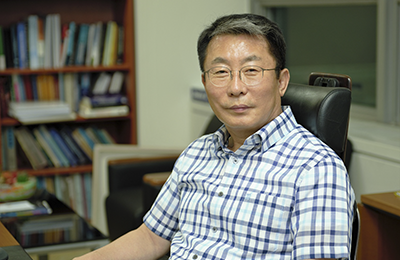
International standards for the cyber-physically controlled smart machine tool systems (CPSMT) for smart manufacturing (ISO 23704-1, 2) developed by POSTECH professor Suk-Hwan Suh (Director of POSTECH Research Center for Smart Factory) has been published. This international standard was approved last May by the ISO Final Draft International Standard (FDIS) and now has been published as the international standard. ISO 23704 is the world’s first international standard for Cyber Physical Systems (CPS), which is the core technology for Industry 4.0, in the Computer Numerical Control (CNC) Machine Tools. As the convener of the ISO Technical Committee (ISO/TC184/SC1/WG11) and the expert on the CNC machine tools and smart factory, Professor Suh has developed and published about 140 technical documents. This time was especially significant since it has taken him 5 years to achieve this feat with the support from several countries that lead the world in CNC machine tool technology. A machine tool is called the “mother machine” in the sense that it is a machine that makes machines and an indicator of a nation’s technological prowess. It not only affects hardware and software solutions, but also service industries and others. Among them, smart machine tools, which contribute to optimization of manufacturing systems as well as prediction and preservation of anomaly detection using Internet of Things, digital twin, and artificial intelligence technology during processing, are key infrastructure for smart manufacturing innovation. This approval of the ISO international standards, which was supported by the Korean Agency for Technology and Standards since 2018 (a program to advance standard technology), is anticipated to not only boost the international profile of Korea, a latecomer to the smart machine tools industry, but also raise Korea’s brand and technological strength when Korean industries preemptively adopt international standards. Professor Suh has been participating in the CNC controlled system development program (K-CNC) for smart manufacturing tool that had begun in 2020 to improve Korea’s global competitiveness. In this project, he had been conducting pilot studies aimed to systematically develop the Korean smart CNC machine tools based on the ISO 23704.
2022.08.11 1876 -
POSTECH Conference 2022 on Complex Analytic Geometry Held
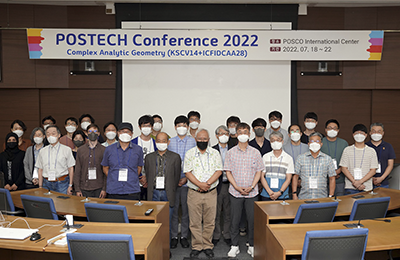
[KSCV14 and ICFIDCAA28 joint international academic conference held on July 18~22, 2022] POSTECH’s Department of Mathematics successfully hosted the POSTECH Conference 2022 on Complex Analytic Geometry on the POSTECH campus. This academic conference, held online and offline from July 18- 22, is an international academic conference in the field of complex function theory and complex geometry. It was held through the alliance of the 14th Korean Conference on Several Complex Variables (KSCV14) and the 28th International Conference on Finite and Infinite Dimensional Complex Analysis and Applications (ICFIDCAA28). About 60 experts from Korea and abroad who specialize in complex analysis and complex geometry discussed and shared about the latest research trends in related fields. The conference was held with the support from the POSTECH conference program and from the Institute for Basic Science.
2022.08.08 1690 -
Professor Suk Bong Hong is the First Asian Scientist to Win the Breck Award
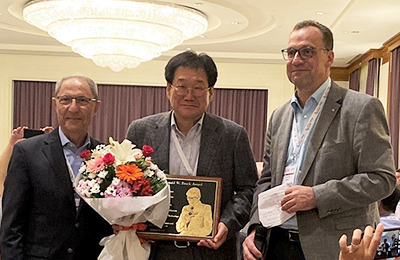
[Professor Hong wins the Breck award, considered the Nobel Prize of zeolite, at the 20th International Zeolite Conference on July 7] The Breck Award announced Professor Suk Bong Hong of the Division of Environmental Science and Engineering at POSTECH as the individual winner of the Breck Award at the 20th International Zeolite Conference (IZC) held in Valencia, Spain on July 7, 2022. The award is known as the Nobel Prize of zeolite*1 and Professor Hong is the first individual winner from Asia. It is worth noting that Professor Hong received the award as an individual 18 years after Professor Avelino Corma Canos from University of Valencia, a leading candidate for the Nobel Prize in Chemistry, won the award in 2004. Professor Hong was also appointed as the next chairman of the nominating committee for the Breck Award at the conference for the first time in Asia. Professor Suk Bong Hong received his Ph.D. degree from Virginia Tech and worked at Caltech and KIST before joining the POSTECH faculty in 2007. He has been publishing groundbreaking research findings using novel concepts of synthesizing zeolites, such as the multiple inorganic cation approach and excess fluoride approach. Professor Hong also received structure codes from the structure commission of the International Zeolite Association (IZA) for discovering 11 new structures, making significant contributions to applied research areas such as the development of zeolite-based catalysts for denitrification and the separation of carbon dioxide. Furthermore, he is recognized for leading academic development by publishing approximately 250 research studies including two in Nature and one in Science, as well as presenting nearly 50 patents. The Breck Award was established in 1983 to honor Donald W. Breck, a pioneering researcher in zeolite synthesis, who contributed to the founding of the International Zeolite Association. The award is presented every three years to an individual or group around the world who have made significant contributions to nanoporous materials. 1. Zeolite Hydrous silicate minerals containing sodium and aluminum
2022.08.02 2082 -
Nobel Laureate Dan Shechtman Visits POSTECH
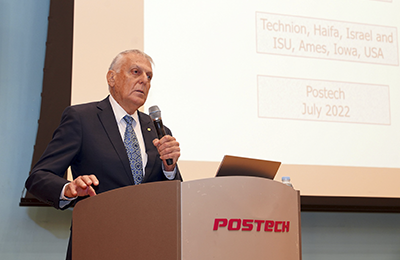
[Special lecture by Nobel Laureate Professor Shechtman and POSTECH-Israel Joint Conference held on July 19.] [The events provided an opportunity for future scientists and engineers at POSTECH to meet with the Nobel Prize winner and dream for their future.] Professor Dan Shechtman (Department of Materials Science and Engineering at Technion - Israel Institute of Technology), the winner of the Nobel Prize in Chemistry in 2011, has visited POSTECH. His visit was hosted by POSTECH to promote a closer cooperation in research and education with Israel to commemorate the 60th anniversary of diplomatic relations between Korea and Israel. The most notable program was Professor Dan Shechtman's special lecture. Professor Shechtman, who won the Nobel Prize for discovering quasicrystals – structures that are halfway between crystals and amorphous solids, gave a lecture titled, 'Quasi-Periodic Materials, a Paradigm Shift in Crystallography' to Postechians on July 19. The lecture was a valuable opportunity for all POSTECH members to interact with the Nobel prize laureate and to dream for their future. The fact that his discovery faced numerous criticisms from academia before being officially accepted and recognized caught the interest of future scientists and engineers who are also working hard in their own research fields despite difficulties and hardship. On the same day, POSTECH also held a joint conference with researchers from Israeli universities, including Professor Ady Arie from Tel Aviv University, Professor Guy Bartal from Technion University, and Professor Steffen Jung from Weizmann Institute of Science, together with POSTECH professors and students. The latest research trends in quantum metaphotonics and immunology were discussed. The quantum metaphotonics session was chaired by Professor Junsuk Rho of POSTECH’s Department of Mechanical Engineering and Department of Chemical Engineering, and the immunology session was chaired by Professor Sin-Hyeog Im from POSTECH Department of Life Sciences. Meanwhile, behind Professor Shechtman's visit to POSTECH was the effort of the Embassy of Israel to Korea. Not only did Ambassador Akiva Tor, the Israeli Ambassador to Korea, spare no effort in facilitating the Nobel laureate’s visit to POSTECH, the Embassy also sponsored the events. Ambassador Tor showed his commitment and friendship to POSTECH by accompanying the Nobel laureate and participating in all events at POSTECH.
2022.07.19 1897 -
POSTECH Students Receive SPIE Scholarship for 4 Consecutive Years
[Two students – Jaehyuck Jang from the Department of Chemical Engineering and Trevon Badloe from the Department of Mechanical Engineering – were selected this year] Two POSTECH Ph.D. candidates, Jaehyuck Jang (Department of Chemical Engineering) and Trevon Badloe (Department of Mechanical Engineering) whose advisor is Professor Junsuk Rho, will receive the 2022 Optics and Photonics Education Scholarship from the American Society of Photo-Optical Instrumentation Engineers (SPIE). This marks the 4th consecutive year that POSTECH students receive this SPIE scholarship. Mr. Jaehyuck Jang has recently succeeded in demonstrating a large-capacity holographic storage device for virtual and augmented reality using the metasurface, a two-dimensional flat optical device. Mr. Trevon Badloe focuses on research on metasurface design using deep learning and on intelligent nanophotonics that applies the design to variable metasurfaces. SPIE awards this education scholarship annually to outstanding SPIE student members, based on their potential to make significant contribution to the field of optics and photonics in the future. Of the 78 students selected for this year's scholarship, 14 were from Asia. Only four students were selected from Korea, of which half were POSTECH students. Established in 1955, SPIE is the world's most authoritative society in the field of optoelectronics with 250,000 accumulative members in 183 countries. For three years from 2019 to 2021, a total of four students from POSTECH – Dr. Gwanho Yoon (2019), Dr. Inki Kim (2020), Dr. Sunae So (2021), and Dr. Minkyung Kim (2021) from the Department of Mechanical Engineering – have received the education scholarship from SPIE, all of whom had Professor Junsuk Rho as their advisor.
2022.06.15 1802 -
Apple Manufacturing R&D Accelerator at POSTECH Launches Two New Labs, Providing Cutting-Edge Training to Korean Enterprises
[The new Smart Process Lab & Smart Quality Lab will help Korean companies improve operational performance and product quality] [Any Korean SME can apply for the courses on the Apple Manufacturing R&D Accelerator website starting today] The Apple Manufacturing R&D Accelerator at POSTECH is the first facility of its kind in the world, designed to provide cutting-edge training in smart and green technologies to Korean small and medium-sized enterprises (SMEs) in the manufacturing sector. The Accelerator opened its doors in May, and has already provided expert-led hands-on training to dozens of Korean SMEs. Applications are now open for two new labs, with classes beginning at the end of June, which will give even more SMEs the opportunity to learn from Apple’s manufacturing expertise and gain new skills to improve operations and production efficiency. "We are proud to have already welcomed and supported over 20 businesses at our new Apple Manufacturing R&D Accelerator at POSTECH,” said Priya Balasubramaniam, Apple’s vice president of Operations. "The courses we offer include cutting-edge manufacturing processes including green manufacturing and we are excited to open new applications for two additional labs to further equip businesses across Korea with innovative new skills, insights, and practices to optimize their operations.” “This course has been a great help to understand smart data and has provided applicable insights to what my company is currently working on, including automated disassembly of waste batteries and non-destructive inspection,” said Haedong Engineering’s Team Leader and Accelerator participant Lee Jaehyuk. The Smart Process Lab will help SMEs improve operational performance. The course will focus on industry best practices to help SMEs optimize their manufacturing assembly processes and maintenance systems. The Smart Quality Lab focuses on product quality, and will introduce advanced analytical tools for reliability evaluation and failure analysis. SMEs will gain the tools to assess and improve product quality through quantitative evaluation methodologies and metrics. SMEs can also still enroll in the Smart Data Lab, which focuses on the fundamentals of Machine Learning and its application in manufacturing. The course provides insight for SMEs to create custom machine learning algorithms. All Apple Manufacturing R&D Accelerator courses are offered at no cost, and are open to any Korean SME recognized by the Korean Ministry of SMEs and Startups. Classes will be held in the Apple Manufacturing R&D Accelerator located on the POSTECH campus. Applications are open at https://accelerator.postech.ac.kr/.
2022.06.09 2047 -
POSTECH and KT to Raise AI Experts Together
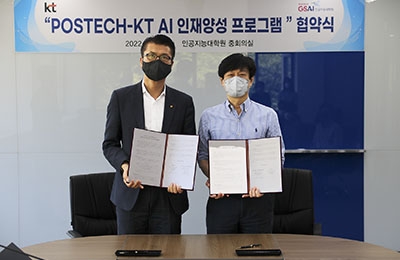
[POSTECH and KT design a master’s degree program leading to hiring to nurture talent in the digital industry and to strengthen competitiveness in AI.] [Students in the full-time program will be sponsored tuition and registration fees, and will be hired as KT R&D researchers upon graduation.] [The program provides opportunities for students to study large-scale AI data by participating in company projects and using the latest GPU servers.] With the digital transformation accelerating across many industries, finding digital experts equipped with the right practical skills in the new fields, such as artificial intelligence (AI), has become a pressing task. As such, prestigious universities in Korea are strengthening their collaborations with private companies, seeking out various ways to nurture human resources that are in high demand. On May 26, KT, a leader in strengthening Korea’s AI competitiveness and cultivating human resources in the digital sector, announced that it will work with POSTECH to raise AI experts together. Based on this partnership, the KT-POSTECH AI Expert Program will enroll its first class of students in 2023. The program is a full-time master’s degree curriculum linked with job opportunities. In the second half of this year, the program will begin accepting applications from (prospective) candidates who have completed their bachelor’s degrees at home and abroad. Based on a customized curriculum, the students will be taught key areas of artificial intelligence, including voice recognition, voice synthesis, natural language processing, graphics, and computer vision. KT will provide registration and tuition fees and research stipend for the entire period of the program for the enrolled students. The company will also provide dormitory accommodations for those students from other regions. The students be allowed to use the latest graphic processing unit (GPU) servers owned by KT for their research and during summer break, students will gain hands-on, real-world experience by analyzing and studying large-scale AI data through KT internship programs. Upon graduation, the students will work as researchers at research institutes including the KT Institute of Convergence Technology. The application information for this new master’s program at POSTECH for the academic year 2023 will be announced after July on KT’s recruitment site (recruit.kt.com). The selection process will be as follows: (1) application screening, (2) personality and aptitude tests and coding test, (3) interview with KT, and (4) interview with the graduate admissions. “It is meaningful that KT will foster future talents in AI together with POSTECH, which is a representative university in Korea with world-class infrastructure for teaching AI,” explained Vice President Hyun-ok Shin of the Management Support Division at KT. “We will not spare our support in various aspects, so that the students participating in this program can grow to become key leading figures in the development of the AI industry in Korea.” “Our goal is to raise bold, creative individuals who will apply artificial intelligence with immeasurable potential to various industries to take Korea’s AI competitiveness to the highest level,” remarked Professor Young Joo Suh, Dean of the Graduate School of Artificial Intelligence. “The POSTECH Graduate School of Artificial Intelligence has the best technological prowess in the field of AI. Its close cooperation with KT, an innovative leader in AI and big data, is expected to create a new model for cultivating talent through industry–academia collaborations.”
2022.05.26 2159 -
POSTECH to Raise Medical Scientists for Medical Patriotism
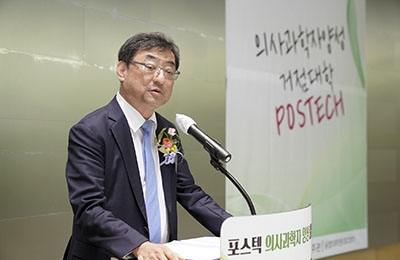
[Inauguration ceremony for fostering medical scientists held on May 19, 2022] [POSTECH also announced plans to open a graduate program in Medical Science and Engineering in 2023] POSTECH, which was founded with the purpose of educational patriotism, is now taking action to raise medical scientists for medical patriotism. On May 19, POSTECH held a ceremony to inaugurate its program for fostering medical scientists. The ceremony was attended by local government representatives of Gyeongsangbuk-do Province and Pohang City, as well as prominent individuals in science and medical fields. At the inauguration ceremony, it was also publicly announced for the first time that a graduate program in Medical Science and Engineering would be opened in 2023. A medical scientist is a doctor who performs research in the developing fields at the cross point of convergence of engineering and medicine with medical knowledge based on basic science and engineering. Half of the winners of the Nobel Prize in Physiology or Medicine are medical scientists, and it is not an overstatement that the development of the COVID-19 vaccine was spearheaded by these medical scientists. Last year, POSTECH announced its plan to open a graduate program of medical science in 2023 to foster medical scientists from diverse backgrounds based on its excellent biomedical infrastructure, including the synchrotron accelerator and the Institute of Membrane Proteins, to prepare for South Korea’ rapid entry into a super-aged society and the post-COVID-19 era. Since that time, POSTECH has actively sought to establish an engineering-based research-focused medical school in collaboration with local governments. The graduate program in Medical Science and Engineering unveiled today will be housed in the School of Convergence Science and Technology; it will make available a graduate program centered on medical science and medical engineering that allows admission even to candidates without a medical license. This program serves as the first step in establishing an engineering-based research-centered medical school that POSTECH is focusing on. POSTECH’s goal is to fulfill a range of medical demands through interdisciplinary convergent education and research linked to existing departments while also nurturing the biomedical and health industry and securing a competitive edge. POSTECH’s President Moo Hwan Kim stated, “The challenges of a rapid entry into a super-aged society and a new virus following COVID-19, common to all mankind, lie before us,” and added, “Medical scientists who comprehensively understand science, engineering, and medicine should seek solutions for these challenges together with approximately 110,000 doctors.” He emphasized that “POSTECH possesses a solid foundation to foster medical scientists who can pioneer the promotion of health for humanity through innovative medical education, and we will contribute to advancing our nation and humanity by raising medical scientists who are crucial for the future of mankind.” Jang-sik Lee, the acting mayor of Pohang, said, “By transitioning from clinical to research-centered medical education, we can present a standard model for future medical education in our nation. We will also focus all of our administrative power to turn Pohang into an exemplary success story for balanced national development as the new growth hub of the bio-health industry.” The event was also attended by the following individuals: Pohang’s National Assembly delegates Jungjae Kim and Byongwook Kim; Vice Governor for Administrative Affairs of Gyeongsangbuk-do Province, Seong-jo Kang; Acting Mayor of Pohang, Jang-sik Lee; Chairman of Pohang City Council, Hea-Jong Jeong; President Dosung Choi of Hangdong Global University; and other local personages. Further, President Yong Hoon Lee of Ulsan National Institute of Science and Technology (UNIST), President Ook-Joon Yoo of the Korean Academy of Science and Technology, and Director Jin-Kwan Han of the Gyeongbuk Institute for Bio Industry were among the personages from the science and technology fields. Finally, President Chul-Hee Lee of the Chung-Ang University Gwayngmyeong Hospital, Director Mun-Chul Kim of the Pohang Stroke and Spine Hospital, and Director Woo Sup Ahn of Kyunghee Recuperation Hospital were among the guests from the medical industry. In particular, Chairman Choong-sik Ha of Changwon Hanmaeum Hospital and Professor Emeritus Eui-ho Suh of POSTECH, who share the vision of POSTECH’s fostering of medical scientists, also participated in the ceremony.
2022.05.19 2173 -
POSTECH Holds Commencement Ceremony for 2021 Academic Year on May 13
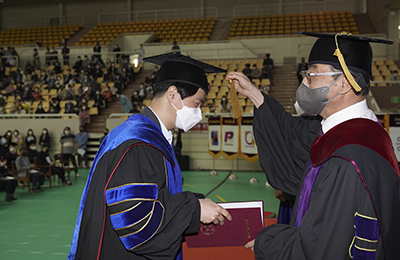
[226 Ph.D. & 224 master’s & 317 nachelor’s degrees awarded] POSTECH’s commencement ceremony for the 2021 academic year was held on May 13, 2022 at the POSTECH Gymnasium. Originally scheduled for February this year, the ceremony was highly meaningful because it was the first in-person graduation ceremony to take place since the COVID-19 pandemic began. At the ceremony, a total of 767 students, including 226 Ph.D., 224 master’s, and 317 bachelor’s degrees were awarded. Vice Chairman Duk-Lak Lee, National Assembly delegate Byongwook Kim, Acting Mayor of Pohang Jang-sik Lee, President Soo-Hee Nam of the Research Institute of Industrial Science & Technology (RIST), President Junku Yuh of the Korea Institute of Robotics & Technology Convergences (KIRO), Chairman Dae-Gong Lee of the Aerin Foundation, and others attended the ceremony to congratulate the graduates. The Founding Chairman’s Award was presented to Mr. Yonghun Jin (academic advisor: Seung Hwan Cho) of the Department of Chemistry, who is the valedictorian of the graduating class. Because this award was awarded to a graduate in the science track, Mr. Hyeonghoon Lee (academic advisor: Dongsik Kim), of the Department of Mechanical Engineering and the top engineering student in the graduating class, received the Chairman’s Award. An award honoring the vision of POSTECH’s first president Mueunjae Hogil Kim, the Hogil Kim Award is given to the graduate who works toward the advancement or honor of the university. This was awarded to Mr. Jongho Park of the Department of Mathematics (academic advisor: Sungmun Cho) who has been actively engaged in scholarly activities, such as conducting various statistical analyses on the flocking behavior phenomenon seen in the virtual currency market as an undergraduate student. The award was given to also recognize his performance in raising the prestige of the university by winning scholarships and awards beyond the campus. The POSTECH Alumni Association Chairman Award, given to students who have demonstrated growth and advancement represented in the POSTECH’s founding tenet (a globally outstanding talent with knowledge and intellect), was awarded to Ms. Eunji Kim (academic advisor: Kunyoo Shin) of the Department of Life Sciences. The Sung Kee Chung Thesis Award (science) and the Kun Soo Chang Thesis Award (engineering), given to the best Ph.D. dissertation, were presented respectively to Mr. Junho Seo (academic advisor: Jun Sung Kim) of the Department of Physics, who wrote his dissertation on the theme of the anomalous hall effect induced by the topological nodal line in ferromagnetic van der Waals metalloids, and Mr. Young jJun Park (academic advisor: Jang-Sik Lee) of the Department of Materials Science & Engineering, who presented a dissertation related to the development of a memory device enabling high-speed movement using a halide-based perovskite material. These awards are supported by the funds from the former president Sung Kee Chung and Professor Emeritus Kun Soo Chang. The School of Electrical Engineering, Computer Science and Convergence Award, which has been newly established this year, was presented to Mr. Junho Park (academic advisor: Wonbin Hong) of the Department of Electrical Engineering. This award is granted to the student earning a Ph.D. degree in the IT field including the Department of Electrical Engineering, the Department of Computer Science and Engineering, the Department of Convergence IT Engineering, and the Graduate School of Artificial Intelligence who publishes outstanding papers and shows potential to achieve excellent research results in the future. In his commencement address, President Moo Hwan Kim remarked, “If we compare life to a book, all of you standing here have just finished one chapter” and added, “Do not cease to grow as of May 2022 but continue to grow in other directions.” He emphasized, “Only when wisdom is added to superior knowledge and individual competency can our society, nation, and the world we are living in achieve progress.”
2022.05.12 1929 -
POSTECH Selects Next-generation Leader Researchers for 2022
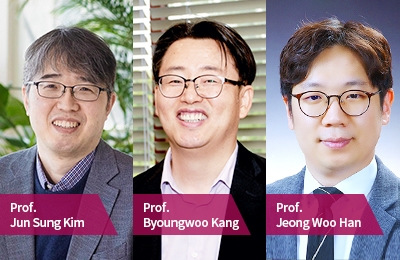
[Selected faculty include Professor Jun Sung Kim of Department of Physics, Professor Byoungwoo Kang, Department of Materials Science and Engineering, and Professor Jeong Woo Han of Department of Chemical Engineering.] Professor Jun Sung Kim (Department of Physics), Professor Byoungwoo Kang (Department of Materials Science and Engineering), and Professor Jeong Woo Han (Department of Chemical Engineering) are the next-generation researchers who will lead the future research of POSTECH. POSTECH’s support initiative for next-generation leader researchers, which began in 2021, offers research funding of KRW 300 million (approximately USD 240,000) over three years to fully support the research of faculty who will lead future of science and technology. Professor Jun Sung Kim, who was selected this year for the funding, has focused on the research on the synthesis of new materials and the extreme physical properties of high magnetic fields and cryogenic temperatures in condensed matter physics. He has consecutively discovered new two-dimensional materials with topological electronic states and ferromagnetic properties and published them in Nature, which is one of the world’s most cited scientific journals. His achievements in Korea and overseas have been recognized for pioneering a unique research field. His research on material development, particularly in conjunction with the usage of new matters is considered to be highly competitive around the world. Professor Byoungwoo Kang has developed and proposed high-capacity cathode materials in lithium-ion secondary batteries as well as materials to be used in next-generation batteries. Additionally, he has demonstrated their applicability, thereby proposing the future direction for the development of secondary batteries materials. He has played a key role in establishing the Graduate Institute of Ferrous and Energy Materials Technology (GIFT) to make POSTECH the mecca of secondary battery materials. Further, he is the director of the Materials Research Center for Batteries and is responsible for operating the POSTECH Samsung SDI Battery Track (PSBT), where he works hard to nurture talented individuals. Professor Jeong Woo Han has pioneered research in the fields of computational chemistry–based catalyst and energy material design. He has published approximately 190 papers in SCIE-indexed journals and is dedicated to developing theoretical design strategies for high-performance materials in clean energy production, conversion, and storage including hydrogen fuel. Through active joint research within and beyond the university, he has served as a “catalyst” for developing Korea’s science and technology through the industry–university research institute partnership. Meanwhile, Professor Jong-Seong Kug in the Division of Environmental Science and Engineering, Professor Chulhong Kim of the Department of Convergence IT Engineering, and Professor Junsuk Rho of the Department of Mechanical Engineering were the next-generation leading researchers selected last year.
2022.05.12 1840