News & Updates
-
Three POSTECH Professors Inducted into the Y-KAST
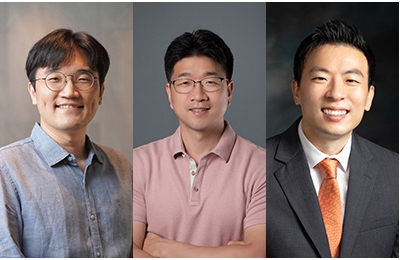
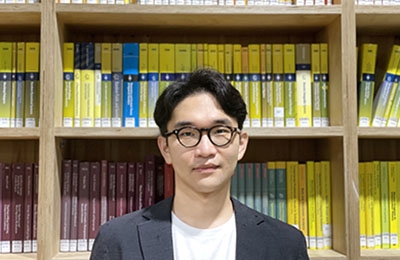
Three professors from POSTECH have been selected to be inducted into the Young Korean Academy of Science and Technology (Y-KAST) for the year 2022: They are Professor Gil-Ho Lee of the Department of Physics, Professor Dae Sung Chung of the Department of Chemical Engineering, and Professor Wonbin Hong of the Department of Electrical Engineering. Professor Gil-Ho Lee of the Department of Physics received his Ph.D. from POSTECH, and worked at the Center for Topological Matter and Harvard University before joining the POSTECH faculty in 2017. Professor Lee has established a research focus of his own by conducting research on core quantum information technologies, including quantum device research based on graphene, superconductivity, and phase materials, and the development of cryogenic measurement technology. Professor Dae Sung Chung of the Department of Chemical Engineering completed his Ph.D. at POSTECH. After working as a postdoctoral researcher at the University of Chicago and teaching at Dong-A University, Chung-Ang University, and DGIST, Profess Chung joined the POSTECH faculty in March 2020. Professor Chung leads the research on developing a water-based semiconductor manufacturing technology using surfactants, and has recently achieved much success in developing filter-free color image sensors. Professor Wonbin Hong of the Department of Electrical Engineering completed his Ph.D. from the University of Michigan (U.S.) and worked as a senior researcher at Samsung Electronics before joining the POSTECH faculty in February 2016. Professor Hong, who is the first scholar on electromagnetic waves to be inducted into Y-KAST, was recognized for his achievement in electromagnetic and antenna engineering, especially for rewriting the history of small antennas for the first time in 70 years by developing the built-in antenna on display (AoD). The Korean Academy of Science and Technology (KAST) selects researchers under the age of 43 with outstanding academic achievements in the field of science and technology to be inducted into the Y-KAST. The next-generation leaders who are highly likely to contribute to the advancement of science and technology in Korea are selected by assessing their achievement as an independent researcher in Korea.
2021.12.02 2032 -
POSTECH to Raise Semiconductor Experts with Samsung Electronics
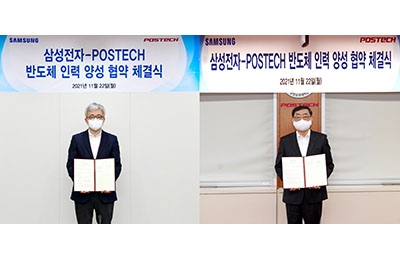
[POSTECH and Samsung Electronics sign an agreement on November 22 to raise 200 experts over five years beginning in 2023.] [POSTECH will operate an undergraduate program with guaranteed employment at Samsung with an option to complete the graduate program.] POSTECH plans to raise the next generation of semiconductor engineers through the newly established Department of Semiconductor Engineering in partnership with Samsung Electronics. Taking advantage of the excellent education and research infrastructure at POSTECH, the program will lead to employment at Samsung and an option to go onto graduate studies. In an online ceremony held on November 22, 2021, POSTECH and Samsung Electronics signed an agreement to raise semiconductor engineers together. President Moo Hwan Kim of POSTECH and President and General Manager Siyoung Choi the Foundry Business at Samsung Electronics attended the ceremony as signees. According to the agreement, the two institutions will operate the semiconductor program beginning with the incoming freshmen of the 2023 academic year. POSTECH plans to recruit 40 students each year for a total of 200 students from 2023 to 2027. After completing POSTECH's core curriculum, these students will complete the program of the Department of Semiconductor Engineering to become semiconductor professionals in the areas of design, materials, processing, devices, and software. These students will receive tuition and additional scholarships, and participate in overseas conferences among other educational programs to grow into global talent. The student selected for the program will be equipped as an engineering talent with basic and applied knowledge in all semiconductor areas, a leader who can identify the latest semiconductor technology trends and analyze the market, and a well-rounded expert with values, great communication skills, leadership and management mindset. POSTECH has been operating a graduate program in semiconductor engineering with Samsung Electronics called PSEP (POSTECH-SAMSUNG Semiconductor Education Program) since 2018 to nurture future leaders in the field. “POSTECH, with its strength in excellent education and innovative research, wishes to cultivate the best talent in the semiconductor field through this cooperation with Samsung Electronics, a leader in the field,” explained President Kim in his congratulatory remarks. “POSTECH graduates from this program will lead the semiconductor industry and contribute to the development of the industry and the nation.”
2021.11.22 2470 -
President Moo Hwan Kim Receives the Distinguished Achievement Award from University of Wisconsin
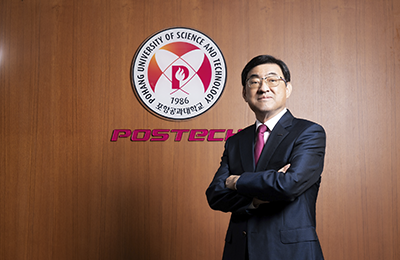
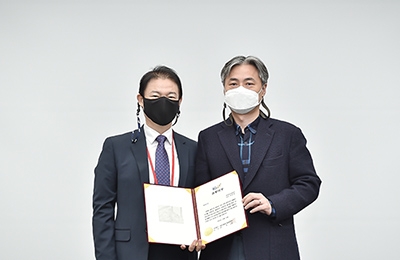
[Recognized for his contribution in academia and education as the president of Korea Institute of Nuclear Safety (KINS) and the president of POSTECH] POSTECH president Moo Hwan Kim received the 2021 Distinguished Achievement Award from the College of Engineering at University of Wisconsin-Madison (UW-Madison). President Kim, who is a nuclear safety expert, received his bachelor's and master's degrees from Seoul National University and completed his Ph.D. at the University of Wisconsin-Madison in 1986. He joined the POSTECH faculty in 1987. Since joining POSTECH, President Kim has been actively engaged in nuclear safety at home and abroad, serving as a member of the National Energy Committee of the Ministry of Knowledge Economy, a non-standing commissioner of the Nuclear Safety and Security Commission, and a member of the International Nuclear Safety Group at International Atomic Energy Agency. A total of 38 Ph.D. and 40 master’s students studied under President Kim’s tutelage over the years and he has published 214 papers in international journals. He has chaired the organizing committee of the International Conference on Multiphase Flow in 2013 to actively lead the development of nuclear safety at home and abroad. At POSTECH, President Kim served in various leadership roles including the vice president of student affairs and admissions, the vice president of planning, and was appointed the 8th president of POSTECH in 2019 after making great contributions to educational and managerial policies at POSTECH. UW-Madison College of Engineering selected President Kim as a recipient of the 2021 Distinguished Achievement Award for his remarkable academic achievements and his contribution to education. In his acceptance speech, President Kim remarked, “I want to take this time to thank Professor Michael Corradini and the late Professor Max Carbon who both had a huge influence on my life. They were my role models and I am who I am today thanks to their guidance and advice,” He added, “I would also like to thank my wife, who I owe my life to. She gave me one of her kidneys so I could keep enjoying life and do the things I love. I wouldn’t be here without her sacrifice and support. I also want to tell my sons how proud I am to be their father. And lastly, I thank my parents my in-laws for allowing our family to exist in this world.” President Kim closed his speech with a quote from Leo Buscaglia, “Change is the end result of all true learning.” He encouraged everyone to continue to learn and be the positive change in the world. The Distinguished Achievement Award of UW-Madison’s College of Engineering’s is awarded each year to alumni who have made significant contribution and led positive changes in various fields including academia or the private sector.
2021.11.15 1476 -
Using the Principle Behind Coffee Ring Effect in Quantum Dot Arrays
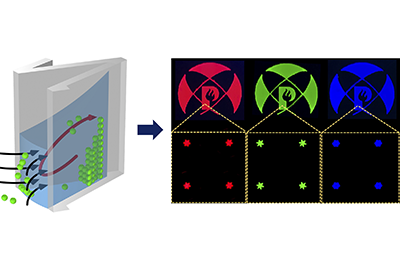
[POSTECH research team led by professors Junsuk Rho and HangJin Jo develops a new method for quantum dot array that yields a resolution 20 times brighter than the conventional materials, using the coffee ring effect] If spilled coffee is not immediately wiped off, it leaves behind a stain where the edges are darker than the rest. This phenomenon is called the coffee ring effect. Using this principle, a POSTECH research team has recently developed a new method for arranging quantum dots (QDs) which are nanosized semiconducting crystals. This new simple method facilitates the development of display panels with up to 20 times higher resolution than the conventional ones. A POSTECH research team – led by Professor Junsuk Rho of the Department of Mechanical Engineering and Chemical Engineering, professors HangJin Jo and Moo Hwan Kim of the Division of Advanced Nuclear Engineering and Department of Mechanical Engineering, Taeyang Han of the Division of Advanced Nuclear Engineering, and Ph.D. candidate Jaebum Noh in the Department of Mechanical Engineering – developed a QD array using a phenomenon that occurs when a suspension evaporates. Suspension refers to a liquid in which solid particles are dispersed and suspended as in muddy water, ink, or paint. QDs, which are several nanometers (1 nm is one billionth of a meter) in size, follow the flow of a fluid very well. Just as coffee stains are left when a drop runs on the side of a cup, when a suspension containing QDs evaporates, the particles automatically assemble in certain areas like the edge of a liquid drop induced by capillary flow. Many attempts have been made to take advantage of this property, but acquiring brightness suitable for displays have been difficult. The cost of the product was also high because QDs were printed directly on the substrate using expensive equipment. To overcome this limitation, the researchers arranged the QDs in the form of very small pixels during the suspension evaporation process using a V-shaped structure. When the liquid is poured and evaporated, the QDs are driven toward the inner tips of the V-shape and accumulate there. The results revealed that the brightness of the QD pixels produced in this way was 20 times brighter than that of the control group and showed high uniformity rate of over 98%. “Recently, the home appliance industry is using QDs in color filters in televisions for bright and natural images,” remarked professors Junsuk Rho and HangJin Jo. “Using the QD pixel array method developed in this study, bright QD pixels are created by simply spraying the suspension without expensive equipment, thus reducing the manufacturing cost. Recently published in ACS Applied Materials and Interfaces, an international journal published by the American Chemical Society, this study was conducted with the support from the National Research Foundation's Mid-Career Researcher Program, Global Frontier Project, Regional Leading Research Center (RLRC) program and the Basic Nuclear Fusion Research program.
2021.11.09 1462 -
POSTECH and Samsung SDI Partner Together to Raise Battery Specialists
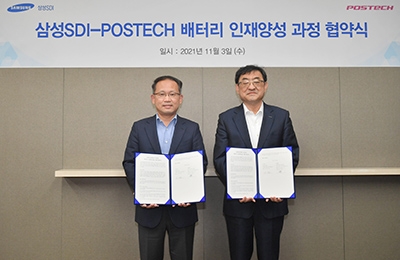
POSTECH and Samsung SDI establishes an academia-industry partnership to foster battery specialists together. POSTECH and Samsung SDI announced the signing of an agreement for POSTECH-Samsung SDI Battery Track (PSBT) on November 3, 2021. Through this partnership, POSTECH and Samsung SDI will operate customized training courses for professionals in battery materials, cells, and systems. Under the leadership of Center for Advanced Battery Technologies, over 6 departments at POSTECH including Department of Materials Science & Engineering, Department of Chemical Engineering, Department of Chemistry, Department of Convergence IT Engineering (CiTE), Department of Electrical Engineering and Graduate Institute of Ferrous & Energy Materials Technology (GIFT), and 25 members of faculties will participate in the program. From year 2022 to 2031, over 100 scholarship recipients (master’s and Ph.D. degrees) of PSBT will be selected. These students will complete creative and professional leadership courses along with battery-focused curriculum. They will conduct research related to the ongoing projects and experiments of Samsung SDI and upon completion of their degree, they will join Samsung SDI as employees. Samsung SDI plans to gain the technological competitiveness for next generation batteries through this agreement and step up efforts to nurture crucial talent in the battery sector. “This agreement with Samsung SDI, which is a company that leads the global battery industry, will be a stepping stone for Korea to take the lead for next-generation batteries,” remarked POSTECH president Moo Hwan Kim. “POSTECH has shown excellence in various advanced research fields including materials, and will do its best to nurture the future leaders of the global battery industry through this agreement.” “This agreement is significant in that it is with POSTECH, a university that produces world’s stop research, and for Samsung SDI to nurture talents to strengthen its competitiveness in the global battery market,” commented Hyuk Chang, the executive vice president of Samsung SDI. “We will offer multilateral support to the scholarship recipients including exceptional curriculum, great joint research projects, and R&D infrastructure of SDI.”
2021.11.04 1922 -
Professor Youn-Bae Kang Receives the Yoon Dong Seok Award
POSTECH professor Youn-Bae Kang of the Graduate Institute of Ferrous & Energy Materials Technology (GIFT) was awarded the Yoon Dong Seok Award from the Korean Institute of Metals and Materials (KIM) on October 21, 2021. Professor Kang completed his Ph.D. in Materials Science & Engineering at POSTECH and worked at the Ecole Polytechnique de Montreal in Canada before joining the faculty of POSTECH in 2009. Since then, he has worked as a researcher at the POSCO Technical Research Laboratories and was a visiting professor at the Ecole Polytechnique de Montreal. Professor Kang, who has been actively conducting research on high temperature process metallurgy, was honored with the award in recognition of his outstanding research achievements, including the development of continuous casting of ultra clean steel using thermodynamics and phase diagram. The Yoon Dong Seok Award is presented to a member of KIM who has made an outstanding academic and technical achievement in metal and material fields. The award is granted with the proceeds from the fund donated by Yoon Dong Seok, a former chairman of the KIM, and from other funds of the institute.
2021.11.03 1643 -
Professor Junsuk Rho Appointed Associate Editor of Nanophotonics
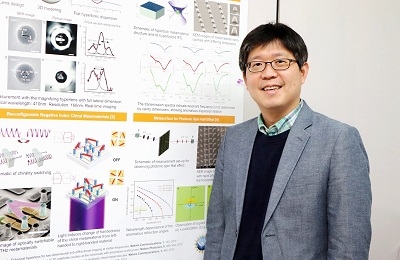
Professor Junsuk Rho of the Department of Mechanical Engineering and Chemical Engineering at POSTECH has been appointed as an associate editor of Nanophotonics. Garnering global attention as a young, pioneering researcher in nanophotonics and nanoprocessing, Professor Rho will work as the main editor of metamaterials, nanoprocessing, and nanodevices. Nanophotonics is one of the top international journals in the field of optics published by the German publisher De Gruyter since 2012. Professor Stefan Maier of University of Munich is the editor-in-chief of the journal and Professor Rho is the only Korean among the journal’s 10 associate editors. The journal impact factor of Nanophotonics is 8.449, which places it in the top 10% of journals in the field of optics by Journal Citation Reports (JCR).
2021.10.28 1714 -
POSTECH Wins Awards at the International Meeting on Information Display
POSTECH researchers and students won the KIDS Award Gold and the Best Paper Bronze at the 21st International Meeting on Information Display (IMID 2021), which took place last month. IMID 2021 commemorated its 20th anniversary by co-hosting with the the Korea Display Exhibition of the Korea Display Industry Association to provide a platform for industry-academia collaboration. The IMID 2021 was held both online and offline, and about 2,000 experts from 20 different countries in display-related industries, academia, and research attended to present research trends and exchange the latest information and technology. Dr. Inki Kim (Assistant Professor of Dept. of Biophysics at Sungkyunkwan University), who won the Gold Prize at the KIDS Award, was praised for opening a new horizon in the field of holographic displays to move static holograms dynamically by using liquid crystals, solving an issue of conventional meta-holograms. Professor Junsuk Rho of the Dept. of Mechanical Engineering and Chemical Engineering at POSTECH led this study, and Professor Youngki Kim and Ph.D. candidate Wonsik Kim of the Department of Chemical Engineering participated in the study. In addition, Ph.D. candidate Gyeongtae Kim of the Dept of Mechanical Engineering at POSTECH won the Best Paper Bronze Prize at the IMID Young Leaders Conference for his paper titled, Dynamic Vectorial Holographic Color Prints by Liquid Crystal-Integrated Metasurface for Anti-Counterfeiting.
2021.10.22 1615 -
POSTECH Professor Moon Jeong Park Appointed as Fellow of American Physical Society
Professor Moon Jeong Park of POSTECH’s Department of Chemistry and Chemical Engineering was selected as a fellow of American Physical Society (APS). Professor Park has been conducting creative and insightful research to explain the function of molecular structure and self-assembled structure based on electrical, ionic polymer actuator and mechanical characteristics. In recognition of her contributions, APS has elected her as a fellow at the recommendation of the polymer physics committee. Professor Park, who joined the POSTECH faculty in 2009, has outperformed in research areas of polymer electrolyte synthesis analysis, correlation of ionic channel-conductivity, and polymer actuator. Professor also gained attention when she won the John H. Dillon Medal from APS as the first Korean, which is awarded to rising scientists who have shown exceptional potential in the field of polymer physical chemistry. APS appoints less than 0.5% of its members as a fellow after strict review and the scholars accept this position as a great honor. Professor Park is the only scholar who belongs to a Korean university elected as a fellow this year and will be awarded the certificate in March 2022 at the annual meeting in Chicago. A total of six POSTECH professors have been elected as APS fellow.
2021.10.18 1736 -
Professor Beomjun Choi Receives the POSCO Science Fellowship
[POSCO TJ Park Foundation awards up to 100 million won (USD 100,000) over two years to the recipients.] Professor Beomjun Choi of the Department of Mathematics at POSTECH was recently selected as the recipient of the POSCO Science Fellowship. Professor Beomjun Choi received his Ph.D. from Columbia University in 2019 and worked as a postdoctoral research fellow at University of Toronto and a CMC fellow at Korea Institute for Advanced Study (KIAS) before being appointed as an assistant professor of mathematics at POSTECH in July 2021. Professor Choi was selected as a POSCO Science Fellow in recognition for the originality and potentiality of his study on geometric analysis based on differential geometry and partial differential equation (PDE). The POSCO Science Fellowship is a grant from the POSCO TJ Park Foundation that annually selects and funds 30 young, competent postdoctoral researchers and newly appointed professors in the field of basic and applied science. The goal of the program is to support Korean researchers to become world leading scientists in the future. POSCO TJ Park Foundation grants up to 100 million won (USD 100,000) over two years to researchers who study basic sciences (mathematics, physics, chemistry, and life sciences) and applied sciences (metals, new materials, energy materials) at universities and research institutes throughout Korea.
2021.10.07 1783