News & Updates
-
Professor Jinah Jang Wins the Medipost New Scientist Award
POSTECH professor Jinah Jang of the departments of Convergence IT Engineering and Mechanical Engineering has received the Medipost New Scientist Award from the Korean Tissue Engineering and Regenerative Medicine Society (KTERMS). This award was established to promote the research competence of scientists under the age of 45 who have shown outstanding research achievements in the fields of tissue engineering and regenerative medicine. Prof. Jang was nominated as a member with high priority owing to her excellent research performance based on the H-index, which shows the scholar’s research productivity and influence in the recent five years. Prof. Jang’s most prominent research achievement is the development and application of tissue-specific bioink, which has the capacity to imitate the biochemical and biological composition of the tissues to be manufactured. In particular, the materials can be wrapped with cells and printed in three-dimensional form using a bioprinter and shows outstanding effectiveness when applied to complex-shaped organs, including the heart, blood vessels, and pancreatic tissues. Each study was published in Nature Communications (2014), which is an authoritative journal on convergence, Biomaterials (2017), Advanced Functional Materials (2017, 2021), Acta Biomaterialia (2019), and Science Advances (2020). A comprehensive review paper related to the development and application of tissue-specific bioinks was published in Chemical Reviews in 2020. The Korean Tissue Engineering and Regenerative Medicine Society (KTERMS) is the only academy of regenerative medicine in Korea, and a multidisciplinary and convergent academy consisting of researchers studying regenerative medicine, including medical, life sciences, science and engineering fields.
2021.07.07 1833 -
Professor Namyoon Lee Wins the IEIE/IEEE Joint Award for Young Scientist and Engineer
Professor Namyoon Lee of POSTECH’s Department of Electrical Engineering was selected as the winner of IEIE/IEEE Joint Award for Young Scientist and Engineer sponsored by the Haedong Foundation. The awards ceremony was held at the Jeju Lotte Hotel on July 1, 2021. Professor Lee, who was selected as this year's winner, leads the research on multiple-input multiple-output (MIMO) communication in 6G and associative learning algorithms for next-generation mobile AI services in Korea and abroad. In particular, he holds the world-leading technology in 'beam forming optimization' which is considered as the key technology in communication and radar for next-generation antennas that use mmWave and THz bands. He also has published 47 papers in top-tier journals of IEEE, 72 international conference papers, and has applied for or registered 50 domestic and international patents. The IEIE/IEEE Joint Award for Young Scientist and Engineer is an international award in the field of ICT that is jointly presented by IEIE and IEEE. It is annually awarded to only one young scientist under the age of 40 who has contributed significantly to the academic and technological development of ICT. The rigorous selection process is carried out by both Korean and international panel of experts every year.
2021.07.06 1791 -
POSTECH-KB Kookmin Bank Opens Digital Innovation Research Center
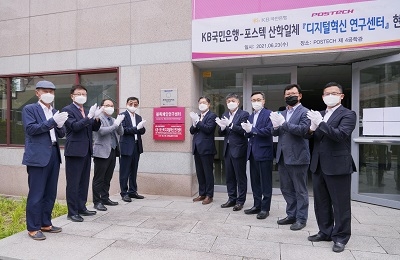
POSTECH held a signage unveiling ceremony for the KB-POSTECH Digital Innovation Research Center at POSTECH Science Building 4 on June 23, 2021. POSTECH has established the KB-POSTECH Digital Innovation Research Center to contribute to the development of the financial industry through R&D collaborations in fintech, joint research, and interaction of highly skilled talents. The ceremony was attended by POSTECH President Moo Hwan Kim, Vice President Joon Won Park and Director of the Center Bong Gyu Jang, and KB Kookmin Bank's Young Seo Cho. The KB-POSTECH Digital Innovation Center will conduct joint research to develop digital financial products and services such as artificial intelligence, big data, blockchain, cloud, augmented reality (AR)/virtual reality (VR), architecture and security. For this partnership, members of faculty and experts from POSTECH’s departments of Artificial Intelligence, Industrial Engineering, Computer Engineering, Electrical Engineering, and Information Technology will join, and strengthen the exchange with KB Kookmin Bank employees. "The demand for the creation of new fintech business that combines the capabilities of big data, AI and blockchain has been increasing recently,” explained Professor Bong Gyu Jang, the director of the KB-POSTECH Digital Innovation Center. He added, “We will cooperate in all areas of fintech to deliver new values and experiences using POSTECH’s state-of-the-art technologies.”
2021.07.06 1843 -
POSTECH Hosts the Pohang AI Poongryu Concert
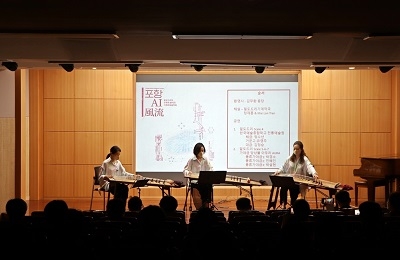
POSTECH hosted a lecture and concert titled “Pohang AI Poongryu: Mathematical Analysis and Mechanical Composition of Mitdodri” at the Pohang Culture and Art Hall on June 11 – 12, 2021. The event was hosted by POSTECH and organized by POSTECH MINDS, the POSTECH-Korea National University of Arts Digital Human Research Center, and the Pohang Culture Foundation. It was successfully held in coordination with the Graduate School of Artificial Intelligence and the Department of Mathematics at POSTECH, National Research Foundation of Korea, the School of Korean Traditional Arts of the Korea National University of Arts, Onseok University, Yeoju Institute of Technology, Art Hall Gayatgoeul, AURA, and Crost Ensemble. At the concert, a newly composed piece was performed created through a technique discovered by a machine that used the mathematical analysis of the haegeum score of “Mitdodri” (Suyeonjangjigok 壽延長之曲), considered as one of the masterpieces of Korean traditional music. The musicians performed "Mitdodri" for solo haegeum, a duet for guitar, a trio for haegeum, daegeum, and geomungo, and a trio for poongryu gayageum led by Soonyun Jeong, a professor at the Korea National University of Arts. The finale of the night was an ensemble piece performed by eastern and western instruments, choir, and VJING. This concert was significant as it was presented in collaboration with POSTECH, Pohang Culture Foundation, local artists, a private concert venue, and eastern and western artists.
2021.06.16 1922 -
Is It Virtual or Real? Classes Held in the VR·AR·MR World
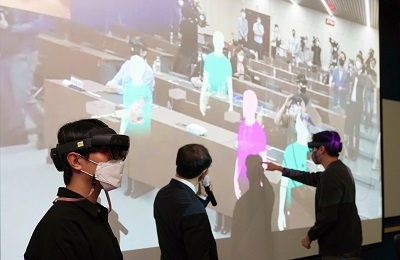
- POSTECH is the first university in Korea to equip all freshmen with VR devices to conduct experiments at home with VR and AR content. - POSTECH seeks mutual growth in education, tourism, and industries in the region by signing an MOU with Gyeongsangbuk-do Culture and Tourism Organization. POSTECH has created an innovative classroom concept where virtual reality (VR), augmented reality, (AR) and mixed reality (MR) are simultaneously applied, and showcased a virtual lecture using this new advanced technology. On May 27, POSTECH conducted a virtual physics lecture including an experiment – generated by VR, AR, and MR technologies – in a VR/AR/MR classroom located on the first floor of LG Cooperative Electronics Engineering Building on campus. POSTECH started VR classes in April 2021 to maintain the educational quality and to encourage creative, self-directed learning after all classes moved online due to the spread of COVID-19. For this purpose, POSTECH built a 106-seat classroom equipped with VR·AR·MR capabilities and became the first university in Korea to provide VR (Oculus Quest 2) devices to all freshmen for their lab classes. "If virtual lab classes become more sophisticated, it can lead to a new educational paradigm in the post COVID-19 era,” commented Prof. Gunsu Yun of the Department of Physics who incorporated the VR-based experiment component to his courses. “Through VR, AR, and MR-based classes, students can continue their studies anywhere in the world, beyond the boundaries of a physical campus.” POSTECH goes even further by sending an experiment kit to every freshman to conduct experiments at home while taking lab courses with the VR devices. In addition to physics experiments, POSTECH will gradually expand to chemistry and other core courses containing experiments. Prof. Wooksung Kim of the Department of Electrical Engineering and POSTECH’s first Industry-Academia Collaboration Professor remarked, "We can experience various contents such as dangerous or inaccessible places without being limited by time or space.” He added, “This technological innovation enables us to create bigger value not just in education but in other sectors.” On the same day, POSTECH signed a Gyeongbuk-style Smart Tourism Platform MOU with the Gyeongsangbuk-do Culture and Tourism Organization. Starting with this government-university partnership, POSTECH plans to pursue mutual growth in the region based on VR·AR·MR technologies in education, tourism and other industrial sectors.
2021.06.01 2042 -
Mechanical Engineering Students Receive SPIE Scholarship 3 Years in a Row
Minkyung Kim and Sunae So, PhD candidates in the Department of Mechanical Engineering at POSTECH, have been awarded the 2021 Optics and Photonics Education Scholarship from the Society of Photo-Optical Instrumentation Engineers (SPIE). Kim has recently published a paper on the spin hall effect of light (SHEL) with near 100% efficiency using an anisotropic metasurface. So is currently working on intelligent nanophotonics research, specifically on topics of metamaterial design in optics and nano-optics fields, by using data-driven deep learning methods. SPIE awards the scholarship annually to students who show promise to contribute greatly in the field of optics. This year, a total of 78 students were awarded and Kim and So were the only Korean students selected among the six winners in Asia. Professor Junsuk Rho is advisor to these students and of the two previous awardees, Gwanho Yoon (2019) and Inki Kim (2020). Founded in 1955, SPIE is the most prestigious society in optics and photonics in the world with serves 255,000 constituents from 183 countries.
2021.05.28 1861 -
POSTECH Professor Junsuk Rho Appointed as Associate Editor of Light: Science and Applications
POSTECH Professor Junsuk Rho of the departments of mechanical engineering and chemical engineering has been appointed as an associate editor of Light: Science and Applications, the most authoritative journal on optics published by Springer Nature. Professor Rho’s research is mainly focused on the development of new nanophotonic materials and devices based on basic physics and experimental research on interactions between light and materials below deep wavelengths. He has also published about 170 influential papers in journals including Science and Nature. In addition, he has been recognized as a young world-class researcher in the field of optics and was the first Korean to receive the MEE/MNE Young Investigator Award and Lectureship in 2020, and was awarded the Young Scientist Award and the Micromachines 2020 Young Investigator Award. Professor Rho is currently the only Korean to be appointed as an editor of this journal. He will be working mainly in the metamaterials, photonic crystal, nanotechnology, micro-nanophotonics, display, and imaging sectors.
2021.05.20 1508 -
Professor Jae Choon Cha Wins the PKC Test of Time Award
POSTECH Professor Jae Choon Cha of the Department of Mathematics was presented with the 2021 Test of Time Award at the Public Key Cryptography (PKC) conference on May 12, 2021. The PKC Test of Time Award is to honor those researchers and research works published at the PKC conference that have shown continuous influence over 15 years. Professor Cha’s paper, “An Identity-Based Signature from Gap Diffie-Hellman Groups,” published 18 years ago at PKC 2003 had established the mathematical definition and proof methods for digital signature system and its stability for the first time. The model and safety proving techniques introduced in this paper have been cited more than 1,300 times since becoming the standard research method for ID-based digital signatures. The PKC Conference is a world-renowned conference on computer science which is organized by the International Association for Cryptologic Research (IACR).
2021.05.18 1701 -
POSTECH Holds the Commencement Ceremony for 2020 Academic Year
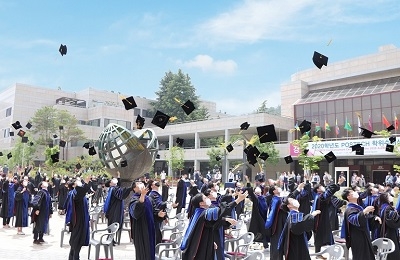
The commencement ceremony for 2020 academic year was held at the POSTECH central square on May 14, 2021. It had been postponed to May due to the spread of COVID-19 and was held as a reduced in-person event to limit the number of attendees to less than 100. The ceremony was streamed live on POSTECH’s YouTube channel. POSTECH conferred a total of 741 degrees in the 2020 academic year, including 316 bachelor's, 193 master’s, and 232 doctoral degrees. But only 81 graduates attended the ceremony including 51 graduates who represented each department and 30 graduates who were selected by lottery. Only a minimum number of officials and staff participated in the ceremony including President Moo Hwan Kim, Dean of Graduate School Kun-Hong Lee, and Vice President of Academic Affairs Gyoo Yeol Jung, making the total number of attendees at 90. In consideration of the COVID-19 regulations and safety of all attendees, the event strictly complied with all COVID-19 prevention regulations. All speeches were replaced with a letter. The commencement ceremony was made special by sending a package to the graduates that includes a letter from President Moo Hwan Kim, the complimentary address of Chairman of POSTECH Foundation Jeong-Woo Choi, and a souvenir. This was to comfort the graduates in having to say their goodbyes to campus through the YouTube live stream, instead of attending the ceremony in person. Through the letter sent to the graduates, President Moo Hwan Kim shared the disappointment in having to hold a limited in-person commencement ceremony. Explaining the meaning of the souvenir pen sent to the graduates with the letter, he encouraged them to “to draw an arc of the moral universe through science, and to make the nation and world more just through the education they have received at POSTECH.”
2021.05.18 1739 -
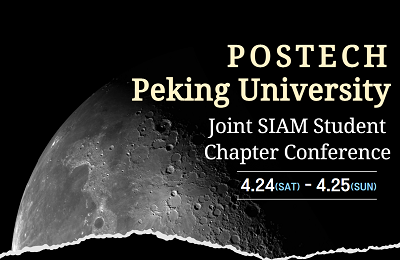
POSTECH and Peking University Hold a Joint SIAM Student Chapter Conference
POSTECH and Peking University will hold a Joint SIAM Student Chapter Conference on April 24. The POSTECH-Peking University Joint SIAM Student Chapter Conference is a joint conference co-hosted by students from POSTECH and Peking University chapters of the American Industrial Applied Mathematics Association (SIAM). The participants will share their research ideas on scientific computing at this conference. In particular, Professor Pars Perdikaris of University of Pennsylvania and Professor Tao Zhou of the Chinese Academy of Sciences are invited as keynote speakers, and they will listen to the students’ research presentations and hold discussions with them. The conference will be held both online and offline (POSTECH Mathematical Science Building, Room 404), and registration is available online at https://forms.gle/ZNaL9aJA8vir3N427.
2021.04.23 1664