News & Updates
-
POSTECH Selected as a Priority Research Institute
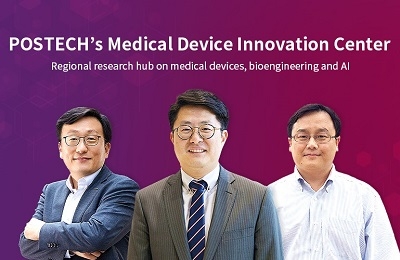
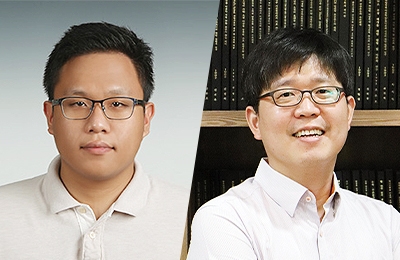
- POSTECH’s Medical Device Innovation Center (MDIC) will receive 700 million won (USD 580,000) per year for a total of 6.3 billion won (USD 5.2 million) over 9 years. - POSTECH to function as a regional research hub on medical devices, bioengineering and artificial intelligence POSTECH has been newly selected to receive funding as part of the 2020 Priority Research Institute Program for Science and Engineering operated by the Ministry of Education. POSTECH’s Medical Device Innovation Center (MDIC), which was selected for the program, focuses on research of medical devices, bioengineering and AI and was registered as an affiliated research center of POSTECH in February this year. With this selection, the Center will receive 700 million won (USD 580,000) annually for nine years for a total of 6.3 billion won (USD 5.2 million). As a recipient of the funding, the Center will mainly carry out research on medical devices for a patient-customized imaging-device-diagnosis-treatment platform and an AI-based biometric data analysis platform. Professor Chulhong Kim will research new-generation photovoltaic imaging system and AI-based diagnosis and prediction service, Professor Hyung Ham Kim will focus on ultra-sound medical device materials and transplantable medical devices, and Professor Sanguk Kim will concentrate on internal simulation platform and AI-based disease diagnosis and treatment forecasting model. The MDIC has appointed Professor Chulhong Kim of the Department of Creative IT Convergence Engineering as the center’s director. Its research team consists of 82 researchers and students with Professor Hyung Ham Kim of the Department of Creative IT Convergence Engineering and Professor Sanguk Kim of the Department of Life Sciences at its center. POSTECH’s MDIC had much success over the years, including publishing 49 papers in 2019, 82 cumulative patent applications and 31 cumulative patent registrations. It strives for accurate diagnosis and treatment for human health and disease eradication. The Center plans to actively cooperate with businesses, universities, research institutes and hospitals in order to implement a ‘labs to hospitals’ system through transferring POSTECH’s latest medical device-healthcare technologies, supporting startups, and managing professional convergent education of medical devices. It is in recognition of this functionality that it was selected as the first research center specializing in medical devices and healthcare. In addition, the Center plans to contribute to the creation of a medical device-bioengineering industrial ecosystem by working with the Pohang Accelerator Laboratory (PAL), the Bio Open Innovation Center (BOIC), and the POSCO Venture Platform.
2020.07.06 1804 -
POSTECH’s AI Graduate School and AI Institute Open Their Doors
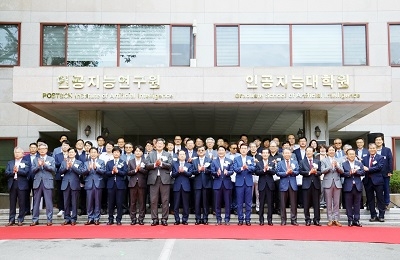
[GSAI kicked off its first semester in March with world-renowned faculty with strong research record] POSTECH held an opening ceremony for its Graduate School of Artificial Intelligence (GSAI) and POSTECH Institute of Artificial Intelligence (PIAI) at 10 a.m. on July 1 at the Auditorium of PIAI (formerly POSTECH Information Research Laboratories). GSAI started its first semester in March this year to foster masters and doctorate-level AI professionals who will lead the future of Korea and play a leading role in the global AI industry. A total of 51 new students were selected for the 2020-2021 academic year through a highly competitive application process in December where the acceptance rate was only 18.5 percent. GSAI boasts the nation’s highest level of expertise in major areas of AI, including computer vision, data mining, database and natural language processing, as well as faculty with abundant experience in related fields. In addition, the School drew attention from the start for catering to even non-engineering students through its outstanding individualized curricula, research capabilities, and industry-academic cooperation. POSTECH plans to expand its AI faculty to 26 members (currently 15) by 2023 to become a leading educational, research and industry-academic collaborative AI institutes in the world and will focus on the three key AI areas – media AI, data AI and AI theory – and nine key convergence (AI+X) research areas including new drugs, energy, manufacturing, robotics and 3D virtual reality research. In addition, POSTECH will create an AI venture ecosystem at the POSCO-Jigok Venture Valley in Pohang and at the PIRL Pangyo R&BD Office to support start-ups. To this end, POSTECH has reopened the POSTECH Information Research Laboratories (PIRL) as the POSTECH Institute of Artificial Intelligence (PIAI) to lead professional development and conduct core technology research. The PIAI has been leading research on AI, big data and IoT and has launched an AI academy since 2016 to operate educational programs to nurture AI and big data experts for companies and for qualified individuals. Along with the opening ceremony, there was an exhibition to showcase POSTECH’s accomplishments in the field of AI over the years. In addition, a job fair was held at the POSCO International Center with participation from POSCO, SK Group, and small to mid-sized companies, startups, and alumni companies of POSTECH. 2nd Vice Minister Seokyoung Jang of the Ministry of Science and ICT said in his congratulatory video, “The opening of the AI graduate school and AI research institute once again confirms POSTECH's commitment to nurturing AI talent. We plan to actively expand support to cultivate the finest AI experts." "POSTECH's goal is to train experts and contribute to Korea's global competitiveness in AI, which is a crucial technology of the 4th Industrial Revolution," said President Moo Hwan Kim in his welcoming remarks. “We ask for your support for POSTECH, the AI graduate school and the institute who now take a bigger step to move our nation forward.” The opening ceremony was attended by POSTECH President Moo Hwan Kim, 2nd Vice Minister Seokyoung Jang of Ministry of Science and ICT, Pohang Mayor Kang-deok Lee, Chairperson Gyeong-sik Jang of Gyeongsangbuk-do Provincial Council, Chairperson Jae Won Seo of Pohang City Council and President Jae-bum Seok of the Institute of Information and Communications Technology Planning & Evaluation (IITP) among many others. POSTECH was selected to operate an AI graduate school in September 2019 as part of an initiative by the Ministry of Science and ICT and opened its doors in March 2020. Starting with 1 billion won (USD 833,000) last year, the school will receive 2 billion won (USD 1.7 million) each year for a total of 9 billion won (USD 7.5 million) over five years. The School is eligible to receive an additional five years of funding through future assessment – for a total of 19 billion won (USD 16 million) over 10 years.
2020.07.03 2351 -
POSTECH and SK to Train ICT and AI Experts Together
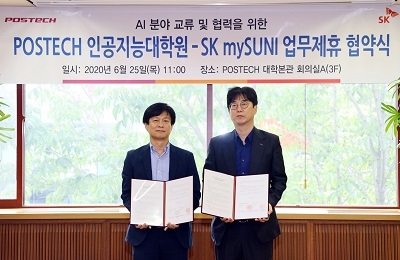
- POSTECH and SK ICT sign an MOU for cooperation in AI/DT areas. - POSTECH to take charge of verification and certification of exams of AI/DT College of SK Group's educational platform MySUNI POSTECH and SK Group will partner together to operate a world-class artificial intelligence (AI) and digital transformation (DT) educational content. POSTECH and SK Group have signed a memorandum of understanding (MOU) on June 25 for the successful advancement in ICT and AI. Under the agreement, POSTECH’s Graduate School of Artificial Intelligence (GSAI) will be put in charge of verifying and certifying the exams of AI/DT College of mySUNI, the in-house educational platform of SK Group. In addition, they will further cooperate to develop and operate the curriculum of advanced educational courses to train AI specialists. The two organizations have agreed to establish a mutual collaborative system in various areas, including training of professional researchers, certification of ICT and AI skills, and research and development of new businesses. "We entered into this MOU to effectively respond to the rapidly changing ICT environment and to secure new and professional technological content," said Hyun Yoon, the vice president of mySUNI AI/DT College. "We are confident that our partnership with POSTECH’s AI graduate school will facilitate ‘deep change’ in SK employees. Youngjoo Seo, the dean of POSTECH’s Graduate School of Artificial Intelligence, stated, "We will cooperate organically with SK with the technical expertise and knowledge of POSTECH who has been a leader in customized AI education and industry-academic cooperation.” He added, “Support for training human resources and continuous joint research in AI will serve as a foundation for SK employees to strengthen their AI/DT capabilities.” MySUNI, which was launched in January this year, currently operates about 640 educational contents in nine areas, including happiness, social value and leadership, in addition to AI and DT. About 8,000 people log on daily to engage in education and popular courses such as "SKMS (SK management system)" and "SV Overview" (understanding the strategic direction of SV pursued by SK) have already been completed by more than 7,000 employees.
2020.06.29 1660 -
POSTECH and Solidware Agree to Conduct Joint Research and Nurture Experts in AI
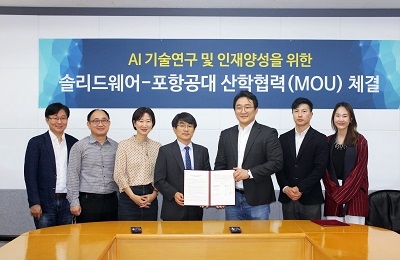
POSTECH and Solidware – a company specializing in AI technology – signed a memorandum of understanding (MOU) to collaborate in AI research and raise AI experts. With the goal to commercialize AI technology, the two organizations will jointly conduct R&D in the following three areas: new technologies, new industries, and new education. The two organizations will engage in developing new technologies that have practical use in the field, including unsupervised learning and time series; new areas such as calculating credit loan limits and developing health insurance products using health care data; and in developing new curriculum to raise AI specialists and data translators to liaise between industries. In light of this, Solidware has donated DAVinCI LABS, an AI-based data analytics system developed by their team, to POSTECH. They are also planning to operate an internship program for nurturing AI experts. DAVinCI LABS is an automated machine learning solution (AutoML) that is loaded with the technical skills and know-how of AI specialists. It has been exported to various countries like Japan, Thailand and Vietnam to be used in industrial sectors. POSTECH Professor Byung-In Kim of the Department of Industrial and Management Engineering emphasized the importance of practical AI research and education, stating, “We look forward to partnering with Solidware in specific areas of AI-X, especially in finance, education, research and commercialization, and in nurturing industrial AI experts at POSTECH.”
2020.06.24 1478 -
Welcome to campus!
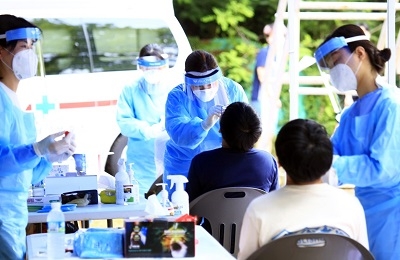
Following the first phase of students entering the dorms on June 13, students taking final exams and the focused supplementary classes have checked into the dorms on the 20th. Like the first round, Students from the Seoul area and some designated regions were tested for COVID-19 and all were confirmed negative.
2020.06.15 1551 -
POSTECH and ECMiner Join Hands in Big Data Development
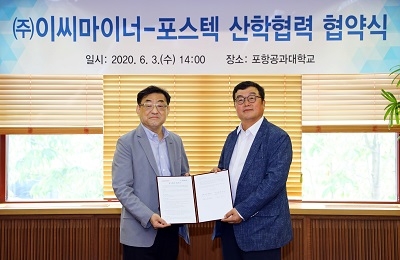
[To provide Korea’s first NEP-certified, data-mining software to POSTECH at no cost] On May 3rd, POSTECH and ECMiner held a signing ceremony at POSTECH’s Administration Building for establishing a collaborative partnership for mutual growth and to stimulate education and R&D in big data. The ceremony was attended by POSTECH President Moo Hwan Kim, Director Young-Joo Suh of POSTECH Institute of Artificial Intelligence, Vice President Hee-Kap Ahn of Academic Information Affairs, Professor In-Beum Lee of Department of Chemical Engineering, Professor Hyeseon Lee of Department of Industrial and Management Engineering, CEO Kwang-Gi Min and Director Sook Choi of ECMiner. As part of the partnership, ECMiner will provide 3 years of ECMiner™, a big data and artificial intelligence solution software, to POSTECH at no cost. The software received a national certification of New Excellent Product (NEP), which is granted to software developed for the first time in Korea using domestic technology. In addition, the two organizations will promote joint research among industry, academia and research institute, collaborate in securing nationally funded projects, exchange technological and academic knowledge, and implement education in big data analysis. ECMiner Co., Ltd. is a startup founded by POSTECH alumnus Kwang-Gi Min in 2000. It has succeeded in domestically developing Korea’s first data mining software and provides consulting services and software to corporations including LG, Samsung, SK and POSCO. ECMiner is recognized for its technological excellence and as a leader in big data and AI analysis.
2020.06.11 1755 -
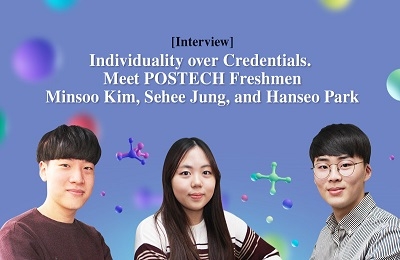
[Interview] Individuality over Credentials. Meet POSTECH Freshmen Minsoo Kim, Sehee Jung, and Hanseo Park
Every year a slew of multitalented POSTECH freshmen who crush the stereotype of ‘nerdy engineering students’ draw much attention. This year is no exception. Many extraordinary students with affinity for inventing, cooking, and sports have arrived at POSTECH. They share a common denominator – their love for science. They are also a group of aspiring young adults who fearlessly pursue their dreams. We spoke with the incoming freshmen of 2020 Minsoo Kim, Sehee Jung, and Hanseo Park. ◆ Dreaming of becoming a warm-hearted robotics engineer Minsoo Kim, who dreams of becoming a robotics engineer, kicked off his college life with more fervor than anyone else even though the campus is off limits and all classes have gone online. He has already joined POSTECH's robotics club POWER-ON. When he was a child, he often took apart broken appliances and unused machines around the house against his mother's wishes. He felt extremely happy when those malfunctioning machines came back to life through his hands. His encounter with robots also came naturally. He attended a regular middle and high school – not a science specialized school – but was obsessed with robots and sought educational programs elsewhere. There were no physics classes offered at his school so he took a class through the Ggumdre Joint Educational Program (educational system joining 31 high schools to offer various classes to students) operated by the Incheon Metropolitan City Office of Education. The commute alone was three hours. Despite the pressures of being a high school senior, he never missed a single class. He humbly replied, “I was excited to take a course in physics experiments, since my school curriculum had left me craving for more. I still have the materials and notes I took from that class.” He added, “I am now taking a physics lab course at POSTECH and I think what I have learned then is helping me.” Park also won prizes at various invention contests. The most memorable was winning the grand prize at the one at his school. His idea was to improve the experience for motorized wheelchair users. He decided this when he saw a wheelchair user having trouble entering through a sliding door. Winning the grand prize allowed him to enter bigger contests and to make the product himself. He got on the wheelchair that he borrowed from the community health center and started writing down the discomforts he felt. He analyzed the aspects that had room for improvement and made the product sawing and using 3D printing at his school’s small shop room. Although it was during the mid-terms, he forgot the passing of time perfecting the product. That special moment that he realized his invention could help those in need eventually led him to POSTECH. He continued, “POSTECH has plenty of educational programs that truly care about nurturing young students and that made me want to attend. My decision became clearer after participating in the Explore POSTECH STEM program in high school. He added, “I have big interests in mechanical engineering, but I think it’s a process to find an area that I really love. I want to choose my career path by exploring various subjects and become an indispensable person in that field.” Also, “It’s true that I had a preconception about POSTECH because many of my classmates hail from science academies or schools for the gifted. But we are all students who love science in the end. I believe all of us will gain opportunities when we do our best in our respective places. Let’s do it together!” Kim is a well-rounded student who excels not only in his studies but also in others like cooking and bowling. He believes that studying and researching are a battle of the physical, and relieves his stress by doing what he likes and has built up endurance to withstand exhaustion. He has not taken a step towards his dream of becoming a robotics engineer. ◆ Scientist who wants to so many things? That’s fine, this is POSTECH! Experiment-obsessed Sehee Jung, who stays up all night when immersed in experiments, dreamt of becoming a scientist while conducting experiments on new and renewable energy. At her parents’ recommendation, she attended the education center for the gifted operated by the office of education during her elementary school years, and encountered scientific experiments for the first time there. She was completely drawn to it as time went by and it became the reason for attending the faraway Daejeon Science High School, leaving her hometown of Ilsan, Gyeonggi Province. Life in Daejeon fueled her love for experiments even more. She was the first to raise her hand when there was project involving experiments. Going back and forth between the laboratory and her dormitory was a pleasure, not a chore. She did not neglect her other school or extracurricular activities either. She was an overachiever who took on roles as club president and officer of her student body. We can get a glimpse into her huge enthusiasm for research from her club activities – she joined and participated in six to be exact. Her favorite among them was the chemical experiments club. She confesses, “It was really interesting to decide on a weekly theme and conduct experiments while discussing about it.” She also participated in plenty of extracurricular activities, such as operating a booth at an educational expo where her peers could conduct experiments. What made her fall in love with experiments? “I got inspired by the graduate students whom I participated in a project with.” She had a great opportunity to participate in a research with graduate students from Korea Advanced Institute of Science and Technology (KAIST) at an academic conference organized by the Center for Women in Science, Engineering and Technology (WISET) and the Korean Institute of Chemical Engineers. The experiment involved the electricity conversion of carbon dioxide and the research on the transformation of copper surface as a catalyst for energy production and carbon fixation. By conducting weekly experiments, she experienced a research institute of the highest caliber which opened her eyes to the joy of using advanced devices in a high quality research facility. Jung says there are still so many researches she wants delve into. To her, POSTECH’s undeclared major curriculum was incredibly attractive. POSTECH implemented this system to help freshmen enjoy a whole year of flexibility, exploration, and challenge in their self-driven academic pursuit without being tied to a major. She says, “The interest in POSTECH grew once I heard the detailed explanation from the admissions officer about the educational environment, the class programs and the facilities. My seniors who had chosen POSTECH sincerely recommended it to me as well.” She continues, “I have extensive interests in new materials and chemical engineering, so I started collecting data on what the researchers were investigating at POSTECH and found them be extremely interesting. I’m very excited and look forward to studying what I want to study here.” Remote learning is making it difficult to conduct experiments but she has set up a ‘tiny laboratory’ at home with the materials the school has sent. She says, “I am taking a lab course on new materials and the school sent me some tools. I’m having fun doing experiments and writing reports at home. It’s an online class but we experiment while communicating in real-time and it’s quite fun.” When the campus returns to normal, Jung looks forward to short-term study abroad programs and club activities. She comments, “When I was in high school, I took a course on new materials and read various research papers published. I think new materials can be used not only in the industrial sector but also in the medical field.” She adds that she decided to take on diverse disciplines, not just one area, in line with the meaning of Mueunjae, which means that there are no boundaries in learning. ◆ Patent flex! Future inventor of Korea’s first self-driving car Hanseo Park, a graduate of Sejong Science High School, was a boy with huge interest in inventions. Upon seeing life’s little inconveniences, he found himself unconsciously thinking, ‘How can I fix those problems?’ Naturally, he was exposed to and intrigued by science and technology. In particular, the self-driving car he happened to ride as a high school freshman was a thrilling and refreshing experience. “I want to make cars not just as a means of transportation but also as a second home where people can rest,” his eyes glisten. Along with autonomous driving technology related to future cars, he wants to research technologies that can ensure safe and comfortable living for people. He also has dreams to launch a startup related to those technologies. Park goes by the nickname ‘High School Inventor.’ He has consistently participated in various contests such as invention fairs, mock startup competitions, convergence science and creativity competitions, research project contest, and Samsung Humantech Paper Award. He has also applied for three patents and has won at a thesis competition. The most memorable competition was the convergence science and creativity competition that he entered in his second year of high school. He begged his friends to enter the competition together after seeing its topic: Improving the ventilation, temperature, and humidity control of underground auditorium. He visited the auditorium over 10 times a day and collected data including the location of the air conditioners and ventilators. He wanted to solve the problem using the Venturi effect that he had learned in his physics class. To explain his conception easily, he made a parody on the Korean TV show Unanswered Questions. This allowed him to pin down his dream of becoming an engineer who fixes inconveniences and helps people to better understand. His other nickname is ‘Soccer Nut.’ He likes soccer so much to have considered becoming a professional player when he was younger. He played at sporting events organized by the union of science high schools. Due to his outstanding performance, Sejong Science High School made history by advancing to the finals for the first time in 10 years since its founding. It was no laughing matter when his parents momentarily worried about his admission to POSTECH after he ran out to check the school’s soccer field, the night before his admissions interview. He answers, “I used to play soccer during my lunch or free time to relieve stress and get closer to my friends.” He expresses his love for soccer and added, “I was able to strengthen my body and mind through soccer. As I became more confident, my grades improved also. Soccer is life.” When time came to choose which college to attend, he chose POSTECH where he could try everything he wanted from sports, inventing and launching a startup. He explained specific reasons for choosing POSTECH, “The elite educational system for a small selection of students and that even freshmen can participate in research projects to enrich their research experience. But above all, the startup incubating programs caught my eye the most.” Park is disappointed that COVID-19 took away the campus life he so long waited for. When everything returns to normal, he wants to tackle a short-term study abroad program. “I would like to broaden my horizons by taking classes and traveling with friends from all over the world,” he speaks of his plans to study in Spain. It doesn't hurt that Spain, of course, excels in soccer.
2020.06.05 1967 -
POSTECH Computer Science and AI School Professors Partake in Microsoft’s Joint Research Project
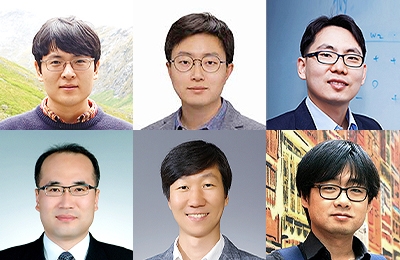
Professors from the Department of Computer Science and Engineering and the Graduate School of Artificial Intelligence (GSAI) at POSTECH have been selected to participate in a collaborative research project with Microsoft Research Asia (MSRA). MSRA is a research institute of the highest caliber and boasts the world’s finest capabilities in AI. The project is part of the global corporation collaborative project of 2020 Fostering Global Talent initiative of Korea’s Ministry of Science and ICT. A total of 12 projects have been selected from the creative proposals corresponding to the research topic set by MSRA. A total of six POSTECH professors are participating in the project. They are: Prof. Seungyong Lee, Hwanjo Yu, Minsu Cho, Suha Kwak, Sunghyun Cho and Jaesik Park. The research topics of the six professors are as follows: Prof. Seungyong Lee’s construction and application of 3D caricature dataset, Prof. Hwanjo Yu’s recommender system with item-interest sustainability, Prof. Minsu Cho and Prof. Suha Kwak’s comprehensive and accurate action recognition via multi-task learning in video, and Prof. Sunghyun Cho and Prof. Jaesik Park’s transparent generative models for 3D world generation. Through this project, some students of the department and GSAI will have the opportunity to conduct joint research at MSRA. Selected as researchers, the students will be sent to MSRA at a later time due to the current COVID-19 situation. They are set to research for 6 months under the guidance of leading AI experts of MSRA to produce results and build a global network of collaboration.
2020.06.04 1854 -
POSTECH and Lablup Inc. Join Hands for Collaborative Research
[Expansion in research partnership in areas of artificial intelligence (AI) and high performance computing (HPC)] POSTECH and Lablup Inc. have joined hands for an active exchange and close collaboration in AI research. The two institutions recently signed a memorandum of understanding (MOU) to expand their academic-industrial collaboration in the areas of AI and HPC and to strengthen their industrial competitiveness. The MOU outlines the overall cooperation between the two organizations in using the AI platform developed by Lablup – Backend.AI – and strengthening the cooperative framework for joint research and internship for the research development and innovation in AI platforms and cloud technology. To succeed in education and research of AI and HPC, large scale computing capabilities and administrative tools are vital. In addition, considerable amount of personnel and materials are needed to build a customized software-developing environment for each researcher. In light of this, the two organizations are planning to support POSTECH researchers in their research of data and computational science, such as AI and HPC, by utilizing Lablup's AI platform and its vast cloud computing resources. Lablup Inc. is a startup founded by POSTECH alumnus Jeongkyu Shin that developed an AI platform called Backened.AI and provides services through it. Recognized for its high technological expertise in AI and HPC platforms and cloud solutions, Lablup won the Minister's Award (Minister of Science and ICT) at the 2019 K-ICT Korea Internet Awards.
2020.06.01 1488 -
POSTECH Doctoral Student Inki Kim Awarded the SPIE Scholarship
Inki Kim, a doctoral student in mechanical engineering at POSTECH has been awarded the 2020 Optics and Photonics Education Scholarship from the Society of Photo-Optical Instrumentation Engineers (SPIE), the largest academic society in the field of optical engineering. This SPIE scholarship, awarded to students who are expected to contribute significantly to the future of optical engineering, was awarded to a total of 78 students from all over the world this year. Kim was one of the two recipients selected in Korea – an unprecedented event – and amongst the seven in Asia. Kim has been specializing in various researches on metasurface, widely known as the ‘invisible cloak’ technology. This research has attracted much attention because it also leads to future technologies such as augmented and virtual reality technologies and 3D hologram display. This scholarship is known to be rarely awarded to non-US countries and Gwanho Yoon in mechanical engineering at POSTECH received it last year. Advisor to both Kim and Yoon, Professor Junsuk Roh commented, “It's very encouraging that Korean students have received this scholarship from the world's largest organization for optics and photonics. I sincerely hope the researches of many promising students will gain continuous attention and produce good results.”
2020.05.25 1496