News & Updates
-
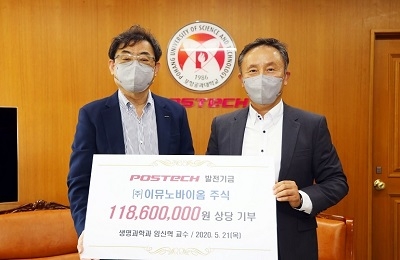
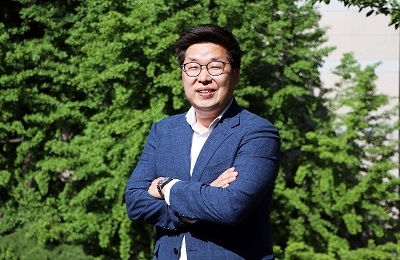
Professor Sin-Hyeog Im Donates 100 Million Won Worth of Stocks to POSTECH
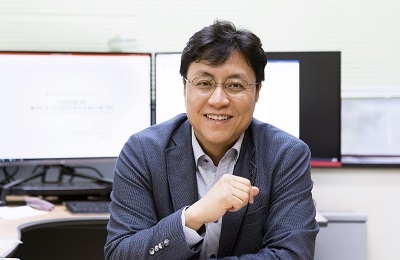
On May 21, 2020, Professor Sin-Hyeog Im of POSTECH’s Department of Life Sciences donated 100 million won (USD 81,000) worth of ImmunoBiome, Inc. stocks to POSTECH. The funds will be used for POSTECH’s life sciences and the bioscience & biotechnology departments to establish education and research infrastructure to nurture future leaders equipped with outstanding abilities to think across academic boundaries. ImmunoBiome Inc. is a lab-based start-up founded in June 2019 at POSTECH, utilizing the technologies that the University possessed. It aims to redesign the immunity using microbiome and to develop drugs to treat incurable diseases. Despite its young age, the company has built up a reputation for its extraordinary technical expertise and garnered much attention from the industry as the ‘second generation microbiome company.’
2020.05.22 1762 -
Professor Namyoon Lee Named Associate Editor of IEEE TWC
Professor Namyoon Lee of the Department of Electrical Engineering at POSTECH has been appointed as associate editor of IEEE Transactions on Wireless Communications (TWC), a journal published by IEEE – the most influential association in electrical engineering. Prof. Lee received his Ph.D. degree in electrical and computer engineering at University of Texas at Austin. After graduation, he worked as a researcher at the Nokia Research Center at Berkeley and Intel Labs in Santa Clara, CA. He has been a faculty member at POSTECH since 2016. Prof. Lee, who is gaining much attention on the subject of wireless communication theory and statistical digital signal processing, has made remarkable accomplishments such as producing 20 U.S. patents in relevant fields. Recognized for his potential, he received the IEEE ComSoc Asia-Pacific Outstanding Young Researcher Award in 2016. Prof. Lee has been serving as an associate editor for the IEEE Communications Letters on the subject of machine learning since 2019. He is currently a guest editor for the Journal of Communications Networks (Special Issue on Advances and Applications of Artificial Intelligence and Machine Learning for Wireless Communications) and also leads a team of review editors as an associate editor for the journal Frontiers in Communications and Networks in the area of communication theory. The IEEE TWC is a journal in the top 7% of influence across all fields of electronic and electrical engineering, and a first-class technical paper journal in the field of wireless communications.
2020.05.20 1866 -
POSTECH is a Powerhouse in Vision AI
- Prof. Seungyong Lee and Prof. Sunghyun Cho make the list of top 100 scholars in computer graphics - Prof. Minsu Cho and Prof. Jaesik Park selected as area chairs for CVPR 2020 - Prof. Minsu Cho and Suha Kwak selected as IJCV’s associate editors As the world engages in the war for talent to research and develop the new AI technologies essential for the fourth industrial revolution, POSTECH professors in the Department of Computer Science and Engineering are receiving the limelight in the areas of computer graphics and computer vision. AMiner, a social network search service targeting researchers in the AI field, has selected Prof. Seungyong Lee and Prof. Sunghyun Cho as the top 100 scholars in computer graphics on the AI 2000 Most Influential Scholars Annual List. AMiner is an online scientific search and mining system developed by Tsinghua University in China. The institute determined the most influential 200 scholars and 1,800 influential researchers in the AI field using the Tsinghua AMiner academic data, which indexes more than 133 million expert profiles and 270 million publications. Prof. Lee and Prof. Cho are the only Korean scholars selected in the computer graphics field. They ranked 54th and 68th on the list respectively. Meanwhile, Prof. Minsu Cho and Prof. Jaesik Park have been appointed as area chairs for Computer Vision and Pattern Recognition 2020 (CVPR 20200), which is a top academic conference in the computer vision field. CVPR is the most influential international conference on computer science and AI that draws over 10,000 researchers every June. Prof. Cho and Prof. Park were appointed as area chairs of CVPR, recognized for their outstanding research achievements and networks. They will review the suitability of papers submitted to CVPR 2020 and write final reports to suggest either to accept or reject each paper. Moreover, Prof. Cho along with Prof. Suha Kwak were recently elected as associate editors of the International Journal of Computer Vision (IJCV). The journal has been published by Springer since 1987 and is currently the most respected journal in the field of computer vision.
2020.05.17 2219 -
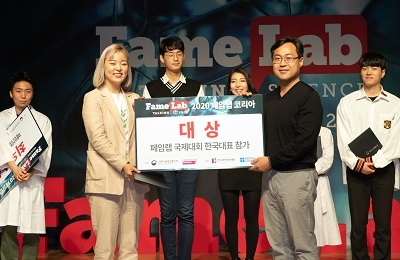
Gayun Bu Wins Grand Prize at FameLab Korea 2020
Ms. Gayun Bu of the Department of Physics MS/PhD integrated program at POSTECH was the grand prize winner at the FameLab Korea 2020, organized by KOFAC (Korea Foundation for the Advancement of Science & Creativity) and the British Council in Korea. Ms. Bu, also the winner of ‘Introducing My Research 2018’ hosted by POSTECH, received praise from judges for explaining complicated concepts of physics and biology in an easy-to-understand manner for the public on the subject of 'Optical Tweezers for Small Things'. Along with the Minister of Science and ICT prize, she has also won the chance to participate in the FameLab International Final 2020 as a Korean representative in the latter half of this year. Meanwhile, all aspects of this year's FameLab Korea was held entirely online from preliminaries to the final rounds. The event was a big success in that more than 6,000 people tuned in to watch the final rounds live-streamed on NAVER TV.
2020.05.15 1717 -
Coping with COVID-19 at POSTECH - Online Lectures
Online and On Air: Our Wise Online Life We have already passed the halfway point since the semester began online due to the ubiquitous onset of COVID-19. The spread has cooled at POSTECH, but remote learning has been extended for the entirety of spring semester to keep social distancing and ensure the absolute safety of all members. According to the survey conducted by the POSTECH Undergraduate Student Association, the students’ satisfaction rate of the online lectures stands at 67.1% (POSTECHx). After an awkward and trying period for both professors and students, the online instruction has become a daily routine at POSTECH. We peek inside the online classrooms of three professors. #You have entered the classroom of life sciences professor Sanguk Kim. Lively lectures, more dynamic than the classroom Like most lectures, Prof. Kim also uses recorded videos and real-time instruction using Zoom – a way of teaching called ‘blended learning.’ He is not shy on camera as he has conducted numerous lectures pre-recorded on platforms like K-MOOC and POSTECHx. However, he misses the organic interaction with his students in the physical classroom, which helps to adjust the pace of his teaching or choose the right examples. So, he opts for more energy. In recording his lectures, he prepares over-the-top gestures and more vibrant images. He adds speed to sustain the students’ concentration. What is missed in the recorded lectures, he supplements in real-time classes. Students are kept on their toes during his Zoom sessions because he will give pop quizzes and answer live chat questions. Students cannot black out their screens or even wear pajama pants - You never know when he might ask, “Shall we stand up now?” Prof. Kim says, “Some point out that the recorded lectures are generally boring. So to appear normal in videos, the speaker needs to exaggerate their actions much more than in classrooms. I can be even more theatrical to enable our students to engage and understand the material from the other side of the screen,” he laughs. And to the anxious students and worried parents who are doubtful if at-home online lectures would suffice, "We are doing well. So no need to worry too much.” #You have entered the classroom of mathematics professor Jeehoon Park. “When he called my name, I became a flower.” Freely but kindly Prof. Park’s class is conducted in a free and open atmosphere. He does not take attendance. You can turn off your screen or upload a profile picture. Even dozing off or slacking off may not be ‘caught’ since there are no rules against doing them. It is completely up to the students. Prof. Park explains, “I essentially believe in my students. Otherwise I think that online instruction itself is impossible. A class is a mutual interaction between students and professors, and amongst the students in a shared space; and the online space is indeed limiting. To overcome that limitation, it’s very important to build a strong bond and trust between the instructor and the students. Prof. Park calls the names of the students to build camaraderie. He also holds his office hour 30 minutes prior to class to field questions from students on previous lectures or assignments and catches up on life. More questions are posed during class than average - Prof. Park tends to ask more. Though conducted online, his class is special in that he does not just lecture the students but rather exchanges questions like a talk show. On top of that, he gives detailed assignments to students and invests time to record videos on problem analysis. In particular, the Department of Mathematics has created its own Zoom account in case the online instruction period prolongs. They also opened Hilbert Space, named after the German mathematician David Hilbert. It is a place where professors, teaching assistants, and students of the department are free to ask questions and give answers at any time. He urges his students, “Remote learning does not excuse you from wearing whatever or behaving carelessly. I also cannot force grown adults to act in a certain way. However, focusing and actively engaging in the lecture with good attitude can be your asset to win in the long-run.” #You have entered the classroom of computer science and engineering professor Hee-Kap Ahn. “We are stronger than we know” Preparing for the post-COVID-19 era Prof. Ahn presents his lectures in English. That is why he has to allot extra attention to record them. He shoots and edits the videos over and over to enhance his delivery and even in anticipation of the students’ response. He supplements what is missed in the recorded lectures during the live Zoom sessions. He tries to catch even the slightest changes in his students’ faces on the small screen. As more than 110 students attend the class, more time is spent checking their assignments and answering questions. Prof. Ahn, however, meticulously answers every question even if it takes time because he wants to engage more actively with his students. Prof. Ahn commented, “At first, the students and I were both caught off guard by this unusual situation. But once we started, we are faring better than expected. All professors share the same goal to provide quality lectures and to properly teach the students – the methods are just different. I am thankful and proud of my students for keeping up,” he says encouragingly. POSTECH starts its semester two weeks before other schools. Unfortunately, the first confirmed case of COVID-19 in Daegu fell on the first day of classes at POSTECH, on February 18th. POSTECH immediately delayed the start of the semester and held the freshmen orientation online. Then it began to discuss about online learning in case COVID-19 would persist. After twice postponing the start of the semester, all classes began online on March 16th. The future was upon us. Prof. Ahn, in charge of the technical support for POSTECH’s entire online instruction, says, “I think that the classroom of the future has perhaps arrived a few years early due to COVID-19. But professors and students alike are adjusting well. Some technical issues linger but classes are operating smoothly without a hitch, even in this unprecedented situation of conducting all classes remotely. I can sense POSTECH’s hidden potential and seasoned expertise.” Now, POSTECH is taking a step forward and preparing for the post COVID-19 world. Discussions have already begun on how to utilize the online lectures as an auxiliary tool, and which systems or infrastructures to construct in order to usher in a better tomorrow.
2020.05.14 1885 -
POSTECH and HKUST Agree to Offer a Dual Degree Doctoral Program
[Exchange in areas of software, AI, and smart cities anticipated] POSTECH and the Hong Kong University of Science and Technology (HKUST) have agreed to initiate a dual degree doctoral program. On April 28, 2020, POSTECH and HKUST signed an agreement after reaching a consensus on initiating a dual degree Ph.D. program between their engineering schools. Through this partnership, students under the program are expected to spend part of their time resident at each institution, and the two schools will designate co-advisors for the supervision of students and award dual Ph.D. degrees to those who fulfill the requirements of both institutions. The two schools will cooperate to nurture talented individuals and expand the exchange of personnel. Professor Tim Cheng, the dean of engineering at HKUST said, “We are pleased to strengthen the cooperative ties established between the two institutions. Blending the experience and expertise of the faculty from two leading institutions in the Asia Pacific region, the dual degree PhD program provides a competitive edge for students to conduct research at the forefront and in an international context. We trust that our students will benefit from this exciting and diversified learning experience through a joint venture in PhD education.” Professor Sung H. Han, the dean of engineering at POSTECH remarked, “This dual degree agreement strengthens the existing partnership between our universities.” He added, “In particular, we look forward to research findings on a global scale derived through the active exchange of convergence research in areas such as artificial intelligence and smart cities.” Established in 1991, the Hong Kong University of Science and Technology is a prestigious, research-oriented public university in Hong Kong specializing in science and technology. The school ranked 47th (third in Asia) on the world university rankings by the Times Higher Education and 32nd (seventh in Asia) by QS in 2020. POSTECH has maintained a student exchange program with HKUST since 2011.
2020.04.29 2733 -
Silicon Mitus CEO Youm Huh Donates 100 Million Won to POSTECH
Mr. Youm Huh, the CEO of Silicon Mitus and the recipient of the 2020 POSCO TJ Park Awards, donated 100 million won (USD 81,500) of the prize money to POSTECH. Silicon Mitus had successfully developed Korea’s first-ever power management integrated circuit (PMIC), an essential semiconductor used in the next-generation smartphones and displays. POSTECH officially announced the receipt of the donation on April 20, 2020. The fund will be used for the core projects that POSTECH strategically operates. Huh won the 2020 POSCO TJ Park Award in technology in recognition as Korea’s top semiconductor expert and for developing the PMIC – an indispensable semiconductor for supplying power in smart devices – for the first time in Korea. Huh, also serving as a member of POSTECH Foundation’s board of trustees, said, “I donated to POSTECH’s development fund to encourage the school to cultivate future global leaders and to grow into a leading university in science and technology.” He additionally donated 100 million won to his alma mater, the College of Engineering at Seoul National University, thus donating the entire prize amount to strengthen the competitiveness in the science and technology sector and to nurture future experts in natural sciences and engineering fields. The TJ Park Awards was established by the POSCO TJ Park Foundation in 2006 to contribute to the national growth by spreading public interest and participation in POSCO’s founding philosophy of creativity, nurturing talent, sacrifice, and philanthropy. The awards are given in four areas of science, education, service, and technology.
2020.04.21 1714 -
Sungmin Cho to Receive an Honorable Mention at IEEE APS/URSI 2020
Sungmin Cho of the Department of Electrical Engineering at POSTECH will receive an honorable mention award at the IEEE International Symposium on Antennas and Propagation and USNC-URSI Radio Science Meeting (IEEE APS/URSI 2020). Cho will receive the award for his paper titled ‘Ultra-low Power Beamforming Wideband OFDM Signal with Active GRIN Lens at 19 GHz.’ The paper proposes an active lens-based beamforming system as an alternative to the power consumption problem which is a stumbling block in implementing beamforming – a millimeter wave 5G core technology. Cho demonstrated this by successfully steering the actual 5G-NR signal at ±40° with power consumption of about 1/2000 times less than the existing technology. It earned attention especially for its low complexity and ultra-low power operations. The IEEE AP-S/URSI 2020 symposium will be held from July 5 to 10 in Montréal, Quebec, Canada. The technical sessions, workshops, and courses with specific themes will be held along with the award ceremony. A total of 203 papers have been submitted to the student paper competition.
2020.04.16 1641 -
Cheer Up! Department of Chemical Engineering’s ‘Cherry Blossom Lunch Day’
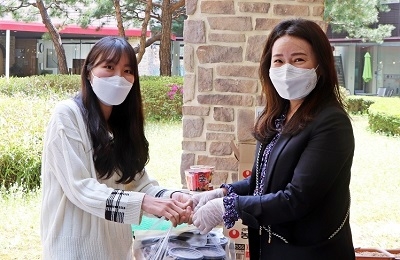
[A sensible way to cope with COVID-19 by the Department of Chemical Engineering] It is getting harder to have close contacts with others due to social distancing in light of the global COVID-19 outbreak. The campus of POSTECH also has been transformed due to various social distancing campaigns such as conducting all classes online. In particular, we find the most changes in the way we eat our meals such as lining-up while keeping a 2-meter distance and facing one direction while eating at cafeterias. Amidst these changes, the Department of Chemical Engineering held a ‘Cherry Blossom Lunch Day’ for its members, including graduate students and researchers who devote themselves to research under these challenging circumstances, the cleaning crew and others. 298 lunch boxes with instant cup noodles and fruits were delivered with active support from the department’s professors. Jihun Choi of the MS-PhD Integrated program said, “I spend most of my time in the laboratory so the lunch time is my only enjoyment of the day. That’s why I was so frustrated that I could not enjoy it due to the COVID-19 situation. However, I am thankful to my department for preparing these delicious lunch boxes - I think I can focus more on my studies.” He added, “I am moved by this gesture even though I cannot sit across from my colleagues or share with them. Beside this event, the department is also planning various events to revitalize the campus life such as sending text messages to cheer up the students who are taking online-courses at home as well as to the parents, distributing newsletters that include news from the department and stunning scenery of the campus, and holding a student-life photography contest. The department’s director Beomjin Cho encouraged everyone and said, “We should be understanding and considerate to each other in these difficult times in the ‘spirit of together’ until we return to normal.”
2020.04.08 1702 -
Professor Seungmoon Choi Selected as Associate Editor-in-Chief of an International Journal
Professor Seungmoon Choi of the Department of Computer Engineering has been appointed the associate editor-in-chief of the IEEE Transactions on Haptics, the most influential international journal on haptics. Professor Choi has served as an editor of the journal for four years since 2010, as a general chair of the 2014 and 2016 IEEE Haptics Symposium, and as a program chair for the 2015 IEEE World Haptics Conference. In his role as the associate editor-in-chief, Professor Choi will assume duties such as categorizing submitted papers, selecting judges and approving publications of papers and more. His term is four years until March 2024. Professor Choi, who is making great strides in the next-generation virtual reality technology, has received his bachelor’s degree and master’s degree from Seoul National University and Purdue University respectively. He joined the faculty of POSTECH in 2005. He is gaining attention in his research that mimics human senses such as sight, hearing and touch, and was the recipient of the Early Career Award from the IEEE Technical Committee on Haptics in 2011. In 2014, Professor Choi published a paper in the IEEE Transactions on Haptics that premiered the concept of applying the degree of consonance to the haptic stimuli felt through the fingertips that attracted the attention of academic circles. To date, he is one of the most prolifically published researchers in this journal.
2020.03.17 1674