News & Updates
-
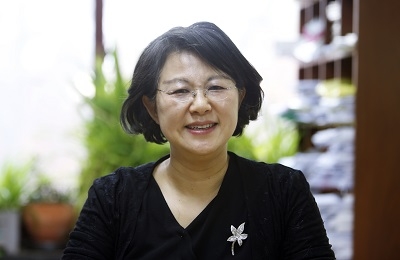
Professor YoungJu Choie Publishes Authoritative Books on Mathematics
POSTECH Professor of Mathematics YoungJu Choie recently published two books on mathematics in cooperation with a world-renowned publishing powerhouse. Professor YoungJu Choie founded and developed the theories on periodic function of automorphic forms and presented it in the Memoirs of the American Mathematical Society, the leading academic journal on mathematics, in 2018. This has led to great advances in understanding and presenting a new direction for L-function research, known as the biggest challenge in number theory. The theory is now utilized in information security, telecommunications, and advanced cryptography. This paper, which was recently released online, is being published as a book and is garnering substantial attention from academic circles. In addition, Professor Choie has newly published two books for graduate students and researchers who study mathematical theories. They are: Jacobi-Like Forms, Pseudodifferential Operators, and Quasimodular Forms and Codes and Modular Forms: A Dictionary. The two books explain the application of theory of automorphic forms in an easy-to-understand manner. Jacobi-Like Forms, Pseudodifferential Operators, and Quasimodular Forms is the first book to systematically show that research methods used in mathematical physics and partial differential equations can be used to understand arithmetic problems. It is explained in a way that mathematicians, physicists, and even non-experts can understand it. The book extensively covers how mathematics occurs in various domains and how it has become of interest to people. It was published in collaboration with the Korean-American mathematician, Professor Min Ho Lee, and published by the global publishing house, Springer Monographs in Mathematics. Codes and Modular Forms is a book that explains the relationship between the errors that can occur when messages are exchanged through telecommunication and the theory of automorphic forms, that when combined, can generate efficient error correction codes. It is a dictionary-like book for graduate students and beginner researchers. It explores the interaction between the pure number theory developed from ancient times and the core telecommunication theory of the 21st century. It presents the theory of error correction code developed after 1990, and the latest theories that explore the link between various types of codes and the codes that Professor Choie has actively researched. Professor YoungJu Choie is a graduate of Ewha Womans University and completed her Ph.D. at Temple University in the U.S. Since 1990, she has been a faculty member of POSTECH’s Department of Mathematics. As one of the leading scholars of number theory, Professor Choie served as the editor-in-chief of the Korean Journal of Mathematical Society and received the Female Scientist of the Year Award in 2005 from the Ministry of Science and ICT. In 2013, Professor Choie was selected as a fellow of the American Mathematical Society. She currently serves as a member of the Presidential Advisory Council on Science and Technology.
2020.01.15 1702 -
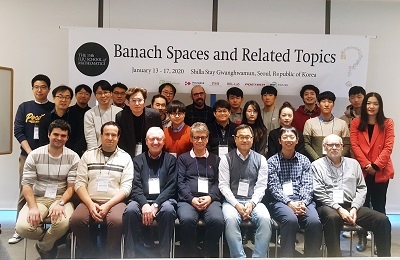
POSTECH Hosts the ILJU School of Mathematics
[From January 13th to 17th at Shilla Stay Gwanghwamun] POSTECH’s Pohang Institute of Mathematics (PMI) hosts the 15th ILJU School of Mathematics at Shilla Stay Gwanghwamun in Seoul from January 13 – 17. Supported by the ILJU Academy and Culture Foundation and PMI, the week-long program explores the theme of 'Banach Spaces and Related Topics' with internationally renowned experts. It will be held in an open school format where students freely discuss everything from fundamentals to core research methods of cutting-edge research projects. The program is open to both Korean and international undergraduate and graduate students, postdoctoral researchers and professors as well as the general public. Guest speakers include Professor Zvavitch of Kent State University and Professor Zheng of University of Memphis in U.S., Professor Lindström of Abo Akademi University in Finland, and Professor García of University of Valencia in Spain. The host of the conference, Professor Yun Sung Choi of PMI, stated, “We will study and discuss the latest major research topics of functional analysis in depth, which will naturally lead to exchanges between researchers during this week.” He added, “We hope that promoting research exchange between world scholars will help the next generation of research groups to reach world-class level.”
2020.01.15 1689 -
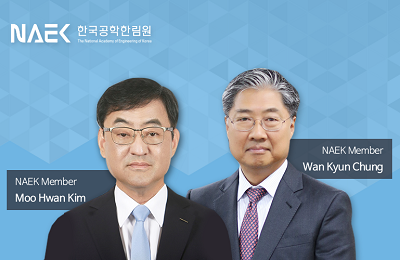
Five Faculty Members Inducted into the National Academy of Engineering of Korea
Five POSTECH professors, including President Moo Hwan Kim, have been appointed as members and associate members in the National Academy of Engineering of Korea, the nation's premier academic institute in engineering. President Moo Hwan Kim, chosen as a member in the Materials and Energy Division, was recognized for his work on developing various measurement techniques and experimental devices in his research on two-phase heat transfer, a key mechanism in the nuclear industry. In the Mechanical Engineering Division, Professor Wan Kyun Chung was acknowledged for leading the development of the intelligent robot technology for diagnostic tests utilizing biotechnology. Additionally, Professor Sei Kwang Hahn of Materials Science and Engineering, Professor Seongjin Park of Mechanical Engineering, and Professor Ki Jung Yong of Chemical Engineering (in alphabetical order) were designated as new associate members for 2020. The National Academy of Engineering of Korea is the nation's most prestigious academic institute in engineering. In addition to academic achievements, it evaluates candidates’ accomplishments across a range of areas, such as development of original technology, patents, and human resource development, then selects new members by written ballot of all academy members. A total of 45 members and 68 associate members were selected for 2020.
2020.01.07 1594 -
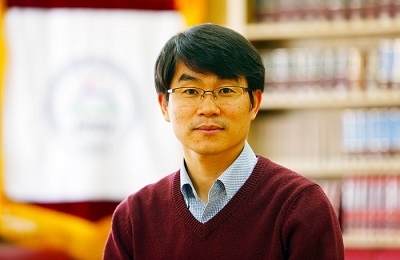
Professor Byung-In Kim Selected as an APIEMS Fellow
[POSTECH Professor Byung-In Kim Named a Fellow of the Asia-Pacific Industrial Engineering and Management Systems] Professor Byung-In Kim of POSTECH’s Department of Industrial and Management Engineering was selected as an APIEMS fellow. APIEMS, one of the prestigious academic organizations in industrial engineering and management science, selects its fellows among scholars who have contributed to academia through a rigorous screening process every year. Only one scholar – Professor Kim – was chosen this year as a fellow. An authority in logistics optimization, Professor Kim received his Ph.D. from the Rensselaer Polytechnic Institute, then joined the POSTECH faculty in 2005 after teaching at the Memphis State University. Professor Kim develops and applies optimization techniques such as mathematical programming and metaheuristics to solve various real-world problems, and was the recipient of 2018 POSCO Smart Innovation Award. He is the third professor from his department to be named an APIEMS fellow, preceded by professors Chi-Hyuck Jun and Kwang-Jae Kim, now making POSTECH a university with the most number of APIEMS fellows in Korea.
2019.12.22 1761 -
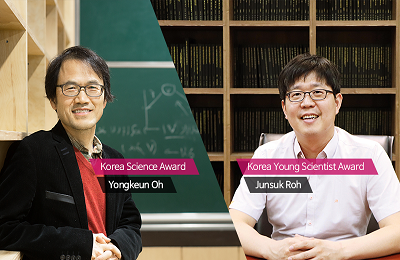
Professor Yong-Geun Oh Receives the Korea Science Award and Professor Junsuk Roh Receives the Korea Young Scientist Award
[Korea's Ministry of Science and ICT honors ‘Scientists of the Year’] POSTECH professors Yong-Geun Oh and Junsuk Roh won prestigious awards at the 2019 Korea Science Awards, jointly hosted by the Ministry of Science and ICT of Korea, National Research Foundation, Korean Academy of Science and Technology, and Center for Women in Science, Engineering and Technology. The Korea Science Award is presented to those scientists who accomplished outstanding world-class achievements in research by identifying fundamental principles in natural science. Professor Yongkeun Oh of Department of Mathematics (Director of IBS Center for Geometry and Physics) received the award for his research on mirror symmetry, widely applied in theoretical physics. In addition, Professor Junsuk Roh was selected as the winner of the Korea Young Scientist Award, given to outstanding scientists under 40, who has made renowned research achievement and significant contribution to the development of science and technology. The award was given to a total of 17 scientists including two Korea Scientist Awards, four Korea Young Scientist Awards and three Women Scientists of the year.
2019.12.13 1785 -
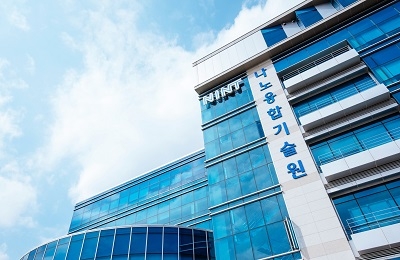
POSTECH’s National Institute for Nanomaterials Technology designated as a National Research Facility for Materials, Parts and Equipment
[Testbed for commercialization of the next generation semiconductors and displays] POSTECH’s National Institute for Nanomaterials Technology (NINT) was selected as a semiconductor support facility for core materials, parts, and equipment among Korea’s national research facilities by the Ministry of Science and ICT. Designated in October 2019, NINT received the certificate of designation from Minister Ki Young Choi on December 11th. It is expected to play a pivotal role as a highway between R&D and commercialization in material, parts, and equipment industries. NINT specializes in next-generation semiconductors and displays, endowed with advanced research equipment and support capacities in order to continuously assist and link industry, academia and research areas. In recognition of these efforts, it was chosen as a national research facility through an application process and an on-site evaluation. As a national research infrastructure, NINT will receive government funding and its main function will be to support R&D and commercialization as a testbed for core materials, parts and equipment. Director Moohyun Cho of NINT stated, “I am pleased that NINT was selected as a national research facility in recognition of its capabilities and achievements." He further added, “We will do our best and spare no effort to become the cradle for commercialization of system semiconductors.”
2019.12.13 2035 -
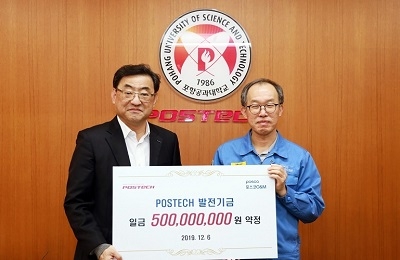
POSTECH Receives a Donation from POSCO O&M
POSCO O&M, a global leading operation and management company, has agreed to make a three-year donation of $420,000 (500 million won) to POSTECH. This charitable donation will be used for improvements of campus facilities for students to lead a more enjoyable campus life. POSCO O&M was established in 1994 and serves as a comprehensive management company for real estate, construction, infrastructure/plant and leisure industries. They also fulfill corporate social responsibility to promote the value of coexistence under the management philosophy of ‘Corporate Citizenship: Building a Better Future Together.’
2019.12.10 1595 -
POSTECH Opens an Engineering Research Center for Korea’s First Extensible Quantum Computing
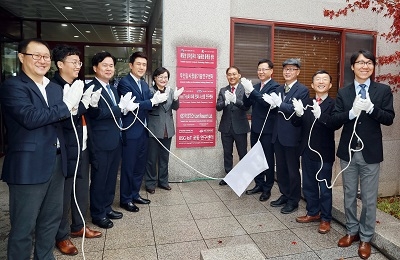
[Vice Minister Miock Mun of Ministry of Science and ICT and Pohang Mayor Kang-deok Lee among guests at the opening ceremony on November 28th] POSTECH opened the Center for Extensible Quantum Computing Technology Convergence Platform (Director: Professor Jae-Yoon Shim of POSTECH’s Department of Electronics and Electrical Engineering) at the LG Cooperative Electronics Engineering Building on November 28th. More than 100 guests attended the opening ceremony, including Vice Minister Miock Mun of the Ministry of Science and ICT, Mayor Kang-deok Lee and Vice President Joon Won Park of POSTECH. In June, the center was selected as the nation's leading research project (ERC: Engineering Research Center) by the Ministry of Science and ICT. It is the first center in Korea to build the extensible quantum computing and will develop its element technology, build an industrial hub platform through cloud services and nurture the core set of engineers for quantum computing. A quantum computer is a computer based on the quantum mechanics principle and outperforms the existing supercomputer by millions of times in computational power. It can be utilized in almost all industries including defense, science, medical, pharmaceutical, automotive, aerospace, and more. The center’s director, Jae-Yun Shim, stated, “Quantum technology has been steadily developing over the last 40 years and now with global IT companies on the scene, quantum computers called dream computers are closer to reality.” He added that “Through building the high-performance quantum computer, we will grow the center into a world-class technology platform for quantum researchers.” Along with the opening ceremony, the center will also host a technology seminar with invited speakers including Dr. Hyeokshin Kwon of Samsung Advanced Institute of Technology, Professor Doheon Kim of Seoul National University and Director-General Joonyeon Chang of Korea Institute of Science and Technology.
2019.12.05 1582 -
Professor Wonyong Choi Designated as a Highly Cited Researcher
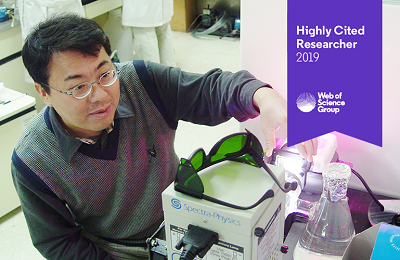
Professor Wonyong Choi of POSTECH’s division of environmental science and engineering was selected as one of the most influential researchers in the world. Clarivate Analytics, an information analytics company, analyzes the number of paper citations using the Web of Science data to identify the top 1% of the most cited researchers. Clarivate recognizes these researchers as “Highly Cited Researchers” and released its 2019 annual list on November 20th. Professor Wonyong Choi has strengthened the fundamentals of environmental and energy technologies using photocatalysts by developing a new variety of them and systematically researching their characteristics and reaction mechanisms. He is particularly drawing attention from global academia for his pioneering work in the field of environmental chemistry by developing a new advanced oxidation technology and identifying a new chemical phenomenon of ice. In 2017, he became the first Korean to become an associate editor of the Environmental Science & Technology, the most prestigious journal in the field of environmental science published by the American Chemical Society. In 2018, he received the Korean Engineering Award from the Ministry of Science and ICT, which is presented to researchers who have achieved exceptional world-class research results in engineering.
2019.11.26 1677 -
Woo-Sung Jung, a Professor at POSTECH, Elected as the Youngest Member of the AAPPS Council
Woo-Sung Jung, an associate professor of the department of physics at POSTECH, was elected as the youngest member of the Association of Asia Pacific Physical Societies (AAPPS) Council. AAPPS held its 10th Ordinary General Meeting in Malaysia on November 17, 2019 and elected sixteen new council members, including Professor Jung, to lead the association for the next three years. He was also appointed as the Deputy Editor-in-Chief of AAPPS Bulletin for three years from January next year. Professor Woo-Sung Jung, an authority on complex systems and computational social science, has served as an expert committee member of Korea’s Presidential Advisory Council on Science & Technology (PACST). He was also invited as a member of the Young Korean Academy of Science and Technology (Y-KAST) this past January and has served as the youngest executive director of the Asia Pacific Center for Theoretical Physics (APCTP) since 2016. AAPPS, an association of 18 physical societies from 17 countries in the Asia-Pacific region, is devoted to the promotion of research, teaching and regional collaboration in physics. It is one of the world’s top three physics associations along with the American Physical Society (APS) and European Physical Society (EPS).
2019.11.26 1693