News & Updates
-
POSTECH Professor Kimoon Kim Edits a Comprehensive Book on Cucurbiturils
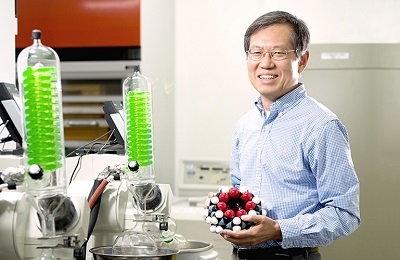
By invitation from the Royal Society of Chemistry, POSTECH professor Kimoon Kim (Director, IBS Center for Self-Assembly and Complexity) has edited the book entitled “Cucurbituril and Related Macrocycles.” This book is part of the “Monographs in Supramolecular Chemistry” series published by the RSC. As the book’s sole editor, Professor Kim compiled the contributions of both high-profile and rising international scientists in the cucurbiturils field. The book consists of 20 chapters including the four written by Professor Kim and covers the history, development, synthesis, and physiochemical properties of cucurbiturils, as well as their applications in a wide range of fields such as materials, biology, and nanotechnology. It also analyzes the current status of cucurbituril chemistry and explores the outlook and the direction it is moving towards. Professor Kim, an internationally recognized scholar in supramolecular chemistry, has pioneered fundamental research on cucurbiturils and made substantial contributions in their applications in nanotechnology and biotechnology. Cucurbiturils are macrocyclic synthetic host molecules resembling hollow pumpkins that form complex structures based on host-guest interactions with guest molecules. The tunability of such host-guest interactions is key to why cucurbiturils are so applicable in a variety of fields. The name cucurbituril is derived from the Latin word Cucurbitaceae, which means pumpkin. Professor Kim expressed his excitement about the book and remarked, “This book being part of the ‘Monographs on Supramolecular Chemistry’ showcases the significance and value of cucurbiturils in the field of supramolecular chemistry.” He hopes that this book will serve as an attractive invitation for exceptional scientists to join in expanding the horizons of cucurbituril chemistry.
2019.11.26 1688 -
POSTECH Reaffirms its Place as Korea’s Top Science and Engineering University
POSTECH ranked first in both natural sciences and engineering in the 2019 JoongAng Ilbo University Rankings according to the news agency’s announcement on November 16, 2019. POSTECH excelled in the areas of student start-up and technology transfer. Since 2017, the school has markedly outperformed other Korean universities in technology transfer revenue, industry-academic research cooperation, and inventions and patents. In particular, JoongAng Ilbo highlighted POSTECH's support for student start-ups in detail through the medical device company “MiDAS H & T,” founded by Seyun Chang, an alumnus of POSTECH’s department of materials science and engineering. Chang developed a pressure sensor for patients who suffer from bed sores with the help from both Professor Unyong Jeong and POSTECH who provided him with KRW 100 million (USD 85,000) over four years and a laboratory space of 115㎡. In his interview, Chang stated, "Thanks to the school, I was able to study and start my company as much as I wanted." Like Chang’s case, POSTECH is putting in much effort into supporting student start-ups through initiatives like start-up fund for every student and many others. In the areas of professor’s research, revenue from technology transfers to companies was robust, amounting to more than KRW 32 million (USD 27,500) per professor in the recent three years. POSTECH has promoted student start-ups by establishing an entrepreneurship minor and launching support organizations such as APGC-Lab in partnership with the Association of POSTECH Grown Companies (APGC), an association of companies founded by POSTECH alumni. Recently, a student entrepreneurship team was additionally created to systematically assist student start-ups. In terms of technology transfers, POSTECH has made a profit of KRW 8.7 billion (USD 7.3 million) from 80 such cases from 2016 to 2018. It is the fifth highest amongst Korean universities, but the profit per transfer reaches KRW 1.6 billion (USD 91,000), making it the highest in Korea.* This shows that the industrial applicability of the transferred technology is very high. The annual JoongAng Ilbo University Rankings is divided into the comprehensive and field-specific rankings. POSTECH, a science and engineering school, is only evaluated in the field-specific rankings. *Source: '2016-2018 University Technology Transfer Status' by Office of Kyu Hwan Kim, a Member of the Korean National Assembly).
2019.11.17 2780 -
POSTECH Has the Highest Number of Exemplary Laboratories in Safety Management among National Research Institutes
[20 labs certified, the highest number of exemplary labs for three consecutive years] POSTECH’s 20 labs were selected as Exemplary Laboratories in Safety Management by the Ministry of Science and ICT this year. This marks POSTECH’s certification for six years in a row since 2014. A total of 14 labs in 2017 and 16 labs in 2018 were certified at POSTECH, setting the record for the most number of exemplary labs in Korea. It was also designated as the best institute and the best lab among universities and research institutes in the nation. President Moo Hwan Kim stated, “We have specifically devoted our attention, efforts and capabilities at the institutional level to raise the safety awareness of our school community, in order to build a clean smart safe campus. With this exemplary laboratories certification, we will do our best in safety management so our members can conduct research in a safe environment and share our know-how externally to be at the vanguard of the industry.” ‘Certification of Exemplary Laboratories in Safety Management’ is a system implemented by the Ministry of ICT to strengthen the autonomous safety management capabilities of science and technology labs at universities and research institutes, and to explore and spread safety management standards. It is a system that grants certification to labs with excellent safety management and activities through inspections conducted by experts. To be certified, the lab should be accident-free for two years and must score above 80 points from 29 categories spanning over the following areas: Laboratory safety environment system (30 points), safety activity standard (50 points), and safety awareness of researcher (20 points). The certification is valid for two years and requires an inspection every two years for recertification.
2019.10.29 1578 -
POSTECH Ranked No. 1 in Asia Among World’s Most Innovative Universities
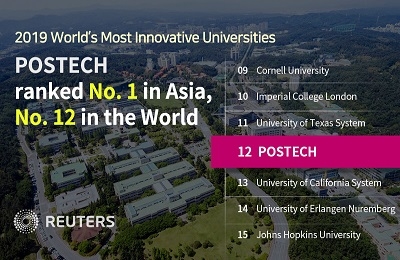
- Reuters ranks POSTECH at 12th place, ahead of UC Schools, Johns Hopkins and Caltech - POSTECH recognized for scientific innovation, including artificial corneal bioink and mussel protein stem cell carrier POSTECH ranked 12th on the World’s Most Innovative Universities list of 2019. Announced on the 24th by the international news agency Reuters, POSTECH ranked the highest among Asian universities. Reuters, along with world-renowned data research firm Clarivate Analytics, publishes the innovative universities ranking every year, using criteria including academic papers and their influence, total patent applications, and citations. POSTECH ranked 12th, surpassing the University of California System (13th), Johns Hopkins (15th) and California Institute of Technology (16th). POSTECH was ranked first in Asia, followed by Japan's University of Tokyo (26th), Seoul National University (29th), KAIST (34th) and China's Tsinghua University (41st). Reuters described POSTECH as “a university founded by the South Korean steel company POSCO in 1986” and as a “research-oriented university with unique ties to industry.” It introduced these two technologies as major innovations: From this year, creating artificial corneas using a 3D printer (Professor Dong-Woo Cho of Mechanical Engineering and Professor Jinah Jang of Creative IT Engineering, supported by Ministry of Trade, Industry and Energy); and protein stem cell carrier technology using mussel adhesive protein from 2018 (Professor Hyung Joon Cha of Department of Chemical Engineering, supported by Ministry of Oceans and Fisheries). Between 2012 and 2017, POSTECH applied for a total of 349 patents and showed a high grant rate of 79.7%. It scored 48.8 points on the commercial impact score – above the average score of 40.5 points – which evaluates the number papers cited in the patent filings. In the evaluation, Stanford University ranked first for five consecutive years, followed by Massachusetts Institute of Technology (MIT) and Harvard University. In Korea, a total of six universities including POSTECH – Seoul National University, KAIST, Sungkyunkwan University (45th), Hanyang University (72th), Yonsei University (76th) – ranked in the top 100.
2019.10.25 2884 -
POSTECH and Dell Technologies Join Hands in IT Development
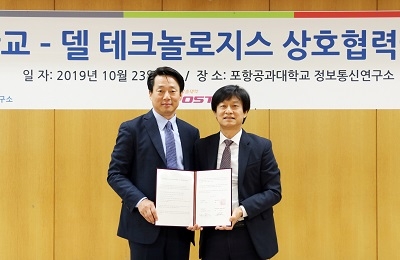
[Plans to conduct joint research and development in areas of AI, machine learning and big data] POSTECH and Dell Technologies (Korea SVP, Kevin Kim) entered into partnership to strengthen their leadership role in IT development. On October 23rd, Director Youngjoo Suh of POSTECH Information Research Laboratories (PIRL) and Vice President Kyeong Deog Kim of Dell Technologies Korea Commercial signed a memorandum of understanding to strengthen collaboration between the two institutions. The ceremony was attended by members of leadership and other guests. The MOU outlines cooperation in: Academic development in AI, machine learning and big data, and related projects of both institutions; joint R&D and the exchange of latest data; academic consultation, research support and joint researches including projects assigned from external organizations; and on other matters that can vitalize cooperation between both organizations and contribute to the development of local and national industries. With this partnership, POSTECH and Dell Technologies expect that the joint research and development in AI, machine learning and big data will help boost related businesses.
2019.10.25 1655 -
POSTECH and Russia’s Far Eastern Federal University Sign an MOU, Widens Influence in the Far East
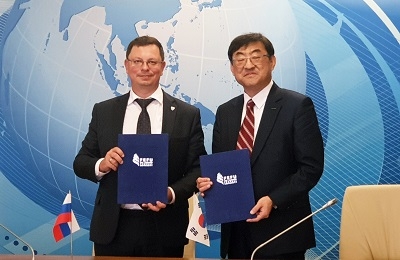
– President Moo Hwan Kim attends the 120th-anniversary round table of the Far Eastern Federal University. – “Let the bilateral exchange be a solid foundation for the growth of Pohang and Vladivostok into smart cities and the development of the Asia-Pacific region.” POSTECH signed a memorandum of understanding (MOU) with the Far Eastern Federal University (FEFU) in Vladivostok, Russia and has agreed to actively cooperate for joint growth of Pohang and Vladivostok and for their evolvement into innovative future smart cities. President Moo Hwan Kim attended the Asia-Pacific Regional Universities President’s Roundtable held on the 20th in celebration of FEFU’s 120th anniversary and signed an MOU to carry out personnel and academic exchanges and joint research. With this MOU, POSTECH has further expanded its network in the Russian Far East and revealed its goal to revitalize the city-level cooperation between Gyeongsangbuk-do Province · Pohang and Vladivostok. In particular, the two universities will closely work together in research areas for the advancement of Pohang and Vladivostok into smart cities. Gyeongsangbuk-do and Pohang each signed an MOU outlining economic, social and cultural cooperation with Vladivostok in 2018, and Pohang is actively collaborating in various areas such as education. President Kim attended the Asia-Pacific Universities Presidents' Roundtable, a gathering of university presidents from the Asia-Pacific region including China, Japan and Vietnam. He stated, “The partnership between POSTECH and FEFU is more meaningful since it was inspired and influenced by the existing cooperation between our cities of Pohang and Vladivostok.” He added, “I hope that the exchange of the two universities will not only help transform Pohang and Vladivostok into smart cities, but also provide a solid foundation for development of the Asia-Pacific region." Founded in 1899, more than 23,000 students currently study at the FEFU, which is one of Russia’s leading universities that offers various degree programs in natural sciences, engineering and medicine, as well as humanities and law.
2019.10.22 1639 -
POSTECH to Become the Heart of Semiconductor Technology Research and Development of Experts
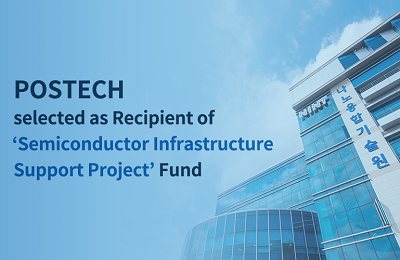
[POSTECH is One of Six Universities Selected in the 'Semiconductor Infrastructure Support Project'] POSTECH was selected as a recipient of '2019 Semiconductor Infrastructure Support Project' funded by the Ministry of Trade, Industry and Energy (MOTIE). A budget of KRW 2.9 billion, including KRW 2.4 billion in national funding, will underwrite this project, spearheaded by POSTECH’s National Institute of Nanomaterials Technology (NINT) and five Korean universities: KAIST, Korea Polytechnic University (KPU), Myongji University, Sungkyunkwan University and UNIST. This project will replace and upgrade aged equipment at research institutes and centers within universities where semiconductor processing training takes place. It allows for repair and replacement of outdated and unusable parts, establishment and operation of educational programs, and training based on corporations’ needs. As a result, six universities – including POSTECH - will replace outdated equipment and create a platform for sharing the equipment. POSTECH will oversee the entire project and semiconductor design, KAIST will manage semiconductor design and Sungkyunkwan University will handle semiconductor sensors. UNIST has been assigned to semiconductor materials, KPU to semiconductor packaging and Myongji University will handle testing of the components. By only updating equipment required for each aspect of the processing, purchase of duplicate equipment is avoided and research collaboration between universities is encouraged. This project is expected to serve companies in the semiconductor field, to act as a base for technology development and education, and to cultivate experts using advanced facilities, equipment and professionals.
2019.10.10 1836 -
POSTECH Selected to Operate AI Graduate School
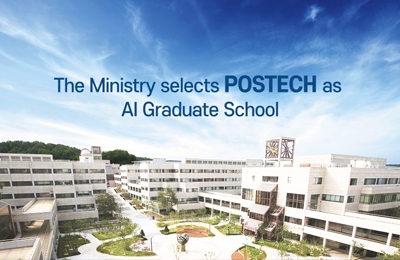
As part of an initiative by the Ministry of Science and ICT (MSIT), POSTECH was selected as an 'Artificial Intelligence Graduate School operating university (hereinafter referred to as the AI Graduate School).’ The AI Graduate School is a project launched by the MSIT to raise globally competent master's and doctoral-level leaders specializing in the AI field in cooperation with the industry-academia-government partnership. The AI industry is known to be at the heart of the fourth industrial revolution. Three artificial intelligence graduate schools were already selected in the first half of last year, but the ministry announced that POSTECH and Gwangju Institute of Science and Technology (GIST) were additionally selected in response to heightened social interest and market demand for artificial intelligence. The AI Graduate School at POSTECH will receive 9 billion won ($7.5 million) in national funding for the next five years and will commence in the spring semester of 2020. Each year, 50 students (30 master’s and 20 MS/PhD Integrated Program) will be selected to cultivate the world's best convergence experts in the field of AI and data science. The School plans to train and produce over 200 highly skilled individuals by the year 2023. Since Pohang houses R&D hubs such as Pohang Research and Development Zone, Pohang Free Economic Zone, and the POSCO Venture Valley, a great synergy is expected in securing outstanding individuals of AI Graduate School early on to the research centers.
2019.10.04 2216 -
Inauguration Ceremony for POSTECH’s 8th President Held on September 3rd
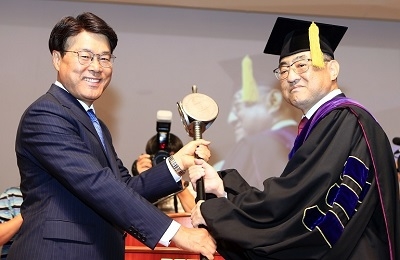
[POSTECH’s greatest strength lies in the ‘power of together’] The inauguration ceremony for POSTECH’s eighth president Moo Hwan Kim was held at 11a.m. on September 3rd at the POSTECH Auditorium. Over one thousand POSTECH students and staff, and guests from academic and government organizations attended the inauguration, including Chairman Jeong-Woo Choi of POSTECH Foundation, Chairman Myung-Chul Lee of Korean Academy of Science and Technology (KAST), President Yong-Hak Kim of Yonsei University, President Mooyoung Jung of UNIST, President Jin Taek Chung of Korea University, President Sun-Heung Jang of Handong University, President Ik Jang of Uiduk University, Mayor Kang-deok Lee of Pohang City and President Byung Joo Min of Korean Nuclear Society. In his inaugural speech, the newly appointed president Moo Hwan Kim stated, “POSTECH was able to grow into a representative university in Asia in a short time because all members of the university, POSCO, the local and central governments joined together under the goal of advancing POSTECH into a world-class research university.” He emphasized that “the true strength of POSTECH lies in the power of together.” President Kim introduced his plans for innovation in education that students demand, education that industry and future require and the university management that today’s POSTECH demands. Underlying these plans is “self-managed” innovation, in which each member and unit of organization proactively detect the status quo and improves on their own. He declared that “instead of leading in front, (he) will be a president much like a coxswain of the boat, reading the wind and tide ahead for (his) crew, steering when each unit makes a spurt.” He quoted Henry Ford, the founder of the Ford Motor Company, who said, “Coming together is a beginning. Keeping together is progress. Working together is success” and encouraged “to work together to make POSTECH the pride of our nation, worthy of respect and esteem.” In his appointment speech, Chairman Jeong-Woo Choi congratulated the new president by stating, “Dr. Moo Hwan Kim is both capable and passionate to realize POSTECH's founding tenets as he possesses excellent leadership and communication skills and demonstrates strong initiative. We agree that he is the most qualified leader for POSTECH.” Chairman Choi described Ubuntu, a word of greeting of South African tribes meaning “I am because we are,” and asked the POSTECH community to “create a new momentum for growth and development for POSTECH under President Kim’s leadership by inheriting and developing the founding tenets and implementing the vision that responds to the societal changes and calling of the times.” He added that “the foundation and its board have great confidence in the new president and promise to partake in the valuable path of history that the university will take and pledge our utmost support.” POSTECH's eighth president Moo Hwan Kim was born in Busan in 1958 and received his bachelor’s (1980) and master’s (1982) degrees in nuclear engineering from Seoul National University. He completed his Ph.D. at University of Wisconsin-Madison in 1986. In 1987, he joined then young POSTECH’s Department of Mechanical Engineering faculty and has served as the department head of Division of Advanced Nuclear Engineering and has held major leadership roles, including the vice president of student affairs, admissions (now admissions and student affairs), and planning. As an expert in the field of nuclear safety, he displayed great leadership as an administrator in the field of science and technology by serving as president of Korea Institute of Nuclear Safety (KINS) from 2013 to 2016, a member of International Nuclear Safety Group (INSAG) at International Atomic Energy Agency (IAEA) from 2014 to 2018 and as a commissioner of Nuclear Safety and Security Commission.
2019.09.05 2079 -
POSTECH Ranked Third Best Small University in the World, First in Asia
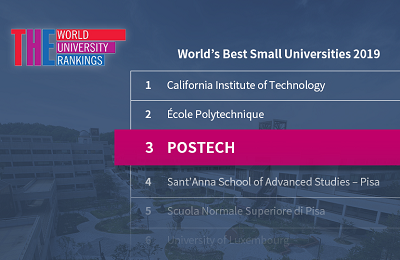
[Strong in University-Industry Collaboration] POSTECH placed third on the 2019 World’s Best Small Universities list, recently published by the Times Higher Education (THE), a London-based leading publisher of higher education analysis and world university rankings. THE announces world rankings annually for universities with fewer than 5,000 students. The same 13 performance indicators under five areas are used for small-scale global university evaluation as the general global university assessment including, teaching, research, citations, industry income, and international outlook. However, this evaluation only includes small universities due to their nature that prioritizes quality over quantity and customized education, which is not properly reflected in conventional university evaluations. Caltech placed first, followed by École Polytechnique and POSTECH placed third. POSTECH’s ranking is the highest among all Asian universities. Caltech, which continues to rank first, is an American engineering university of the highest level, established in California in 1891. It has produced outstanding scientists and engineers, such as Charles Richter, the developer of Richter scale and faculty members, including Albert Einstein, Linus Pauling and Richard Feynman. It is a frontrunner among small and strong universities. École Polytechnique, in second place, is a leading university among France's small elite educational institutions labeled ‘Grandes Écoles.’ It is the epicenter of French mathematics, science and engineering research and boasts 222 years of history and tradition. Three presidents, including Giscard d’Estaing, numerous senior officials and CEOs from major French companies graduated from the university. It has been analyzed that POSTECH ranked third due to its high marks in industry-university cooperation compared to other universities. THE stated, “POSTECH was founded in 1986 to cultivate future engineers” and praised POSTECH for encouraging entrepreneurship by “providing students with entrepreneurship programs such as clubs for student startups, support for prospective entrepreneurs, patent training and leave of absence granted for launching startups.”
2019.08.27 2713