News & Updates
-
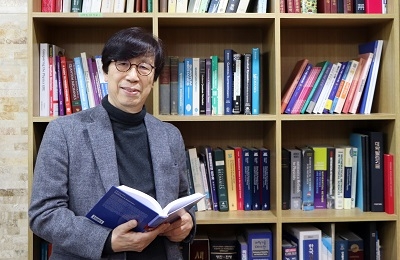
Professor Emeritus Wokyung Sung publishes the first graduate level textbook on statistical physics for biological matter
Statistical physics is a branch of physics that uses mathematical tools for dealing with large populations and approximations, such as probability theory and statistics, to solve physical problems. As such, it has allowed researchers to explain and quantitatively describe complex topics such as superconductivity, superfluidity, and turbulence. A typical statistical physics course covers ideal gases (classical and quantum) and interacting units of simple structures. However, as the simplest of biological fluids are solutions of macromolecules, and hence, extremely complex, there is a chasm of available content to train the burgeoning young researchers of this field. Professor Emeritus Wokyung Sung, a renowned expert in the fields of statistical physics and biological physics for over 30 years, recently published Statistical Physics for Biological Matter—the first graduate level textbook to bridge this chasm. The textbook aims to cover a broad range of topics in the field, including statistical mechanics (equilibrium and non-equilibrium), soft matter, and fluid physics for applications to biological phenomena at both cellular and macromolecular levels. The major topics covered include thermodynamics, soft matter physics of polymers and membranes, and hydrodynamics. Methods and theories are described with detailed derivations, followed by applications and examples in biology—all based on Professor Sung’s lectures at POSTECH. Professor Sung’s illustrious career spans decades of excellence working with a variety of biological matter and processes at the mesoscopic level using statistical physics of soft matter and stochastic phenomena. His breakthrough in pioneering the theory of polymer translocation through membranes brought about an entirely new field in biological/polymer physics.
2018.12.17 1591 -
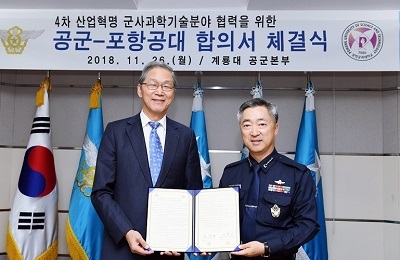
POSTECH and ROK Air Force sign MOU for research collaboration
On November 26th, POSTECH signed a cooperative MOU with the Republic of Korea Air Force (ROKAF) to collaborate on national defense research. President Doh-Yeon Kim and General Wang-keun Lee (Chief of Staff of ROKAF) attended the signing ceremony where they agreed to pursue joint activities such as research, mobility of personnel, and symposiums. In particular, POSTECH and ROKAF will work on the advancement of national defense projects related to the Fourth Industrial Revolution. Furthermore, a collaborative committee will meet regularly to ensure continuous progress. After the ceremony, President Kim gave a seminar entitled ‘Planning for a Blissful Future’ to 150 members of the ROKAF. General Lee expressed his enthusiasm at the signing and said, “I sincerely look forward to the synergy in national defense science to be created through the collaborative efforts of POSTECH and ROKAF.”
2018.12.05 1548 -
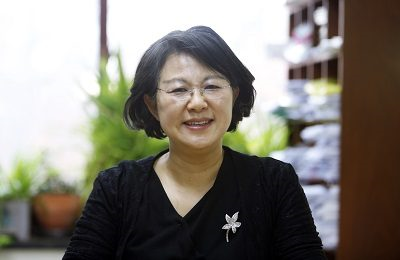
Professor Youngju Choie becomes the first female recipient of the KMS Prize
The Korean Mathematical Society awarded Professor Youngju Choie with the prestigious KMS Prize at the 2018 Joint Meeting of the Korean Mathematical Society and the German Mathematical Society. Since 1982, the prize has been annually given to the top mathematician in Korea. This year’s prize is made even more notable due to the fact that Professor Choie became the first ever female recipient of the prize. Hyang-Sook Lee, the President of the Korean Mathematical Society, expressed her excitement and said, “The KMS Prize represents a lifelong dedication to excellence in mathematics. As such, I am delighted to present the prize to its first female recipient.” After receiving her Ph.D. from Temple University, Professor Choie has been with the Department of Mathematics at POSTECH since 1990. An expert of number theory and modular forms, Professor Choie’s contributions into research of L-functions was credited for the decision to bestow the highest honor given by the Korean Mathematical Society. Professor Choie is also a Member of the Board of Trustees of the National Research Foundation of Korea, the President of the Korean Women in Mathematical Sciences, and a Fellow of the American Mathematical Society.
2018.11.17 1611 -
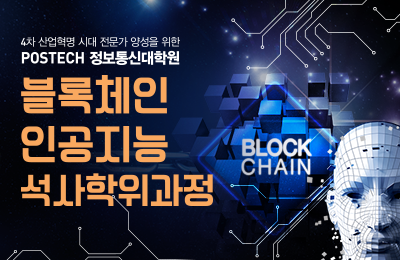
POSTECH GSIT Offers Korea’s First Nano-Master’s Program
Coursera and edX, the leading massive open online course platforms, offer a series of online graduate level courses that one can take to develop skills for career advancement or earn graduate level credits. It was designed to bridge the gap for working professionals to continue advancing their education without detriment to their careers. Since the credits can be transferred to shorten the time required to receive an advanced degree, the program has been a success for professionals in the United States. Recently, POSTECH has become the first university in Korea to offer such a program through the Graduate School of Information Technology (GSIT). The initial nanodegree programs offered will be in the fields of Blockchain and Artificial Intelligence. Select courses from GSIT’s newly established Master’s program in Blockchain and AI will be made available online, and students who complete all the requirements and attain a grading of at least 70% will receive graduate credits. The first three courses available are Introduction to Blockchain & Cryptocurrency, Smart Contracts & Applications, and Machine Learning. These 3-credit courses will be taught with the same level of academic intensity as the regular on-campus courses. In line with the Ministry of Education’s current regulations, a student may apply up to 6 credits for a Master’s degree program. As such, should the regulations expand to permit for a greater number of credits, POSTECH will likewise match the allowance. The POSTECH GSIT provides top-notch graduate level programs for professionals and researchers through online and offline courses to meet their demanding schedules. GSIT also offers MOOC programs in Big Data, IoT, 5G Networks, and Software Development.
2018.11.05 1616 -
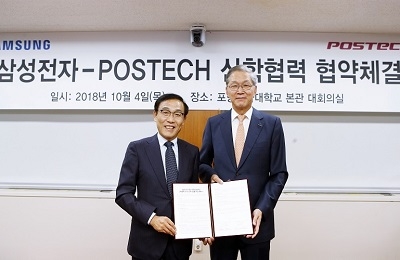
POSTECH and Samsung Electronics agree to an industry-academia partnership
On October 4, POSTECH and Samsung Electronics signed a cooperative MOU to strengthen the relationship between academia and industry. As the leading institutions of their respective fields, POSTECH and Samsung Electronics have agreed to pursue collaborative projects based on each of their core expertise in research and semiconductors. The agreement also laid the foundations for the establishment of the POSTECH – Samsung Electronics Industrial Academic Cooperation Center that will spearhead the procurement of world-class research excellence through close collaboration. Nine departments of POSTECH (Electrical Engineering, Materials Science, Creative IT Engineering, Computer Engineering, Chemical Engineering, Mechanical Engineering, Chemistry, Physics, and Mathematics) will participate in a wide breadth of semiconductor research projects for the Center. The collaborative projects will encompass a spectrum of initiatives in semiconductors including strategic academia-industry projects, fundamental research projects, research support for new and retiring professors, specialized education programs for students, and infrastructure support. Along with the LG Display, Samsung SDI, and Hyosung Corporation centers, the POSTECH – Samsung Electronics Industrial Academic Cooperation Center will be the fourth of its kind for the university.
2018.10.23 1846 -
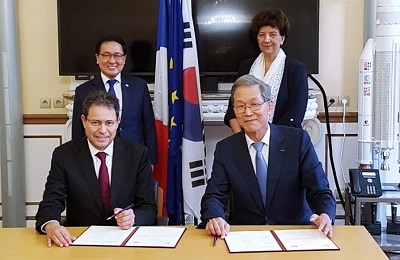
President Doh-Yeon Kim signs the first multilateral MOU of K-STAR
On behalf of K-STAR (Korean Universities for Science & Technology and Advanced Research), President Doh-Yeon Kim signed into effect the first multilateral MOU of the cooperative initiative with the INSA Group (Institut National des Sciences Appliquées) of France. President Kim, representing K-STAR, attended the signing ceremony held on the 15th in Paris alongside M’Hamed Drissi, Directeur de l’INSA Rennes. As part of South Korean President Moon Jae-in’s visit to France, the respective Ministers from both countries (Korea’s Ministry of Science and ICT and France’s Ministry of Higher Education, Research and Innovation) also attended the ceremony. As the alliance of leading STEM universities in Korea, K-STAR is comprised of KAIST, DGIST, GIST, UNIST, and POSTECH. The INSA Group is the leading French group of grande écoles and is comprised of 6 INSA institutes: Centre Val de Loire, Lyon, Rennes, Rouen, Strasbourg, and Toulouse. The collaborative activities between the two national networks will include academic and student exchanges to foster international cooperation between and Korea and France. The multilateral agreement between K-STAR and INSA Group is expected to usher in a new vibrant era of robust partnership in science and technology for both nations.
2018.10.17 1747 -
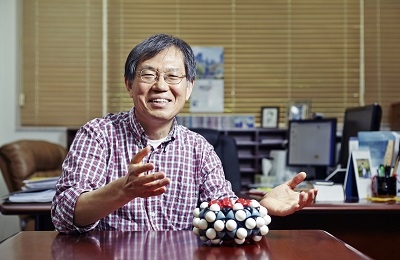
Professor Kimoon Kim Publishes the First Textbook on Cucurbiturils
Professor Kimoon Kim (Director, Center for Self-assembly and Complexity, IBS) has published the first textbook on cucurbiturils entitled Cucurbiturils: Chemistry, Supramolecular Chemistry and Applications through the world-renowned World Scientific. Once considered a peculiarity, cucurbiturils—molecules shaped like a hollow pumpkin—has since been propelled to the forefront of supramolecular chemistry due to their suitability as hosts for an array of neutral and cationic species. For years, Professor Kim, a prominent leader and internationally recognized authority in the field of supramolecular chemistry, has been working on a wide variety of functional materials based on cucurbiturils. In his career, he has published over 260 papers that have amassed over 22,600 citations. Most notably, his paper published in Nature in 2000 was selected as one of the 35 most notable papers among chemical related papers published in Nature from 1950 to 2000. The textbook chronicles the history and development of cucurbiturils and provides a general introduction and a field-wide overview of the synthesis, properties and applications of the fascinating macrocyclic molecules. Comprised of nine chapters that detail among other topics, preparation, properties and host-guest chemistry, the textbook showcases the uses of cucurbiturils in chemistry, materials science and biology. Professor Kim expressed his enthusiasm on the publication and commented that the textbook is “an essential resource for both new and experienced researchers, as it provides an overview of the diverse applications, new methodologies and research, as well as challenges in the field.” The publication is made even more noteworthy because Professor Kim will donate his entire royalty to POSTECH to nurture the next generation of scientists.
2018.09.12 1720 -
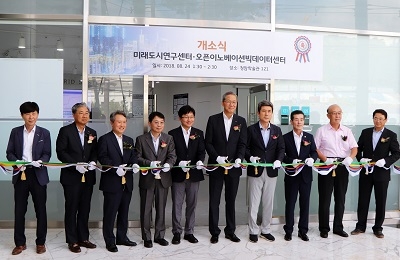
POSTECH Announces the Establishment of the Future City Open Innovation Center and Open Innovation Big Data Center
The few planned exceptions aside, cities of past and present grew through a reactive process. Natural structures and strategic locations played important roles during the founding, but the growth itself was mostly ad hoc. Infrastructures organically blossomed and weaved throughout the cities in an ever-expanding layering of new on top of the old. As city dwellers now account for more than 50% of the global population (and experts project that the figure will rise to 66% by 2050), modern urbanization—with its foundations in the industrialization of the past era—is simply not equipped to meet the needs of the trend. Gridlocks, pollution, and gentrification are all symptoms of a system that is unsustainable in the wake of modernity. Accordingly, POSTECH has identified Future Cities as a crucial field of research to create lasting social value for the betterment of society. As POSTECH’s first steps towards this direction, the University announced the establishment of the Future City Open Innovation Center (FOIC) and Open Innovation Big Data Center (OIBC). As the two newest members of POSTECH’s Open Innovation Centers, FOIC and OIBC will go beyond cutting-edge research and act as a hub that connects academia, research, and industries. Much like the recently announced Bio-Open Innovation Center, the two new centers are based on a foundation of open cooperation: the Open Innovation Centers aim to create socioeconomic value by attracting companies and startups to foster their growth through cooperation with the University’s advanced research infrastructures. FOIC will focus on the development of innovative future and smart city technologies, including retrofitting existing infrastructures with the latest technological advances for the efficient establishment and proliferation of a smart city. As the field of interest is a convergence of many different disciplines, the center will host faculty members and researchers from all throughout POSTECH. OIBC will focus on developing platform technologies from big data gathered from the implementation of FOIC-led initiatives. Comprised of eight departments, including Industrial & Management Engineering, Mechanical Engineering, and Life Sciences, the center is currently researching technologies related to smart power grids. POSTECH anticipates that the Open Innovation Centers will act as potent catalysts to the actualization of the University’s Value Creating Mission and develop innovative solutions to the most pressing issues pervading society, which in turn will revitalize both the local and national economies.
2018.09.04 1792 -
Professor Sung H. Han Receives the IEA Fellowship
The International Ergonomics Association (IEA) selected Professor Sung H. Han (Department of Industrial Management Engineering) as the recipient of the prestigious IEA Fellowship. Professor Han is a world-renowned scholar in the fields of human-computer interaction, usability engineering, affective/adaptive user interface design, user interface design for mobile devices and user experience. He is the Founder and Chairman of the Asian Conference on Ergonomics and Designs and sits on numerous editorial boards and committees. The IEA Fellowship is awarded in recognition of “extraordinary or sustained, superior accomplishments of an individual” in the field of ergonomics. Selection for this honor is highly competitive and only 120 individuals have been selected as IEA Fellows in 60 years. Professor Han will receive the award at the 20th Congress of IEA in Florence, Italy. Established in 1959, the IEA is a federation of 51 ergonomics organizations from around the world. Its mission is to “elaborate and advance ergonomics science and practice, and to expand its scope of application and contribution to society to improve the quality of life, working closely with its constituent societies and related international organizations.”
2018.08.14 1714 -
POSTECH-MCST Sports Industry Support Center Agreement Signed
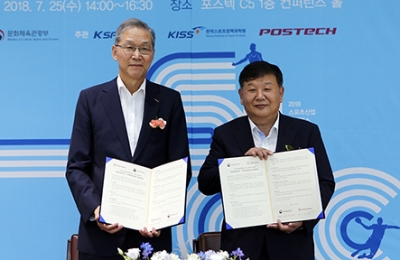
POSTECH signed an agreement with the Ministry of Culture, Sports and Tourism (MCST, Minister Jonghwan Do) at the C5 Conference Hall on July 25th for the designation and operation of the Sports Industry Support Center. In April, through an open bidding process, MCST awarded POSTECH with the first Sports Industry Support Center in an effort to advance Korea’s sports industry and to facilitate its growth into a prolific industry of the future. The agreement ceremony included discussions on the operational plans for the Sports Industry Support Center. Tae-kang Roh (The 2nd Vice Minister of MCST), Doh-Yeon Kim (President of POSTECH), Jong-jin Yoon (Vice Governor for Administrative Affairs of Gyeongsangbuk-do), Kang-deok Lee (Mayor of Pohang) and sports industry experts attended the ceremony. The main contents of the agreement include details on policies for a collaborative and convergent sports industry and related research, industry-academia-research cooperation, collaboration with municipalities, and nurturing of professionals. POSTECH and MCST will cooperate to strengthen national competitiveness and public health through cutting-edge convergent technologies and advancements in the sports industry. As the firsts step in collaboration, the two institutions also cohosted a forum titled 'A New Beginning: Innovation and Challenges for the High Tech Based Sports Industry.' The participants of the forum discussed issues pertaining to the pivotal role of the Sports Industry Support Center as an innovative leader, including in-depth forecasts on the future of the sports industry as it braces for rapid transformations. The MCST expressed its enthusiasm and said, “the outstanding technology and creativity of a private research institute like POSTECH will make a great foundation for innovation in the sports industry. We eagerly anticipate the Sports Industry Support Center to become a successful example of private sector-government cooperation.”
2018.08.08 1671