News & Updates
-
POSTECH Recruits Professor Ho-Keun Song
[Professor Ho-Keun Song has been named as the Head of the Division of Humanities and Social Sciences to strengthen the humanities program] Professor Ho-Keun Song, the leading Korean sociologist and Distinguished Professor at Seoul National University (SNU), has recently moved to POSTECH with the aspiration to strengthen the humanities education for the nurturing of STEM leaders. POSTECH has announced that Professor Song has been hired, effective September 1st, as a Chair Professor and Head of the Division of Humanities and Social Sciences. Professor Song holds a Bachelor’s and Master’s Degree from SNU and a Ph.D. in Sociology from Harvard University. Also, in recognition of his groundbreaking research on social policy and welfare, social theory, and sociology of labor markets, SNU named him as the first Distinguished Professor of its Department of Sociology. As a professor in SNU since 1994, he has contributed to the university as the Chair of the Department of Sociology and Dean of the Office of External Affairs. Professor Song has written many books and articles on sociology since his first publication of “Karl Mannheim’s Sociology of Knowledge” at the age of 27. His famous writings include “Birth of the People” and “Birth of the Citizens,” as well as “They Don’t Cry Out Loud,” “The Road Not Taken,” “Ganghwa Island,” and “Time of the Candle.” He is highly acclaimed for his elegant analyses on the nature of social phenomena and relevant policies, as well as for his broad insights that transcend sociology, economics, and politics. He is also a renowned columnist with a regular column in JoongAng Ilbo since 2004. Up until recently, South Korea has achieved its remarkable growth by incubating Fast Followers. However, POSTECH believes that the leaders of the contemporary hyper-connected era of rapid innovations must possess a convergent skillset that merges technical expertise with the creativity and interpersonal communication skills provided for by interdisciplinary training in the humanities. Professor Song’s recruitment marks the new beginning to a robust humanities and social sciences program at POSTECH. President Doh-Yeon Kim said, “As a STEM university that nurtures the leaders of tomorrow, the humanities education offered at POSTECH was relatively cursory.” He explained, “The students today will live a longer life than ever before and will hold many different jobs during their journey. An education restricted by departmental barriers cannot properly train the students for such a future.” He further stated that, “Only the talented individuals equipped with both scientific expertise and the insights afforded by a holistic humanities education can contribute to the betterment of the nation.”
2018.07.24 1888 -
PIRL and Keysight Technologies to Collaborate on 5G/IoT Research
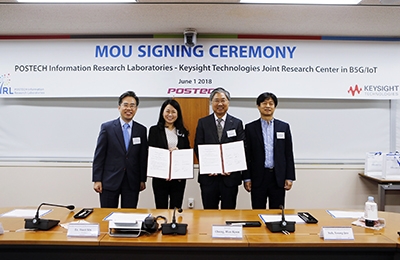
Keysight Technologies, an industry leader in electronic measurement equipment, will establish its first joint research laboratory in Korea in conjunction with POSTECH. POSTECH Information Research Laboratories (PIRL) and Keysight Technologies Korea recently signed a Memorandum of Understanding for educational and research cooperation in the fields of 5G, B5G, and IoT. Under this MOU, Keysight will share its expertise with the top-notch minds at PIRL to not only nurture leaders in the respective fields but also to contribute to progressive advancements in 5G, B5G, and IoT. Furthermore, the establishment of the joint research laboratory will facilitate close cooperation and sustainable collaborative research between the two institutions. It is anticipated that this partnership will enable PIRL to become the preeminent research hub in the field. Professor Young-Joo Suh, the Director of PIRL, expressed his enthusiasm and said, “It is truly a pleasure to have the PIRL-Keysight Joint Research Center established at POSTECH.” He also stated that PIRL will work towards establishing the best educational and research infrastructure in Korea. Jun-Ho Choi, the CEO of Keysight Technologies Korea, said, “I truly hope that this MOU will contribute to technological advancements in the field of 5G and IoT, as well as help enhance POSTECH students’ practical research skills and capacity.” He also expressed his desire to cooperate and said, “Through joint research with POSTECH, we hope to develop great technologies and become one of the leading corporations in the field of 5G and IoT.”
2018.06.22 1584 -
Professor Chulhong Kim wins the 2018 Nightingale Prize
The Medical & Biological Engineering & Computing (MBEC) Editorial Board, in association with the International Federation for Medical and Biological Engineering (IFMBE) and the Institute of Physics and Engineering in Medicine (IPEM), has selected Professor Chulhong Kim of the Department of Creative IT Engineering at POSTECH to receive the prestigious Nightingale Prize. Professor Kim’s research has made significant contributions to the advancement of new biomedical imaging techniques such as photoacoustic tomography, ultrasound-modulated optical tomography, fluorescence imaging, and ultrasound imaging. Particularly, his research led to the world-first photoacoustic-imaging device that is capable of capturing in vivo images of small animals at a high resolution without using a contrast medium or inserting needles into the body. This achievement was published in the March 2016 issue of MBEC (Multiplane spectroscopic whole-body photoacoustic imaging of small animals in vivo), and for the past two years gathered enormous attention throughout academia. The innovative and revolutionary research outcome was eventually recognized as the best MBEC article of 2016. The Nightingale Prize, awarded biannually, was established by the Biological Engineering Society (currently IPEM) in memory of Alfred Nightingale, a physicist and both President and the first Honorary Secretary of the Society, as well as an editor of the precursor to MBEC, who passed away suddenly in 1963 at the age of 40. MBEC is the official journal of IFMBE and is one of the oldest biomedical engineering journal, serving the community since 1963. The international journal introduces the latest trends in theoretical analysis of experimental results and computer-based analysis methods as well as other exciting and vital advances in the field.
2018.06.17 1604 -
The 2018 SES Program Kicks-off
Postechians are off to enjoy the extended three-months-long summer vacation, all ready to immerse themselves throughout society. In 2016, POSTECH extended the summer vacation period to three months and introduced yet another innovation to the curriculum. A three-month-long summer vacation is quite unusual in Korea’s higher education system as most universities allocate less than 10 weeks for summer recess. POSTECH made the bold move to provide its students with sufficient time and institutional support to pursue their interests in greater depth. The extended break makes it easier for students to participate in overseas programs, travel, or start their own businesses. It also facilitates students’ career path exploration through internships at global corporations or research institutes through the Summer Experience in Society (SES) program. SES connects POSTECH students with summer internship opportunities at more than 200 institutions including global corporations, domestic and overseas research institutes, and venture companies. From Samsung, LG, SK Hynix, SAP, and Oracle to the Max Planck Laboratory, Fields Institute, KIST, Genexine, and Lendit, the list of participant goes on. The wide variety of institutions, out of which students can choose to intern with, offers numerous options regardless of whether the students dream to be a researcher, to work for a global business firm, or to become a CEO of their own company. Currently in its third year, the SES program has attracted more than 300 participants annually. POSTECH anticipates that measures like the extended summer break and SES will drive students to challenge themselves with new tasks to accumulate experience. “Our students will be living in a society that is far different from the one we are living in. A revolutionary and innovative education will be the key to fostering leaders in the era of changes,” President Doh-Yeon Kim explained. “We hope to give our students the full support they need to acquire a comprehensive skill set befitting future leaders.”
2018.06.12 1967 -
POSTECH and ADD Sign a Cooperative Agreement
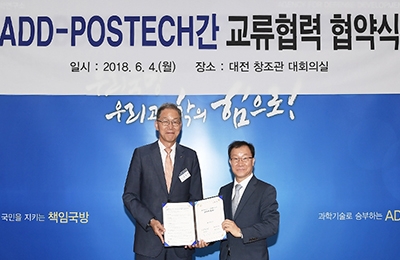
[Collaboration in the field of national security for the betterment of Korea] We live in a hyper-connected world where science and technology evolve at an exponential rate, and military science and technology, including the development of advanced equipment, are not exempt from this trend: National security is directly correlated with technological advances. To bolster Korea’s national defense capacity and better serve its populace, POSTECH and the Agency for Defense Development (ADD) have signed a cooperative agreement for the advancement of military science and technology. The primary aim of this agreement is to nurture talented individuals in the respective field and foster the active exchange of resources between the institutions. POSTECH and ADD will also promote academic exchanges and carry out collaborative research to realize this vision. President Doh-Yeon Kim expressed his great anticipation and said, “It is my genuine desire that through this cooperative agreement with ADD, the outstanding research achievements and talented individuals of POSTECH will form a solid bedrock for Korea’s national security.” He also reaffirmed POSTECH’s passionate drive and said, “We will fully support the advancement of Korea’s technological resources through world-class collaborative output with ADD.” President Sae-Kyu Nam (ADD) said, “The power to drive advancements in national security lies in the hands of innovative scientists.” He added, “This cooperative agreement will become the all-important cornerstone of a self-reliant and independent national defense program.”
2018.06.11 1731 -
Postechians shine in the 2018 Forbes 30 Under 30 Asia
[Five Postechians have been selected in three categories: Media, Marketing & Advertising, Finance & Venture Capital, and Healthcare & Science] Every year, Forbes releases the ‘30 Under 30 Asia’: A list of 300 innovators and disruptors—all under the age of 30—from across the Asia-Pacific who are reinventing their industries and rewriting the rules for the next generation. This prestigious group includes 30 honorees in the following 10 categories: The Arts (Art & Style, Food & Drink), Entertainment & Sports, Finance & Venture Capital, Media, Marketing & Advertising, Retail & Ecommerce, Enterprise Technology, Industry, Manufacturing & Energy, Healthcare & Science, Social Entrepreneurs, and Consumer Technology. Chanhoo Park (Department of Computer Science & Engineering) and Hyunsung Kim (Department of Electrical Engineering), cofounders of the media startup Geekble, were selected in the Media, Marketing & Advertising category. Geekble produces entertaining science & technology media content—from instructional videos on how to build a flame-throwing Infinity Gauntlet to Q&A videos that answer all-important questions such as ‘if a nuclear bomb goes off, how far from ground zero will steak begin to cook?’—and shares them through platforms such as Naver and Youtube “to bridge the gap between geeks and the world.” Geekble was also acclaimed for establishing a makerspace where scientists can freely experiment to create something new. In the Finance & Venture Capital category, Myunghun Cha (Department of Computer Science & Engineering) was selected for founding Coinone, a startup that that has grown into one of Korea’s largest cryptocurrency exchanges. With the rise of the cryptocurrencies such as Bitcoin, Coinone rapidly reached KRW 23.2 billion in monthly revenue with over 643,000 users in 2017. Forbes reported that Mr. Cha founded Coinone in 2014 “to build the future of finance based on blockchain and cryptocurrency.” In the Healthcare & Science category, Research Assistant Professor Hyungkook Jeon (Division of Mechanical Engineering for Creative Emerging Technologies) and alumnus Seonghoon Woo (B.S., Department of Materials Science & Engineering, Valedictorian - Graduating Class of 2011) of the Spin Convergence Research Center at KIST were selected. Prof. Jeon has published over 10 articles in top international journals. He also holds more than 12 domestic patents. Dr. Woo’s collaborative research on spin-electronic technology and nanomaterials led to the discovery of a method to produce the world’s first non-electrical memory. He remarked that the achievement is expected to lead towards “huge benefits in energy efficiency.” The honorees were selected from a rigorous selection process as more than 2,000 submissions were received. According to Jay Samit, one of the world’s leading experts in innovation and disruption, ‘disruptive innovation’ refers to bringing about irreversible changes to the system or market. POSTECH’s innovative and forward-thinking educational system provides the environment to nurture such visionary disruptors. Honoree Chanhoo Park said in his interview that, “because POSTECH is such a small school, there are actually many more opportunities and systems available to help students pursue their passion” and remarked that coming to POSTECH has been a turning point in his life.
2018.05.09 2040 -
The 1st POSTECH Fund Establishment Ceremony
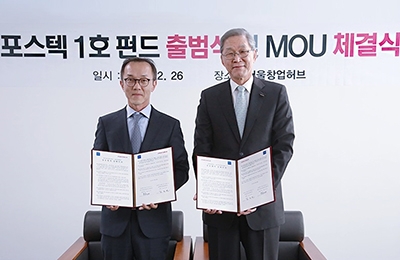
[The University for Venture Support – The First and Largest Private Fund Creation of new markets and jobs for the betterment of the local community] POSTECH has embarked on its new voyage to create real-world socioeconomic value through job creation and entrepreneurial activities upon its 30 years of research-oriented foundation. On February 26, Dr. Doh-Yeon Kim (President of POSTECH), Hosung Hwang (CEO of QUAD Investment Management), and Prof. Young Chul Sung (Chairman of Genexine) convened at the Seoul Startup Hub for the Establishment Ceremony of the 1st POSTECH Fund. With a value of KRW 53.5 billion, this venture support fund was jointly established by the University and private investors, and is the first of its kind. The Fund began with a stock donation of KRW 10 billion by the founder of Genexine—Prof. Young Chul Sung (POSTECH Division of Integrative Biosciences and Biotechnology). Once POSTECH declared that the fund will be utilized to invigorate and support startups, additional investments poured in from members of the private and corporate sectors who had faith and confidence in the research capacity of the University. The Fund will focus on startups in the biotechnology, health care, and IT fields along with other startups based on technology owned by POSTECH, and will be managed by QUAD Investment Management. At the initial phases, POSTECH, through the KRW 5 billion fund managed by POSTECH Holdings, encourages the entrepreneurial activities of students and members. For the startups that demonstrate solid business feasibility, the University will facilitate additional investments through the POSTECH Fund, effectively providing a continuous investment system throughout the early stages of establishing a startup. POSTECH has spearheaded the creation on the Fund to energize entrepreneurial activities of both members of the University and the local community. Furthermore, POSTECH anticipates the creation of a virtuous cycle where successful startups invest in POSTECH, much like Genexine. This cycle is the actualization of the Value Creating University vision that aims to create Socioeconomic Value by connecting Human Value and Knowledge Value to entrepreneurship and job creation. Doh-Yeon Kim, the President of POSTECH, explained, “There are many people who dream of establishing a successful company, but the risk of failure compounded by the many instances of the sheer difficulty to recover economically from such a failure has served as a barrier from entrepreneurial activities. The 1st POSTECH Fund will serve as a solid support system for not only members of POSTECH but all young visionaries to realize their startup goals.” President Kim also remarked that “The 1st POSTECH Fund will play a vital role in the fostering of a healthy startup ecosystem based on the outstanding Human Value and Knowledge Value of the University. POSTECH looks forward to the creation of high-value industries such as biotechnology and health care around the campus that will contribute to the local economy.”
2018.04.17 2117 -
POSTECH-Yonsei University, Beyond the Boundaries of the University
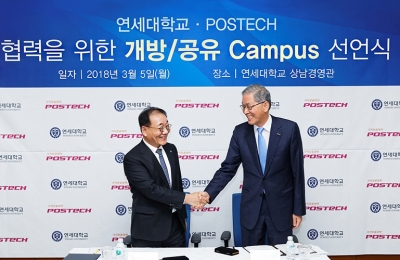
POSTECH and Yonsei University announced a new model of cooperation to move beyond the boundaries of universities. On March 5th, POSTECH and Yonsei University held a joint press conference where they announced the establishment of an all-encompassing model of cooperation between the two universities in both as a proactive response to the ever-changing global landscape and as a reaffirmation of their passion to lead the progress of higher education. The most noteworthy of the field of cooperation will be in education. POSTECH, the leading science and technology university in Korea, and Yonsei University, an elite university robust with tradition, will pool their resources to create a transcendent collaborative educational system that will converge both technical and holistic education. Starting from 2018, both universities will open all their respective courses to each other and ultimately will seek to develop a joint degree program. POSTECH and Yonsei University will also jointly develop concentrated lecture systems, Nano Degree programs, modular curriculums, and other innovative educational programs. Furthermore, the universities will develop a digital-based educational platform and will progressively make it available to all universities in order to foster an Open Education Platform. The two universities also plan to create synergy in research as well. For POSTECH and Yonsei University professors who partake in joint research with each other, the universities will appoint them as concurrent professors so that they may take full advantage of all available resources of the respective universities, such as research centers, laboratories, and MOOC based educational platforms (POSTECHx), in order to actualize world-class research teams and facilities. POSTECH and Yonsei University reaffirmed their wholehearted dedication towards social engagement and vowed to pursue joint research projects that will create solutions for the betterment of tomorrow’s society. While simultaneously striving towards the establishment of a joint institute for intimate collaboration, the two universities plan to create novel socioeconomic value through a comprehensive industry-academia-research model that breaks down existing barriers. Another important plan is the joint development of the future-oriented Blockchain Campus that will enable a more active and efficient sharing of resources. POSTECH and Yonsei University are both determined to use blockchain technology—widely recognized to play an integral role in the 4th Industrial Revolution—to bring down boundaries throughout the campuses. POSTECH President Doh-Yeon Kim remarked that, “In our rapidly transforming society, universities must recognize the need for institutional cooperation and collaboration that transcends existing models in order to faithfully execute their duties of education, research, and societal contribution. The POSTECH-Yonsei University cooperation will be at the vanguard of Korea’s higher education to create new value and contribute to the betterment of society.” Yonsei University President Yong-Hak Kim added that, “Yonsei University will actively participate in creating solutions for the future and will strive to meet the demands of society by fostering creative leaders equipped to tackle the 4th Industrial Revolution. Breaking down the barriers between universities is but another step towards the realization of that goal.”
2018.04.13 2119 -
POSTECH Unveils ‘Value Creating University’ UI
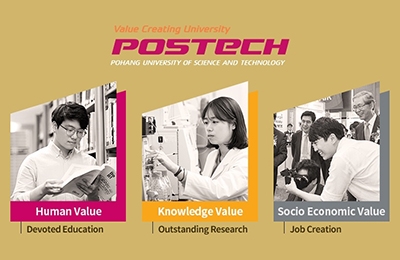
POSTECH has unveiled its new UI (University Identity) that corresponds to the ‘Value Creating University’ vision. During POSTECH’s 30th anniversary ceremony in 2016, the University declared a new vision to build upon its 30 years of research-oriented foundation and take the next step into becoming a Value Creating University. Based on human value through devoted education and knowledge value through outstanding research, Value Creating University is an institution where its policies and systems are directed to both maximize economic value through entrepreneurial activities and expand social value through job creation and contributions to society. Since 2016, POSTECH has been implementing innovative policies in education and research, from novel approaches in faculty recruitment, admission system, and undergraduate education, to reorganization of academic departments, among others. As such, the existing UI that represents the innovative spirit of POSTECH was updated with an italicized Value Creating University that represents the vision’s challenging spirit. Accordingly, the color of the slogan is POSTECH Orange, which both maximizes visibility and creates a harmonious balance with the POSTECH Red. In addition to this traditional version, a more contemporary version that accentuates the English slogan will also be available to meet any demands. The new UI will be adapted into 10 application-specific designs that will permeate throughout the campus, from business cards, PowerPoint templates, and souvenirs, among others.
2018.04.02 2585 -
POSTECH expands its teacher training program
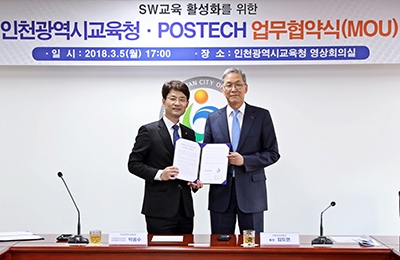
Incheon Metropolitan City has newly joined the group of POSTECH’s governmental partners to educate its elementary and secondary school teachers on how to better teach students on computational thinking and digital literacy. Computational thinking and digital literacy are deemed as a defining feature of the future and an extremely important skill that the younger generation should be learning to succeed in a fast-changing landscape of today and tomorrow’s society. Since 2017, POSTECH has been collaborating with provincial governments and their offices of education to offer teachers open-online courses and offline training on the campus to help them acquire a better understanding of these important skills. POSTECH also has been running a content warehouse platform for pedagogical resources and providing the teachers with creative contents they can utilize for class activities. South Korea’s Ministry of Education announced its plan in 2015 to add coding to the compulsory educational curriculum effective in 2018 as part of a wider undertaking to prepare for the 4th industrial revolution. With the need for qualified teachers becoming ever greater, POSTECH took the initiative to “Teach the Teachers.” The educational program, developed in collaboration with the Yeosijae think tank, provincial governments and their offices of education, came amid efforts to support the educational innovation as the nation’s flagship university. Incheon has become POSTECH’s 4th governmental partner following Chungnam, Gyeongbuk, and Daegu offices of education.
2018.03.09 1838