News & Updates
-
New Postechians matriculated as undeclared major
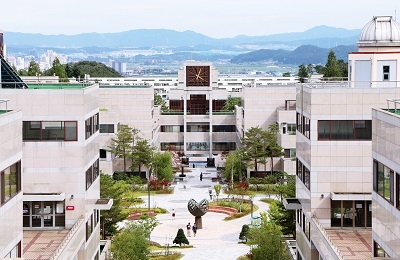
POSTECH matriculated its first class of the heralded Mueunjae School of Undergraduate Studies on February 26, 2018. A total of 335 freshmen (including 20 students for Creative IT Engineering) took their new steps as Postechians. To foster talented individuals with a wide breadth of experience, POSTECH have had its first fully open admission process for 2018 where all incoming freshmen were admitted as undeclared majors, and admission quotas were removed from all departments. POSTECH implemented the undeclared major admission process to help freshmen enjoy a whole year of flexibility, exploration, and challenge in their academic pursuit without being tied to majors. The students are encouraged to freely explore diverse academic interests and immerse themselves in the joy of learning without fear of hurting their GPA. When declaring a major later, students can choose a major of their interest regardless of their GPA as there is no fixed quota or cut-off score. “You who have matriculated entirely with undeclared majors are the protagonists of educational innovation of Korea,” said President Doh-Yeon Kim in his matriculation address. As the first class of Mueunjae School of Undergraduate Studies has embarked on their academic pursuits, President Kim emphasized that “there will not be any fixed roads.” The newest Postechians will learn to “have the strength to go instead where there is no path and leave a trail” as “boundaries of nations and cultures will fade away, and all areas of academics and technology will transcend barriers to converge,” according to President Kim. Mueunjae School of Undergraduate Studies was named after the nom de plume of Dr. Hogil Kim, the First President of POSTECH, and Mueunjae means ‘academics without boundaries.’
2018.03.09 2465 -
POSTECH, Value Creating University
In commemoration and celebration of its 30th anniversary, POSTECH declared a new vision in 2016 for the next three decades to propel itself to becoming a Value Creating University. Building upon its foundation of research excellence, POSTECH has poised itself to take another leap forward as a flagship institution of higher learning. As a Value Creating University that enriches and advances the nation and humanity, POSTECH has defined its mission as leading the proliferation of these three values: Human Value, Knowledge Value, and Socio-Economic Value. While continuously dedicating itself to providing the finest education and fostering talents, as well as conducting pioneering research, POSTECH strives to further build upon these Human Value and Knowledge Value to make direct contributions in leading the socio-economic progress of society. In such endeavors towards becoming a Value Creating University, since 2016, POSTECH has refurbished its systems and implemented innovative policies in recruitment of academic staff, student admissions, undergraduate curriculums, and restructure of faculties and departments.
2018.03.01 1823 -
PAL-XFEL, the 4th Generation Light Source at Pohang Accelerator Laboratory
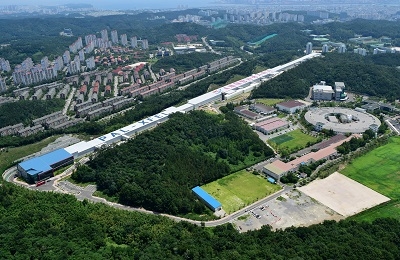
The 4th generation light source (X-ray Free Electron Laser) is a facility that accelerates electrons up to the light speed and creates a strong x-ray, allowing scientists to observe ultrafast phenomena in nano-worlds. It is a building-sized super-microscope, in a simple description, that can analyze biostructures and their dynamic reactions at the atomic level. The 4th generation light source distinctly sets itself apart from those of previous generations in many ways. The most noticeable difference is its long, rectangular shape unlike the circular form of the 1st, 2nd, and 3rd generation models, which use the synchrotron radiation emitted to the tangential direction as the orbit of the electron beam is bent out when the electron beam passes through a dipole magnet. The XFEL, the 4th generation light source, produces a light much coherent like a laser that can travel a long distance without breaking its collimation and still stay strong. The XFEL has an extremely short wavelength, a speed faster than lightening, and the brightness 10 billion times greater than the 3rd generation light source (10 quadrillion times of the sunlight). With this ultrafast, ultra-bright, and ultra-small light, it becomes possible for scientists to observe matter at nanoscale levels, as small as 1/40 of the thickness of human hair, and capture moments as short as one ten-trillionth of a second in which molecules are bonding and breaking. Scientists anticipate that using the XFEL they can tap the uncharted frontier and pioneer groundbreaking innovations in science and technology. As the XFEL is extremely useful in the examination and analysis of protein structures and molecular chemical reactions that require utmost sensitivity, it may now be promising to find solutions for incurable diseases such as dementia and diabetes. The XFEL is expected to play a key role in making a giant leap not only in the medical, but also in new materials and semiconductor industries.
2017.11.18 1679 -
Happy Chuseok for the POSTECH International Community
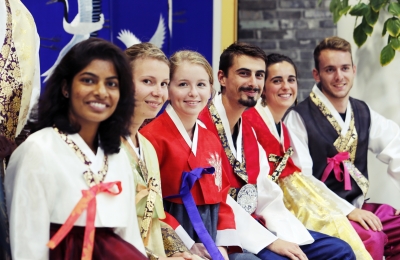
POSTECH international community members and their families gathered at the Student Union on Wednesday, September 27 to celebrate the Korean thanksgiving, also known as Chuseok, in true Korean fashion with festivity. The event, organized by POSTECH International Relations and International Student and Scholar Services (ISSS), gave the POSTECH international community an opportunity to better understand Korean traditions and experience Chuseok. More than 180 participants attended the event, where they got to dress up in traditional Korean attire called Hanbok and had dinner followed by Songpyeon, the signature rice cake for Chuseok. Stephanie Broaden, an exchange student from University of Illinois at Urbana-Champaign, shared that she greatly enjoyed the event and the opportunity to learn about the traditions surrounding Chuseok. “The Chuseok Celebration kindly organized by ISSS was a wonderful introduction to Korean traditions,” said another attendee, Aizhan Ismukhanova. She is a master’s student from Kazakhstan who has just started her degree program in Chemical Engineering at POSTECH. “The idea of wearing Korean traditional clothes, Hanbok, was the most intriguing and beautiful part of the evening. And certainly, I was very excited to try Songpyeon, the rice cake that symbolizes Chuseok.” Aizhan was glad that the Chuseok holiday started with such a friendly and warm celebration. Mingling with other POSTECH international members from all around the world, she felt that she was a member of a big international family, especially more significant since Chuseok is the time of the year when the whole family gathers.
2017.10.12 1858 -
POSTECH researchers winning Marcus A. Grossmann Young Author Award
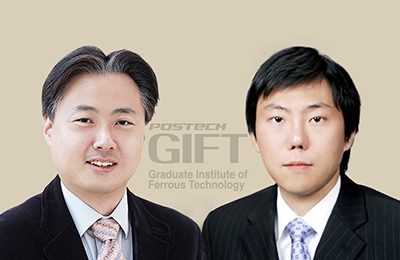
Dr. Sung-Hoon Jung and Prof. Youn-Bae Kang with the Graduate Institute of Ferrous Technology at POSTECH have been selected as the 2017 Marcus A. Grossmann Young Author Award recipients. Bestowed by AMS International, the world’s largest association of materials-centric engineers and scientists, this award honors young researchers whose paper has been selected as the best of those published in a specific volume of Metallurgical and Materials Transactions. Dr. Jung and Prof. Kang conducted research to better understand the evaporation refining of Cu and Sn in molten ferrous scrap. They examined and analyzed the effect of S and C, using a comprehensive evaporation kinetic model and proposed optimum conditions of steel compositions for the rapid evaporation of Cn and Sn. They published the findings in a paper entitled, "Simultaneous Evaporation of Cu and Sn from Liquid Steel." Upon publication, their paper was widely acclaimed and selected as the Editor’s Choice for Open Access and also This Week’s Featured Article by the International Metallographic Society. The Marcus A. Grossmann Young Author Award was established in 1960 in recognition of Dr. Grossmann's accomplishments and especially in recognition of his abiding interest in and encouragement of younger metallurgists and materials engineers. The author must be under 40 years of age on January 1 of the year in which the paper was published to be considered for the award. The award ceremony will be held at the Materials Science and Technology 2017 Conference and Exhibition in Pittsburgh, USA, during October 8-12 this year.
2017.09.28 1740 -
POSTECH wins consecutive Science War
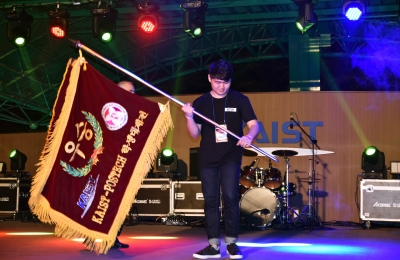
POSTECH has conquered KAIST for two years in a row in their annual friendly competition known as the “Science War.” It has been six years since POSTECH’s last consecutive wins. The 2017 POSTECH-KAIST Science War was held on September 22 and 23 at KAIST. This year’s competition consisted of hacking, artificial intelligence programing, science quiz, e-sports (League of Legends), soccer, baseball, and basketball. POSTECH beat KAIST, winning four out of the total seven matches. KAIST had an auspicious start as they won the soccer and baseball matches. Nevertheless, POSTECH outclassed its opponent in the 12 hour-long computer hacking match and won by a landslide, seizing the shift in momentum. POSTECH made a clean sweep in the science quiz, e-sports, and AI programming and confirmed its overall victory. The Science War has been held every September since 2002, and the two universities take turns in hosting the event. It serves as an opportunity for students from both universities to celebrate their friendly rivalry and expand their network with each other through competitions in various fields of science, e-sports, and sports. The all-time Science War record is 7 wins for POSTECH and 8 wins for KAIST. POSTECH will be hosting the event next year.
2017.09.26 1819 -
POSTECH Teaches the Teachers How to Teach Coding
POSTECH has launched a new educational program for elementary and secondary school teachers to train them how to teach students on computational thinking and digital literacy through basic coding. Starting this September, POSTECH will offer teachers open online courses and offline training on the campus to help them acquire a better understanding of computational thinking, or the thinking behind coding. The program is also to serve as a content warehouse platform for pedagogical resources and provide the teachers with creative contents they can utilize for class activities. Computational thinking (CT), as described in Google for Education, “is a problem-solving process that includes some characteristics, such as logically ordering and analyzing data and creating solutions using a series of ordered steps (or algorithms), and dispositions, such as the ability to confidently deal with complexity and open-ended problems.” It is deemed as a defining feature of the future and an extremely important skill that the younger generation should be learning to succeed in a fast-changing landscape of today and tomorrow’s society. In this backdrop, South Korea’s Ministry of Education has announced its plan to add coding to the compulsory educational curriculum effective in 2018 as part of a wider undertaking to prepare for the 4th industrial revolution. The need for qualified teachers has never been greater. POSTECH’s Teach the Teachers initiative, developed in collaboration with the Yeosijae think tank, provincial governments and their offices of education, comes amid efforts to support the educational innovation as the nation’s flagship university. In May 2017, POSTECH signed a Memorandum of Understanding (MOU) with Chungnam Provincial Government and Chungnam Provincial Office of Education to facilitate the program. Gyeongsang Province is next in line for collaboration. POSTECH plans to gradually extend the program nationwide.
2017.07.26 1972 -
POSTECH Students Welcome Summer Experience in Society (SES)
Postechians are off to enjoy the extended three-months-long summer vacation, all ready to immerse themselves in society. In 2016, POSTECH announced a change in the academic calendar to extend the length of summer vacation to three months, introducing yet another innovation. Three-month-long summer vacation is quite unusual in Korea’s higher education system as most other universities have less than 10 weeks for summer recess. POSTECH has made the bold move in order to provide its students with sufficient time and institutional support to pursue their interests in greater depth. The extended break makes it easier for students to participate in overseas programs, travel, or start their own business. It also facilitates students’ career path exploration and hands-on experience building by interning at global corporations or research institutes through the university’s internship match-up program called Summer Experience in Society, aka SES. SES connects POSTECH students with summer internship opportunities at more than 230 institutions including global corporations, domestic and overseas research institutes, and venture companies. From Samsung, LG, SK Hynix, SAP, and Oracle to Max Planck Laboratory, Fields Institute, KIST, Genexine, and Lendit, the list of participant goes on. The wide variety of institutions, out of which students can choose to intern with, offers students numerous options regardless of whether they dream to be a researcher, to work for a global business firm, or to become a CEO of their own company. Currently in its third year, the SES program has attracted more than 270 student participants this year. POSTECH hopes that measures like the extended summer break and SES will drive students to challenge themselves with new tasks and accumulate experience. “Our students will be living in a society that is far different from the one we are living in. A revolutionary and innovative education will be the key to fostering leaders for the era of changes,” President Doh-Yeon Kim explains. “We hope to give our students the full support they need to acquire a comprehensive skill set befitting future leaders.”
2017.07.26 1845 -
Prof. Hyung Joon Cha Named Inventor of the Year
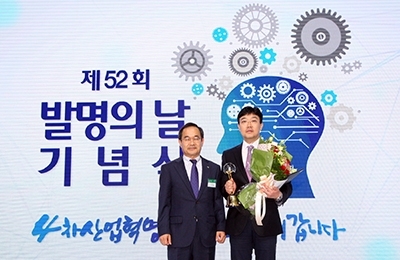
POSTECH Professor Hyung Joon Cha received the Inventor of the Year Award from the Korean Intellectual Property Office (KIPO) at the 52nd Anniversary Ceremony for Korea’s Invention Day on June 14th, 2017. Cha, a professor at the Department of Chemical Engineering, was awarded the honor in recognition of his contribution to developing innovative technologies to produce next-generation materials on a commercial scale. He is the first in the world to engineer mussel protein-based bioadhesive inspired by how mussels attach themselves to underwater surfaces. While commonly used medical adhesives such as cyanoacrylates are chemically derived and likely to provoke an adverse reaction, Cha’s bioadhesive has high compatibility with the human body. In addition, its strong adhesiveness in wet conditions and easy mass production opens possibility for myriad medical applications including tissue engineering, bio-sensors, drug delivery, cosmetics, and veterinary uses. Cha’s invention is expected to increasingly lead the global medical adhesive market with a 50% share, contributing to the advancement of national industries. Since he joined POSTECH in 1999, Cha has created 135 intellectual properties including 23 international patents, 47 domestic patents, 34 international patent applications, and 31 domestic patent applications.
2017.07.26 1851 -
POSTECH Rowing Club Wins Silver Medal at National Rowing Championship
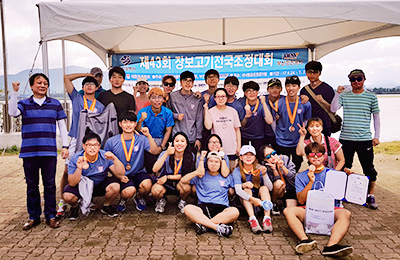
POSTECH’s new rowing club, only one year old, earned medals at the 2017 Jang Bogo Flag National Rowing Championship, which took place at West Nakdong River Rowing Arena on July 1-2, 2017. In its 43rd year, the two-day event is the most respected competition of its kind in the country. POSTECH rowing club placed in second and third in Women’s Collegiate Coxed Four (4+) and Men’s Collegiate Eights, respectively. POSTECH rowing club, the university’s first official athletic team, was established in May 2016 as part of the efforts to foster well-rounded global leaders equipped not only with intelligence and moral virtues, but also with physical strength. Only after a year of training, they have achieved success at the national level competition. POSTECH will also participate in the Korea National Collegiate Championship at the end of this month. Nine universities including SNU, Korea Univ. and Yonsei Univ. will be competing for the national title. As it will be POSTECH’s debut in the competition, POSTECH is placed in the extra round and excluded from the rankings.
2017.07.07 1987