News & Updates
-
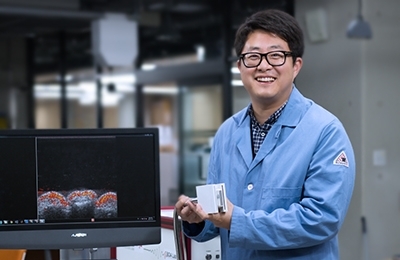
First Korean Biomedical Researcher to Win IEEE-EMBS Early Career Achievement Award
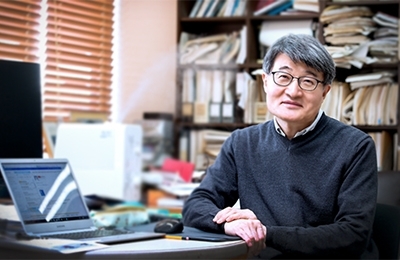
Chulhong Kim, Associate Professor of Creative IT Engineering at Pohang University of Science and Technology (POSTECH), has been selected to receive the 2017 IEEE Engineering in Medicine and Biology Society (EMBS) Academic Early Career Achievement Award for his contributions to ‘multi-scale photoacoustic imaging from super-resolution atomic force photoactivated microscopy for research to systems for clinical applications.’ This highly prestigious award is given annually to an individual “for significant contributions to the field of biomedical engineering as evidenced by innovative research design, product development, patents, and/or publications made by an individual who is within 10 years of completing their highest degree at the time of the nomination.” The distinguished award by the world’s largest international society of biomedical engineers has never before been awarded to researchers affiliated with a Korean university. The only previous recipient of Korean ethnicity was Yongmin Kim, also a Professor and Past President at POSTECH, while he was a faculty member at the University of Washington, Seattle in 1988. Chulhong Kim’s research has made remarkable contributions to the development of novel biomedical imaging techniques including photoacoustic tomography, ultrasound-modulated optical tomography, fluorescence imaging, and ultrasound imaging. Particularly, his lab at POSTECH developed world-first photoacoustic gastro-intestinal tract imaging using organic agents, photoacoustic cystography, clinical photoacoustic/ultrasound imaging scanner (clinically translated with Alpinion Medical), fast optical-resolution photoacoustic microscopy based on a 2-axis water-proof MEMS scanner (licensed to MGB; spin-off company, PAMsTECH), virtual intraoperative photoacoustic surgical microscopy, raster scanning based photoacoustic whole body imaging of small animals, combined photoacoustic and optical coherence tomography using a single pulsed broadband laser source, etc. Before joining POSTECH, Kim received his Ph.D and postdoctoral training at Washington University in St. Louis, and was an Assistant Professor of Biomedical Engineering at the University at Buffalo of the State University of New York. He has published 95 peer-reviewed articles in journals including Nature Nanotechnology, Nature Materials, Chemical Reviews, Light Science & Applications, Nano Letters, ACSNano, Radiology, Scientific Reports, etc. His Google Scholar h-index and citations have reached 37 and over 5,500, respectively. His group’s works have been selected for the 2016 and 2017 Seno Medical Best Paper Award Finalists in Photons Plus Ultrasound Conference (the largest conference in the field), Photonics West, SPIE. He has currently served as an Editorial Board Member of Scientific Reports and Photoacoustics Journal, and a Guest Editor of Journal of Biomedical Optics and IEEE Pulse Magazine. He has served as an Organizing Committee for the conference on “Photons plus Ultrasound: Imaging and Sensing” and “High-Speed Biomedical Imaging and Spectroscopy: Toward Big Data Instrumentation and Management” held annually under auspices of SPIE (Photonics West) and as a Theme Co-Chair for the 39th Annual International Conference of the IEEE-EMBS. The IEEE Engineering in Medicine and Biology Society is the world’s largest international society of biomedical engineers. The Society benefits both humanity and its members by advancing medicine and biology through the application of engineering sciences and technology, promoting the profession of biomedical engineering, fostering professional development and recognizing excellence, presenting conferences that bring together scientists, engineers and physicians from multiple disciplines to disseminate knowledge and solve complex problems, establishing technical standards, and providing global leadership for the profession.
2017.06.28 2216 -
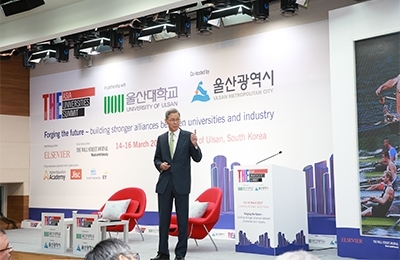
President Doh-Yeon Kim Speaks at THE Asia Summit in Ulsan
President Doh-Yeon Kim spoke on the subject of university-industry collaboration at the Times Higher Education’s Asia Universities Summit, which drew over 220 academic leaders and delegates from 86 institutions across 24 countries. The three-day summit with the theme of “Forging the future – building stronger alliances between universities and industry” was co-hosted by University of Ulsan and Ulsan Metropolitan City, the industrial capital of Korea. President Kim started his talk, titled “Driving innovative cooperation: a new paradigm of University-Industry partnership,” with an African proverb saying, “If you want to go fast, go alone. If you want to go far, go together,” to emphasize the importance of collaboration. POSTECH, founded in 1986 as Korea’s first research university, is to become a university that creates value and directly contributes to society through cooperation, according to President Kim. He pointed to POSTECH’s various collaborative efforts with different sectors – with alumni, the cities of Pohang and Ulsan, as well as corporations. A case in point was the POSTECH-Industry Integrated Research Center, which invites researchers from industries as tenure-track professors to bridge research collaboration and share their field expertise. President Kim plans to recruit 150 new professors during his term, and one third of them will be through the POSTECH-Industry Integrated Research Center. President Kim added that the university is helping students create and successfully run startups through mentoring with the Association of POSTECH Grown Companies (APGC) and entrepreneurial support from APGC-Lab, an on-campus startup incubator. To overcome the economic stagnation in the two major industrial cities of Korea, Pohang and Ulsan, POSTECH is also leading the “Univer+City” forum, a collaborative initiative with the two cities’ governments, local chambers of commerce, and other higher education institutions in the region. 2017 THE Asia Universities Summit was in its second run this year. It will be hosted by South University of Science and Technology of China (SUSTech) next year in Shenzhen, China.
2017.05.30 1820 -
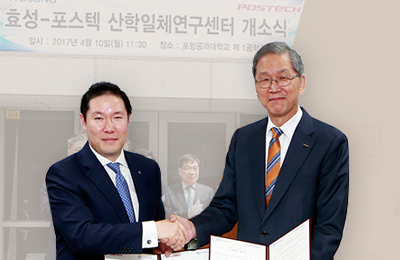
POSTECH Steps up Collaboration with Industry
POSTECH has moved up a gear in its collaboration with industry as it welcomes Hyosung, South Korea’s leading chemical and textile company, onto its campus. Hyosung and POSTECH signed a memorandum of understanding (MoU) in April 2017 to open a joint research center as part of POSTECH’s “University-Industry Integration (hereinafter UII)” initiative. POSTECH launched the UII movement last year to take university-industry collaboration to a higher level. POSTECH has been long known for its strong link with industry. The university has topped the recent list of universities publishing the highest proportions of their research output in collaboration with industry, according to Times Higher Education. Yet again, POSTECH’s leadership has been developing even a stronger drive to bring the university and industry closer. POSTECH’s UIC initiative involves two main projects: 1) establishing on-campus University-Industry Integrated Research Centers and 2) running a University-Industry Professorship program. POSTECH currently runs two centers – with LG Display founded in April 2016 and with Hyosung, the new partner. LG has been a close partner with POSTECH since the founding years as one of the university’s main buildings was built and named by LG in 1998. Joint research with LG Display on various subjects in display-related fields has been going strong for more than 6 years, and it is poised to reach greater heights with the opening of the Integrated Research Center. With Hyosung, research will focus on steel cords, the company’s main product, with an aim to push Hyosung to the top place in the global market. There are some universities in the world that run a corporate joint research lab/center on campus such as Rolls-Royce@NTU Corporate Lab at Nanyang Technological University. POSTECH’s U-I Integrated Research Center, however, is the first of its kind in Korea In addition to the research centers, the University-Industry Professorship forms the essential core of POSTECH’s UIC endeavor. The program allows the university to identify and recruit exceptional researchers as its tenured faculty members in collaboration with corporations. Corporations would make recommendations to the university on competitive researchers who have field-expertise and insights on market-oriented technologies, and the university make the final decision. The salary of U-I Professors will be jointly paid for by the corporation and the university as they are the bridge between the two institutions and will lead joint research to benefit both. POSTECH has recently hired its first University-Industry Professor with LG Display. Prof. Wook Sung Kim, who held the position of Principal Research Engineer at LG Display where he had worked for over 26 years, is now to lead R&D on post-OLEDs at POSTECH-LG Display Integrated Research Center on campus. POSTECH will continue expanding its partnership with corporations. President Doh-Yeon Kim comments, “POSTECH strives to create value and make direct contributions to the society not only through its research but collaboration with the business sector.”
2017.05.29 1996 -
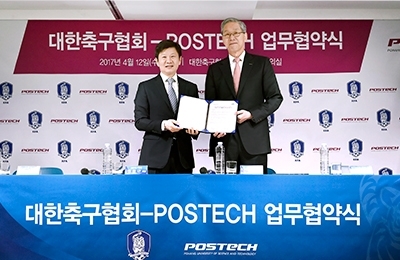
POSTECH’s technology to take Korean football to higher ground
POSTECH and Korea Football Association (KFA) have signed agreements on collaboration and use of technologies to make Korean football more competitive. Their partnership focuses on applying cutting-edge technologies to football, such as AI, IoT, and big data analysis, to give the national team a boost. High-speed, robotic cameras for lively broadcasting will lift the sport’s popularity, while players and prospects hone their skills in training with deep-learning methods. POSTECH President Doh-Yeon Kim notes that football is not merely a sport anymore but a culture, an industry, and possibly a parameter for measuring national development. President Kim hopes that POSTECH will help meet the increasing needs of advanced technologies in sports and make the Korean team stronger. Andy YS Kim, a professor at POSTECH whose specialty lies in sport engineering and ICT convergence, adds that the researchers will use AI to recognize and analyze the players’ performance patterns. High-tech wearable devices with an ergonomic design will synchronize with cloud platform to systematically assess players’ condition and provide data. Accumulated big data will then be translated into meaningful insights and strategies. The agreement, the first ever signed between KFA and a university, lasts for three years starting on April 12, 2017.
2017.05.15 1931 -
POSTECH is #1 in university-industry collaboration, according to THE
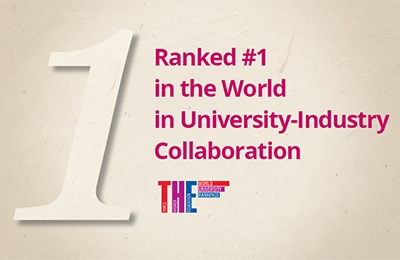
POSTECH boasts the most extensive industry collaboration in the world when it comes to applying sciences, according to the Times Higher Education (THE), a London-based leading publisher of higher education analysis and world university rankings. In its recently published article, South Korean universities lead way on industry collaboration, THE directed attention to the universities worldwide that publish the highest proportions of their research output in collaboration with industry. South Korean universities, with POSTECH in the forefront, are making great strides in forging stronger partnerships with industry. According to the Clarivate Analytics’ analysis, POSTECH has the highest research intensity in collaboration with industry, resulting in a total of 13,545 research publications during the period of 2007-2016. The proportion of these publications to POSTECH’s total research output is 22.98%, the highest in the world. INSA Lyon of France was ranked second with 18.01% of publications from industry collaborations. The list of top 50 universities includes MIT, Carnegie Melon, and Stanford University respectively ranked at 26th, 29th, and 50th. Five other South Korean universities also made the list – SKKU, KAIST, GIST, Hanyang Univ., and SNU ranked 8th, 11th, 32nd, 34th, and 37th, respectively. THE attributed South Korea’s strong university-industry collaboration and R&D intensities to its miraculous industrialization and rapid growth which began in the early 1960s when the nation was still poor and agricultural-based. South Korea’s proportion of GDP spent on R&D in 2015 was 4.23%, the second highest among OECD members. President Doh-Yeon Kim welcomed the result, noting that as of the 30th anniversary celebration last year, POSTECH has reaffirmed its commitment to creating value for society and the nation as a leading entrepreneurial university with a foundation of research excellence. He commented, “THE’s recognition of POSTECH’s strong links with industry adds momentum to our endeavor. We will continuously strive for the advancement of human life through application and commercialization of research outcomes as well as groundbreaking discoveries in basic sciences.”
2017.03.23 3170 -
POSTECH University Professorship Created as the Highest Honor of Distinction
POSTECH has established the University Professorship in efforts to recognize and further support its individuals of distinction. The title of POSTECH University Professor is to be bestowed to its tenured faculty members who are at the very forefront of excellence with powerfully influential research and knowledge. University Professorship is known to have been first created at Harvard University in the U.S. in 1935 as the university’s most distinguished professorial post. Since then, the program has been adopted by numerous prestigious universities worldwide as one of the most honorable entitlements granted to faculty members whose scholarship and groundbreaking work exceeds the conventional boundaries of academic disciplines. As the title of POSTECH University Professor is awarded only to faculty members who have demonstrated extraordinary achievements in teaching and research, the University Professors receive special honor and privileges. The benefits include extension in retirement age, special bonuses, and larger lab/office space with more graduate students, etc. There are currently two faculty members with this honorable title: Professor Kimoon Kim (Dept. of Chemistry) and Professor Kilwon Cho (Dept. Chemical Engineering). Prof. Cho has been newly awarded with the title, while Prof. Kim, who had previously held the title of POSTECH Fellow, was automatically elevated to POSTECH University Professor as the former honorary professorship was integrated into the new one. Since joining POSTECH in 1988, Prof. Cho has accomplished outstanding research achievements in flexible electronic materials based on organic semiconductor such as organic transistor and organic photovoltaics. In 2014, Thomson-Reuter listed Prof. Cho as one of the World’s Most Influential Scientific Minds based on the analysis of citation data over ten years (2002-2012). He also won the Duckmyeong Hanlim Engineering Award presented by the Korean Academy of Science and Technology in 2015 and was selected as the Scientist of the Month in 2010. Prof. Cho gave a special lecture on Interface Engineering for Organic Electronics in commemoration of the distinction on March 9th.
2017.03.22 1749 -
Cafeteria Turns into New Multi-purpose Hall Named “Haedong-Aurum”
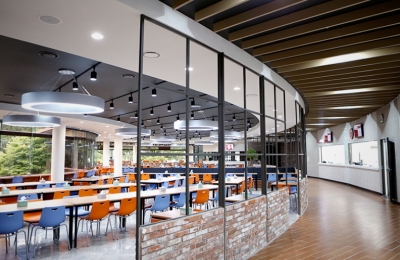
The Student Cafeteria, built during POSTECH’s first years, has been reborn after almost three decades as a multi-purpose hall that can serve as a dining hall, performing stage, studios for one-man media projects, or all at the same time. POSTECH held a ribbon-cutting ceremony for the new multi-purpose hall, named Haedong-Aurum, on March 21st 2017 with President Doh-Yeon Kim and Chairman Chung Shik Kim of Haedong Science and Culture Foundation, who contributed a significant portion of the remodeling cost, presiding. In June 2016, Chairman Kim made a KRW 500 million endowment to POSTECH. The donation was made in support of POSTECH’s initiative to create a cultural venue to stimulate students’ creativity and innovation. The multi-purpose hall was designed around the needs of students, who wanted larger spaces to do creative activities such as producing online content and student club performance. Students also wished to have group study rooms for discussions and collaborative projects. Haedong-Aurum is located inside Jigok Community Center near the residential area where students most frequently come and go. It is anticipated that Haedong-Aurum will be the hub of student activities and socialization in the community. The name Haedong-Aurum, which was selected through a naming contest, has various roots. The first part of Haedong-Aurum is named after the Haedong Science and Culture Foundation, a nonprofit organization with a mission to propel the development of Korean industries and support various science and education initiatives. The other half of the name, Aurum, comes from a Latin word that stands for gold (as with the element symbol Au). It also means a light that breaks dawn or the rising sun. In Korean, on the other hand, Aurum is a communal area that brings many together. “I hope that Haedong-Aurum will be a venue for all POSTECHians to interconnect, embrace each other’s difference beyond personal and academic boundaries, and strive together for a brighter future,” President Doh-Yeon Kim said. Chairman Kim of Haedong also noted that he is much delighted to see the younger generations committing themselves to academic pursuit for the betterment of the nation. Chairman Kim hopes that Haedong-Aurum supports POSTECH students’ endeavor to make best of their talents and contribute to the society.
2017.03.21 2102 -
Again and Better – POSTECH Ranked Third Best Small University in the World
POSTECH is the third best small university in the world, according to 2017 ranking by the London-based Times Higher Education (THE), a leading publisher of higher education analysis and world university rankings. POSTECH was number four in the 2016 THE ranking, behind California Institute of Technology (Caltech), and two of France’s most prestigious universities, École Normale Supérieure (ENS) and École Polytechnique. This year, POSTECH has climbed above École Polytechnique to claim third place. THE noted that “the structure and operation of POSTECH was inspired by Caltech” and how “this system of running a small science and technology research-focused university” has enabled POSTECH to replicate Caltech’s success and maintain its top five position in the World’s Best Small University ranking for two consecutive years. THE added that “POSTECH students hail the small classes and the fact that professors know them by name as one of the main reasons why they love studying there (at the university).” Caltech, the defending champion of the Best Small University ranking, has impressive credentials with successful graduates and affiliates that includes 34 Nobel laureates. World-famous scientists and engineers such as Albert Einstein, Linus Pauling, and Richard Feynman had been affiliated with the university. ENS, which remained in second place, is also an established institution well known for training of leaders in academia and public administration. École Polytechnique has produced three Presidents of France and many CEOs, as well. POSTECH is continuously ranked among the worlds’ most prestigious universities despite its short 30 year history, proving its excellence in research and education. “We will continue to achieve high-impact research and top-quality education and contribute to society with our excellence,” President Doh-Yeon Kim of POSTECH commented.
2017.03.01 2828 -
2017 FALL & 2018 SPRING GRADUATE ADMISSIONS
☞Apply for POSTECH☞Admission Guideline ☞Apply for POSTECH☞Admission Guideline
2017.02.17 3932 -
POSTECH Information session for Graduate Admissions in Seoul
☞Apply for the session☞Apply for the session
2017.02.13 2421