News & Updates
-
Haedong Science & Culture Foundation donates KRW 500M to POSTECH
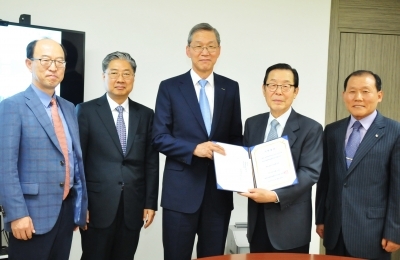
Haedong Science and Culture Foundation (hereinafter Haedong Foundation) has made a KRW 500 million endowment to POSTECH in support of our endeavor to strive for the world through science and technological developments. The foundation, established by Chairman Chung Shik Kim of Daeduck Electronics, is a nonprofit organization with a mission to propel the development of Korean industries and support various science and education initiatives. Haedong Foundation believes that the gift will help POSTECH members reach beyond their academic boundaries to bring forth and realize ideas that will change the world for better. The donation will fund POSTECH’s initiative to create spaces in Jigok Community Center with a purpose to stimulate students’ creativity and innovation.
2016.06.20 2181 -
Prof. Seung-Jae Lee and PhD Candidate Murat Artan Find Sensory Neurons Modulate Aging Hormone
Animals can perceive changes in many environmental factors such as temperature and the taste or smell of foods. This is achieved by specialized nerve cells called sensory neurons. Interestingly, sensory neurons have been known to control the rate of aging in various animals, including the tiny free living roundworm C. elegans. The impairment of sensory neurons has been known to delay aging by switching on the action of a well-known anti-aging protein called FOXO. FOXO then turns on the gene’s encoding proteins that protect cells and repair damages in various body parts. However, how sensory neurons influence the activity of the anti-aging FOXO proteins in an entire animal has remained a mystery. Prof. Seung-Jae Lee (Dept. of Life Sciences) and PhD candidate Murat Artan hypothesized that the smell or taste of food acts on sensory neurons, which may produce a type of aging hormone. This aging hormone may be delivered to various body parts and may affect the action of FOXO proteins. The team discovered that the smell or taste of food can directly shorten lifespan by affecting sensory neurons that produce insulin-6, an insulin hormone-like factor. They also showed that insulin-6 from sensory neurons alters the action of FOXO in various tissues. Their findings were published in Genes & Development as the cover article. They then attempted to turn on the function of only a pair of food-sensing sensory neurons by a blue light, a technique called optogenetics, to mimic the taste of food. Prof. Lee and Mr. Murat discovered that blue light itself can decrease the lifespan of animals through producing insulin-6 hormone that leads to the reduction of FOXO action without food taste or smell. It has been shown that perception of food increases the level of blood insulin hormone levels in humans. In addition, many biological processes related to aging are similar in C. elegans and mammals which include humans. Therefore, the team concluded that it is unsurprising to find that food smell or taste play similar roles in the aging of mammals via sensory neurons and hormones like insulin.
2016.05.26 6371 -
POSTECH Matriculates 828 New Students
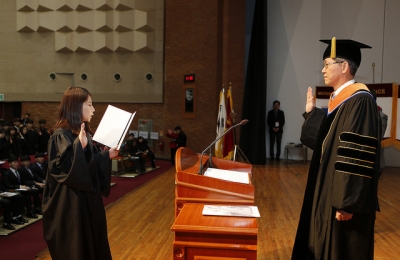
POSTECH welcomed a new batch of incoming students at the 2016 matriculation ceremony held at the university auditorium on Monday, February 29, 2016. A total of 828 students were matriculated, out of which 303 entered the undergraduate program, 146 the master’s program, 80 the doctoral program, and 299 the M.A/Ph.D. integrated program. Over one thousand guests including families attended the ceremony to celebrate and welcome the new students marking their beginning as Postechians. “The only thing worse than being blind is having sight but no vision,” President Doh-Yeon Kim quoted the famous activist, Helen Keller, in his remarks to the freshmen. He urged the students to “create a grand vision for [their] future and persistently work hard to realize it.” President Kim also ensured the students that “POSTECH is fully equipped for [them] to strive for excellence… and POSTECH will be a pillar of support.” Mr. Seokwoo Lee, an alumnus and the president of the Association of POSTECH Grown Companies (APGC), shared his advice for students in a special lecture under the theme of “POSTECH Universe.”
2016.03.02 2216 -
Honorary Doctorate Awarded to CEO Seok-Hyun Hong of JoongAng Media Network
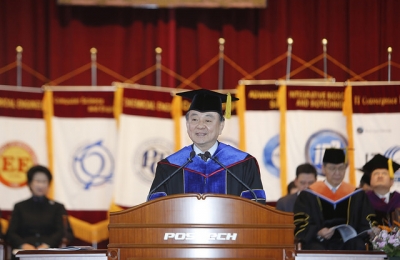
POSTECH awarded an honorary doctorate to Seok-Hyun Hong, chairman and CEO of the JoongAng Media Network, during the commencement on February 19, 2016. It is the fourth honorary doctorate conferred since the university's opening, and the first for a South Korean national. Chairman Hong is an engineering major, having received a bachelor’s degree in electrical and computer engineering from Seoul National University. He earned a master’s degree in industrial engineering and a doctoral degree in economics from Stanford University. Yet, Chairman Hong not only has been leading the largest media group in Korea, he has also served as a leader and contributed to the development of various sectors within society as an entrepreneur, scholar, administrator, and businessman. In addition to previously having worked for the World Bank and the Korea Development Institute, he was named, as the first figure from Asia, president of the World Association of Newspapers and News Publishers. Chairman Hong was an ambassador to the United States and also served as a board member of POSTECH. "Chairman Hong, who has persistently confronted such challenges in various areas, poses as an exemplary role model for our students," said President Doh-Yeon Kim in his conferment address. “The conferment of this Honorary Doctoral Degree…reflects our University’s founding tenets to nurture global leaders who contribute to the society.” In his acceptance speech titled “Own your life,” Chairman Hong advised students to be entrepreneurial and to lead a creative life. “First, we should discover the true meaning of our own lives hidden within ourselves. … Second, we must live an autonomous life. Only you can be the owner of your life,” Chairman Hong said. With an emphasis on the importance of studying habits, he also asked the graduates to sympathize with other people’s worries and troubles. Chairman Hong is the fourth recipient of an honorary doctorate, and second recipient of an engineering doctorate, awarded by POSTECH. Previous recipients of POSTECH’s honorary doctorate include Roderick MacKinnon, Rockefeller University professor and Nobel Prize laureate in chemistry; Jeong H. Kim, former Bell Labs president; and Peter S. Kim, former president of Merck Research Laboratories.
2016.02.29 1900 -
POSTECH Holds Commencement Ceremony for 2015 Academic Year
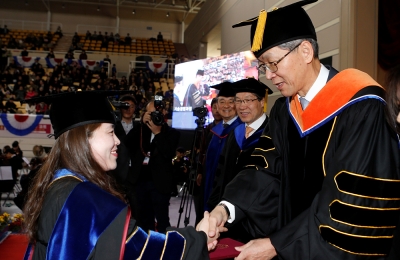
POSTECH recognized 773 candidates for degrees during its 2015 Academic Year Commencement Ceremony held last Friday, February 19, 2016, at the university gymnasium. The commencement was presented by over three thousand attendees including university members, graduates, families, and distinguished guests. The university awarded 102 bachelor’s degrees in science, 220 in engineering, 40 master’s degrees in science, 143 in engineering, 81 doctoral degrees in science, and 187 in engineering. The degree recipients included Seok-Hyun Hong, the chairman and CEO of the JoongAng Media Network, who was awarded with an honorary doctorate by POSTECH on that day. Outstanding graduates were honored during commencement. Mr. Mingu Kang, the valedictorian and the top student of the graduating class, received the Founding Chairman’s Award. Mr. Kang graduated summa cum laude with a cumulative GPA of 4.21. The second best student, Mr. Youngkyu Kim, received the Chairman’s Award. Ms. Choyeop Kim was given the Hogil Kim Medal (Mueunjae Award) for her contribution to the university development through various student activities and community service. President Doh-Yeon Kim said, “There will be no such thing as failure as long as you do not give up on your goals,” in his commencement address. President Kim asked the graduates to “become leaders who care only for their own success, but leaders who share with others and devote themselves to enriching the world.”
2016.02.29 1952 -
POSTECH Ranked 4th in the 2016 THE World’s Best Small Universities
POSTECH is the fourth best small university in the world, according to the London-based Times Higher Education (THE), a leading publisher of higher education analysis and world university rankings. Announced on January 26th (Korean time), THE ranked California Institute of Technology (Caltech) in the US as the top small university in the world. Two of France’s most prestigious universities, École Normale Supérieure (ENS) and École Polytechnique were ranked second and third respectively, and POSTECH followed was ranked fourth. The top three in the list are unquestionably prestigious universities, especially Caltech, which took the top spot in both the Small Universities and the THE World’s University Rankings 2015-16. Placed fourth in the world and first in Asia, the list shows that POSTECH ranks with the worlds’ most prestigious universities despite its short 30 year history. POSTECH was also ranked first for three consecutive years in the THE 100 Under universities since 2012, proving its excellence in research and education. “Since its opening, POSTECH has relentlessly strived to achieve high-impact research and top-quality education for select talented students,” President Doh-Yeon Kim of POSTECH commented. “Our efforts towards becoming the world’s best university will continue.” Click here to see the 2016 THE World’s Best Small Universities table Click here to read POSTECH students’ blog
2016.01.27 3618 -
Prof. Kimoon Kim Named One of the World’s Most Influential Scientific Minds of 2015
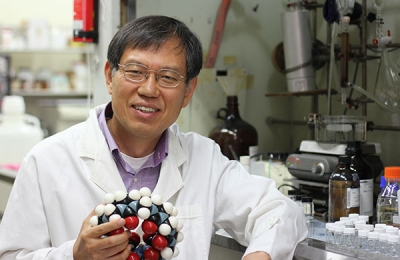
POSTECH Prof. Kimoon Kim (Dept. of Chemistry) has been named one of the World’s Most Influential Scientific Minds of 2015 by Thomson Reuters, the world’s leading source of intelligent information for businesses and professionals. Covering an 11-year period, Thomson Reuters identified scientists who have been prolific in the production of top-cited papers in their fields, designating them as Highly Cited Researchers, among which Prof. Kimoon Kim is listed. Prof. Kim is a prominent leader and an internationally recognized authority in the field of supramolecular chemistry. He is especially known for his work on a wide variety of functional materials based on cucurbiturils, a family of pumpkin-shaped macrocyclic molecules, and metal-organic porous materials useful for catalysis, separation and gas storage. Prof. Kim has authored and coauthored 265 papers which have been cited more than 22,600 times with an h-index of 74. In particular, his paper published in “Nature” in 2000, which reported the synthesis of homochiral nanoporous crystalline materials using self-assembly and an application for a chiral catalyst, was selected as one of the 35 most notable papers among chemical related papers published in “Nature” from 1950 to 2000 including Watson and Crick’s DNA structure, Kroto and Smalley’s discovery of fullerene, and Nicolaou’s Taxol total synthesis. Prof. Kim was also selected as one of the world’s top 100 chemists announced by UNESCO in 2011 to celebrate the 'World Year of Chemistry'. The World’s Most Influential Scientific Minds 2015 list was released on January 14, 2016.
2016.01.22 2762 -
POSTECH Joins Partnership with MOOC Giant Coursera
POSTECH began the New Year with a big step toward innovation by partnering with online education company Coursera to provide Massive Online Open Courses (MOOCs). POSTECH announced its plan to financially support students taking online courses available on MOOC platforms and give various incentives to encourage faculty to apply the Flipped-Learning model in their classrooms. The university has also started offering its high-quality courses to the world by establishing a partnership with Coursera, the leading provider of MOOCs. POSTECH undergraduate and graduate students are now able to receive a partial reimbursement for the expense they spend to obtain a completion certificate for online courses on MOOC platforms such as Coursera, edX, and K-MOOC. The initiative aims to guide students toward self-motivated, in-depth learning and provide broader opportunities to seek the world’s greatest knowledge in their interested fields anytime anywhere. Starting next semester, students will also be able to transfer their online course credits taken from the SKP Science and Technology MOOC initiative, same as a regular university course. Furthermore, not only students but also university administrative staff may complete MOOCs and have lecture hours count towards their professional development training while enjoying the same reimbursement benefit. POSTECH is the first Korean university to support the learning experiences of its members from undergraduate/graduate students to university staff. The partnership with Coursera also promises that POSTECH will have the opportunity to offer courses taught by POSTECH faculty to Coursera’s 15 million registered users. POSTECH will first offer courses related to ferrous technology, one of its strength areas, with plans to develop more online courses. “We hope to further enhance the quality of our courses by making them available to the world,” commented President Kim of POSTECH. “As our students will benefit from various MOOCs, our courses offered through the SKP Science & Technology MOOC Initiative and Coursera will inspire interest in science and technology among the wider public and society.”
2016.01.18 3648 -
POSTECH Ranked #1 in Science & Engineering in the JoongAng Daily University Rankings
POSTECH topped the JoongAng Daily University Rankings both in natural science and engineering, yet again proving that it is the best science and technology university in Korea. POSTECH excelled in both quantity and quality of research by receiving the highest score in the number of international journal publications and citation counts. POSTECH’s exceptional research quality had already been reported earlier this year as POSTECH took the third place in citations per faculty, a higher place than Harvard or MIT, according to the Quacquarelli Symonds’ (QS) list of World University rankings announced in September 2015. Citations per faculty are known to best measure research strength while taking into account the size of an institution because the more frequently a researcher’s work is cited by peers the higher the impact his/her work has in a given field. In the publication of its university assessment results, the JoongAng Daily, reported in detail, in particular, about POSTECH’s positive feedback loop for research strength, citing Professor Young-Chul Sung (Dept. of Life Sciences)’s development of a vaccine that can treat cervical intraepithelial neoplasia (CIN). Prof. Sung’s case shows that POSTECH’s superb research infrastructure and support creates outstanding outcomes that lead to high income back to the university through technology commercialization. The reinvestment of funding contributes to maintaining and enhancing POSTECH’s research environments in turn. POSTECH has also outperformed other universities in education, especially in faculty retention and educational expenditures per student compared to tuition fees. Students seem to be largely satisfied with their educational experiences at POSTECH, according to the JoongAng Daily assessments, as it recorded the highest completion rate (in other words, the least dropout rates) among universities specialized in science and engineering. The JoongAng Daily, one of the major daily newspapers published in Korea, annually announces university assessment results and rankings. POSTECH has been ranked number 1 nine times in the comprehensive assessment since 1994. This year, POSTECH was number one in science and engineering as the comprehensive assessments were divided into two types, humanities and social sciences on another side.
2015.11.26 2679 -
POSTECH Researchers Sweep Awards at Home and Abroad
POSTECH faculty, researchers, and students have been named as the recipients of prestigious awards at home and abroad in recognition of their outstanding research. Congratulations to all award recipients! Prof. Yun Sung Choi, Korean Math Society (KMS) Academic Award Professor Yun Sung Choi (Dept. of Mathematics) was selected as the winner of the KMS 2015 Academic Award in recognition of his academic achievement and contribution in the field of functional analysis. In particular, Prof. Choi’s research on the numerical index of Banach spaces, Bishop-Phelps theorem, and polynomials and multilinear mappings on Banach spaces was highly regarded. Prof. Junsuk Rho, Edmund Optics Educational Silver Award Prof. Junsuk Rho’s research team was recognized by Edmund Optics Inc and received the Silver Award in the 2015 Educational Award program. Edmund Optics Inc, a world’s leading producer of optics, imaging, and photonics technology, annually awards outstanding undergraduate and graduate optics programs at universities around the world. Prof. Rho’s team competed against more than 800 applicants this year and was awarded the Silver Award for development of a metamaterial hyperlens system for subwavelength bioimaging. Prof. Heecheon You, Korean Institute of Industrial Engineers (KIIE) Baek-Am Paper Award Prof. Heecheon You (Dept. of Industrial & Management Engineering) was awarded the 2015 KIIE’s Baek-Am Paper Award that honors the author of the best paper presented in the Journal of KIIE for the last three years. Prof. You’s paper entitlted “A Case Study of Eco-Design for a Small-Size Electric Heater by Performance, Usability, and Life-Cycle Assessments” was highly regarded for its exceptional scholarly value and industrial applicability. Dr. Seok Su Sohn, 2015 Steel Science Forum - Solution & Idea 1st Place Award Dr. Seok Su Sohn, an alumnus (Dept. of Materials Science & Engineering) and post-doctoral researcher at POSTECH, won the highest award in Solution at the 2015 Steel Science Forum hosted by the Korean Institute of Metals and Materials and sponsored by POSCO. Dr. Sohn suggested a solution that maximizes strength and ductility in steel using the “Development of Ferrite+Austenite Duplex Lightweight Steel by TRIP + TWIP (Transformation – and Twinning – Induced Plasticity).” Dr. Sohn’s solution received the highest score in creativity, feasibility, and cost effectiveness. Dr. Sung-Yong Min & Mr. Donghwi Choi – Samsung Electro-Mechanics (SEM) Inside Edge Thesis Competition Gold & Bronze Awards Dr. Sung-Yong Min, an alumnus (Dept. of Materials Science & Engineering) and post-doctoral researcher at POSTECH, won the Gold Award in the 11th Inside Edge Thesis Competition by Samsung Electro-Mechanics (SEM). Dr. Min’s thesis entitled “Low-temperature processed core-sheath conducting nanowires for flexible all-wire electronics” was selected as the best paper for its exceptional quality and scholarly value. Mr. Donghwi Choi, a doctoral student (Dept. of Mechanical Engineering), was also awarded the Bronze Award for his thesis, “Mass producible fabrication of transparent and flexible triboelectric nanogenerator based on thermal nanoimprint technology.” The SEM paper contest, annually held for encouraging fresh ideas and creativeness, received more than 300 abstracts from 33 universities this year.
2015.11.26 2700