News & Updates
-
Professor YunSung Choi Receives the Korean Math Society’s Academic Award
The Korean Math Society (KMS) announced on October 23 that POSTECH Professor YunSung Choi was selected as the winner of the KMS 2015 Academic Award. This selection took place alongside the 2015 KMS Fall Meeting held at Yonsei University. Professor Choi was selected as the award recipient in recognition of his academic achievement and contribution in the field of functional analysis. In particular, Professor Choi’s research on the numerical index of Banach spaces, Bishop-Phelps theorem, and polynomials and multilinear mappings on Banach spaces was highly regarded. Professor Choi earned a doctorate degree from the University of Rochester in New York, USA after graduating from Seoul National University. He has been a faculty member at POSTECH since 1988 and has served as the director of the Pohang Mathematics Institute since 2007. He was a member of the Organizing Committee for the International Congress of Mathematicians in 2014 and he became an editor of the Journal of Korean Math Society starting this year. The award ceremony took place on October 24 at the Science Hall at Yonsei University.
2015.10.28 2421 -
POSTECH Staff Wan Heup Song Listed in World Biographical Dictionary
University administrator Wan Heup Song of the POSTECH Future IT Innovation Laboratory will be listed in the Marquis Who’s Who in the World 2016. Administrator Song is the first ever Korean university staff member to be listed in the world biographical dictionary. He is a renowned expert in policy development for university research, industry-academia collaboration, and R&D support system. During his employment at POSTECH since 1989, Mr. Song has actively led over a hundred cases of policy research and publications. Annually published in the U.S, Marquis Who's Who in the World is one of the world’s top three publishers of international biographical reference directories, along with the American Biographical Institute (ABI) and the International Biographical Centre (IBC) of Cambridge, England.
2015.10.27 1932 -
Minister of Science, ICT, and Future Planning Visits POSTECH and APGC-Lab
Minister of Science, ICT and Future Planning, Yang-hee Choi, paid a visit to POSTECH on Monday, October 12. Upon the invitation of President Doh-Yeon Kim, Minister Choi visited the APGC-Lab at the Jigok Research Building and the Pohang Center for Creative Economy & Innovation (CCEI) at C5 to witness the growing collaboration of university and local economy and to encourage tenant companies and entrepreneurs. The POSTECH APGC-Lab, a startup incubator founded and supported by POSTECH and Association of POSTECH Grown Companies (APGC), opened in September 2014. Since its launch, the APGC-Lab has provided opportunities and support for student entrepreneurs to connect with experienced alumni and grow into hidden champions under their mentorship and guidance. Minister Choi had a meeting with startup teams participating in the APGC-Lab’s coaching programs and lent an ear to their concerns and needs in the field. In particular, the minister took great interest in learning the APGC-Lab’s activities and strategies to cultivate the entrepreneurship among the student body as the APGC-Lab is a unique, experimental business incubator that leads POSTECH’s technology commercialization. Following the APGC-Lab tour, Minister Choi moved on to look around the Pohang CCEI’s Dream Venture Lounge where tenant companies and their products are introduced.
2015.10.27 1000 -
POSTECH-TU Dresden to Establish a Joint International Research Training Group
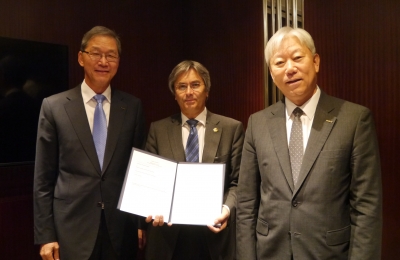
South Korea’s four research universities including POSTECH and Germany’s TU Dresden announced that they have agreed to engage in international research collaboration. POSTECH, Seoul National University (SNU), Yonsei University, UNIST, and TU Dresden signed a Letter of Intent on October 13 to establish a joint international research training group named ‘iEGSEMP Korea’ (International Excellence Graduate School on Emerging Materials and Processes) for training and research collaboration on Materials Science, a central field in academic and industrial research in both countries. This joint initiative is a fruition of follow-up efforts to further strengthen the Korean-German collaboration, succeeding the visit of the President of the Republic of Korea, Geun-hye Park, to Dresden and the honorary doctorate which she was awarded from TU Dresden in March 2014. According to the institutions involved, iEGSEMP Korea is to train ten PhD students, five from Germany and five from Korea, in a synergetic way in current topics of materials research for applications in electronics, energy and medical technologies. The formal signing ceremony took place alongside the Joint Korean German Conference "Science and Innovation," which was attended by the German Federal President, Joachim Gauck. The foundation of the international research training group was announced during the opening ceremony of this event and is recorded in the photograph of German Federal President Gauck with Prof. Doh-Yeon Kim (POSTECH), Prof. Mooyoung Jung (UNIST) and Prof. Hans Müller-Steinhagen (TU Dresden), the presidents of three of the five institutions involved. “Diverse experiences outside the classroom, and outside Korea, will be valuable assets for students wishing to become global leaders,” said President Doh-Yeon Kim of POSTECH. “I have no doubt that iEGSEMP Korea will allow Korean students to build international networks and hone their knowledge on the world stage. It will also add momentum to create more binational synergy between Korean and Germany.” Prof. Hans Müller-Steinhagen, the Rector of TU Dresden, also added after signing the Letter of Intent, "The PhD students will be working on highly innovative topics and they will greatly benefit from the close cooperation within the network of excellent partners in Germany and Korea." To allow them to gain international research experience and to promote the synergetic approach, the German and Korean PhD students will each spend six months at an institution in the partner country.
2015.10.27 1076 -
Professor Sung Ho Han Elected as President of the Ergonomics Society of Korea
Professor Sung Ho Han of the Department of Industrial & Management Engineering has been elected as the 18th president of the Ergonomics Society of Korea (ESK). Founded in 1982, ESK is one of major academic societies in Korea. ESK’s research areas include user interface, human factors, human sensibility ergonomics, occupational health and safety, and user experience management. Announced at the 2015 ESK Fall Conference held in Busan on Oct. 15, the newly appointed president, Prof. Han, will take the lead of ESK for the next two years with a focus on the globalization of ESK and increased convergence in its research with other disciplines. An authority in the field of ergonomics, Prof. Han has been a key player in various research activities that place ergonomics as the engine of future economy growth. Prof. Han’s research interests lie in experience design, experience management, and experience creation based on the user scenario generation techniques.
2015.10.27 2168 -
POSTECH to Develop Open Online Courses Together With SNU, KAIST
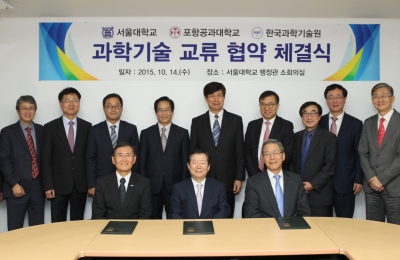
South Korea’s top three universities have come together to develop the highest quality STEM (Science, Technology, Engineering, and Math) courses one can find online. President Doh-Yeon Kim of POSTECH, President Nak-in Sung of Seoul National University (SNU), and President Sung-Mo Kang of KAIST gathered on Wednesday, October 14, 2015 and signed an agreement outlining their joint efforts to develop MOOC (Massive Open Online Course) content for basic STEM subjects. The agreement was born out of the three universities’ consensus that the traditional way of knowledge transfer is insufficient in elevating the quality of teaching and learning in the STEM fields. Faculty members of these universities will collaborate from the very initial stage of developing the curriculum and will produce contents for the online courses by summer 2016, which will be openly available to the public. They also plan to create an education model that utilizes the online contents and share with any higher education institution wishing to participate. For a start, online courses will cover the rudimentary knowledge of physics, chemistry, life sciences, mechanical engineering, chemical engineering, and materials engineering. The courses will be designed to spark interest in a wide range of audiences including high school students and undergraduate students majoring in not only STEM fields but also the humanities and arts. The MOOC contents will also be of great use to professors and instructors trying to apply the Flipped-Learning model in their classroom. The leadership of these universities are leading at the front line of this innovative initiative by undertaking the creation and teaching of online courses themselves in the initial stage. “As the jointly developed MOOC courses will bring the university faculty’s expertise and experiences, we hope that this initiative much contributes to enhancing youth’s foundation knowledge and popularizing science,” commented President Doh-Yeon Kim of POSTECH. “The collaboration of POSTECH, SNU, and KAIST could be a fresh stimulus to other universities.”
2015.10.27 1324 -
President Doh-Yeon Kim’s Inauguration Ceremony Held
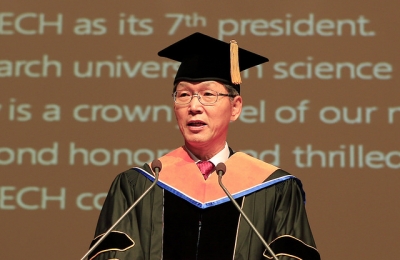
View President Doh-Yeon Kim's Inaugural Address English / Korean The POSTECH community came together on Tuesday, September 1, 2015 to mark the beginning of Dr. Doh-Yeon Kim’s term as the 7th president of POSTECH during his inauguration ceremony. Held at the POSTECH Auditorium, the inauguration ceremony was attended by over a thousand POSTECH members and distinguished guests ranging from academics and political leaders to local dignitaries. Among the distinguished attendees to grace the occasion were Chairman Ohjoon Kwon of the POSTECH Foundation, President Min Keun Chung of the National Research Foundation of Korea, President Nak-in Sung of Seoul National University, and Pohang Mayor Kang-duk Lee. During the ceremony, President Doh-Yeon Kim announced his pledge in his inaugural address to “devote [himself] … to ensure that POSTECH continues to fulfill its mission and hold true to its reputation as a leading university that shepherds the advancement of Pohang and Korea.” “It is the crucial role of universities to drive innovation and growth momentum in society”, President Kim said. “POSTECH is to become a flagship university, with a more daring and open heart, to steer our nation into a new direction of higher education and research.” President Kim outlined his plan for POSTECH and highlighted these three following points: 1) placing utmost priority and effort on educating the next generation of talent; 2) continuously pursuing excellence in research and translating into a concrete contribution to society; and 3) enhancing the university administration based on transparent and open management. President Kim quoted the Oriental classics to emphasize the crucial need for the POSTECH community to unite and harmoniously work toward the goal of standing in the vanguard of the world. President Kim, who began his presidential term on Tuesday, September 1, is admired as not only a distinguished scholar in materials science and engineering, but also an experienced leader devoted to Korea’s policy-making to innovate science and technology development. Currently a fellow of the American Ceramic Society, President Kim served as the minister of the Ministry of Education, Science and Technology and as the chairman of the National Science & Technology Council of Korea. He was also the president of the University of Ulsan. Ohjoon Kwon, the chairman of the POSTECH Foundation, expressed his “trust [in] President Kim’s excellent character and exceptional leadership,” during his remarks at the ceremony. POSTECH also hosted a celebration concert on Friday, September 11 to commemorate the inauguration of its seventh president.
2015.09.07 2574 -
Young Minds Learn How to Think Like Computer Scientists at POSTECH-NAVER Boot Camp
A group of eighty top-notch high school students from around the nation gathered on the POSTECH campus on August 3, 2015 for a rare opportunity to be immersed in the world of computer science and engineering at POSTECH-NAVER boot camp, also known as the Computational Thinking (CT) camp. Participants were selected at an acceptance rate of less than 15 percent for this joint initiative of POSTECH and NAVER Corporation (NAVER). The three-day event featured a wealth of programs to help young talents build their creative and computational thinking skills and engineering mindset. Carrying out various activities and exercises, the participants learned how to think like computer scientists and tackle problems using algorithms and programming. Students of the Department of Computer Science and Engineering at POSTECH, who helped plan and organize the activities, closely assisted and mentored the participants throughout the camp. “I wanted to get a sense of what it is like to study computer science in college,” commented Min-young Jung, a CT camp participant and junior at Wonhwa Girls’ High School. Min-young believes that “the experiences at the boot camp will be great help in deciding on a future path.” The CT camp was sponsored by NAVER, the biggest web portal in the nation well known for its mobile messenger service ‘Line,’ as a part of the agreement between POSTECH and NAVER. The agreement, which was established in last April, promises support for initiatives and programs to identify and nurture the next generation of IT and computer science leaders.
2015.08.26 2366 -
Max Planck POSTECH/Korea (MPK) Holds Symposium on Frontiers in Materials Science
Materials science has become one of the most competitive fields for talent in science and engineering as the race to develop and find next-generation materials heats up worldwide. Reflecting this current trend and increasing interest in materials science, many world-leading scientists flocked to the 2015 MPK Symposium on Frontiers in Materials Sciences held on June 29-30 at the POSCO International Center. Focused on the subjects of optics, materials and functionality, the symposium provided a platform to introduce cutting-edge research on attosecond science, nano science, and complex phase materials. Many outstanding scientists graced the symposium with their presence. Dr. Philip Bucksbaum, a professor of Physics at Stanford University and the former President of the Optical Society, spoke about “Ultrafast X-ray Science at LCLS.” Dr. Philip Kim, a professor of Physics at Harvard University and a top authority on graphene gave a talk on “Physics Near Change Neutrality of Graphene.” Other distinguished participants included the heads of top research institutes associated with the Max Planck Society for the Advancement of Science (Max-Planck-Gesellschaft zur Förderung der Wissenschaften, also known as MPG). Researchers were from the Max Planck Institute (MPI) for Physics of Complex Systems, MPI for Iron Research, MPI of Quantum Optics, MPI for Solid State Research, and MPK. MPK was established in 2011 with an aim to introduce to Korea the advanced research institute operation and management methods of MPG. MPK is to build a foundation for enhancing competitiveness in basic science research in Korea. The Max Planck Society for the Advancement of Science is a world-renowned research organization founded in 1948. Including the 15 winners from its predecessor organization, MPG has produced 33 Nobel Prize winners in total; it is known to have the largest number of Nobel Prizes in the world awarded to a single organization.
2015.07.20 2796 -
New Mussel-Inspired Surgical Protein Glue: Close Wounds, Open Medical Possibilities
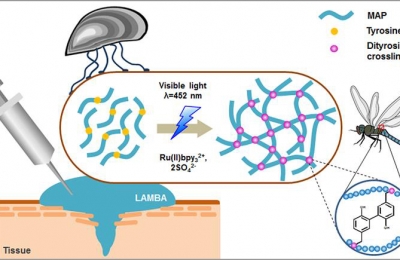
One of the most basic yet important surgical skills to keep a patient alive and intact may be closing wounds. It seems that doctors will now get the job done with more ease thanks to new, nontoxic surgical glue that instantly seals a bleeding wound and helps it heal without a scar or inflammation. Inspired by nature’s wonders, Korean scientists at Pohang University of Science and Technology (POSTECH) have developed a light-activated, mussel protein-based bioadhesive (LAMBA) that works on the same principles as mussels attaching to underwater surfaces and insects maintaining structural balance and flexibility. The product, called LAMBA, has emerged as a promising candidate for an ideal bioadhesive for its outstanding properties; LAMBA’s compatibility with the human body, strong adhesiveness in wet conditions, and convenient handling point to the possibility of myriad medical applications. Mechanical fasteners like sutures and staples have accounted until recently for a major portion of conventional medical devices that are used to hold body tissues together. The invasive nature of traditional methods, however, has been the biggest drawback causing severe tissue damage, complicated post-treatment management, and scars. Their use is also limited when handling delicate tissues and internal organs, giving rise to a need for alternatives that do not require penetration. Tissue adhesives have been increasingly pursued these days as a more desirable bonding material, but the adhesives currently available in the market likewise have their own limitations. While chemically derived adhesives such as cyanoacrylates are likely to provoke an adverse reaction, biologically derived ones are not strong enough to close wounds like sutures do. A common and critical challenge, moreover, is that most surgical glues do not stick in a wet environment, which is essential for medical applications. Dr. Hyung Joon Cha, a professor of the Department of Chemical Engineering at POSTECH, and his student, Eun Young Jeon, have developed a new approach that readily overcomes these drawbacks. The new product LAMBA, a focus of their recent publication in Biomaterials, is an upgrade version of previously known mussel-inspired adhesives that copy mussels’ ability to fix their body under water. Instead of producing recombinant mussel adhesive proteins (MAPs) by modifying DOPA, a key element for the adhesive property, E.Y. Jeon et al., have created the new tissue adhesive via a photochemical reaction using blue visible light. E.Y. Jeon et al gained the idea for this more economic, facile, and reliable strategy from dityrosine crosslinks that are often found in dragonfly wings and insect cuticles. When visible light triggers a photo-oxidation reaction in MAPs plentiful of tyrosine, neighboring tyrosine residues are instantly coupled into dityrosine crosslinks, which in turn enhance structural stability and adhesive properties of the new MAPs in the form of hydrogel. The researchers report in their article published in Biomaterials that animal studies have proved LAMBA’s superiority to existing options including sutures and other surgical glues, potentially qualifying for an ideal tissue bonding material. The new adhesive hydrogel not only closes an open wound on a bleeding site within less than 60 seconds, but also effectively facilitates the healing process without inflammation or a scar. “LAMBA opens numerous doors for medical practices ranging from blocking air leaks and sutureless wound closures of delicate organs or tissues beyond surgeons’ reach, to hemostatic agent and drug delivery medium, just to name a few,” commented Dr. Cha, a corresponding author of this study. This work was supported by the Marine Biotechnology program of Ministry of Oceans and Fisheries, Korea. The main author, E.Y.J was supported by Global PH.D Fellowship program funded by the Ministry of Education, Korea.
2015.07.20 3781