News & Updates
-
POSTECH Selects Dr. Doh-Yeon Kim as Its Next President
Pohang University of Science and Technology (POSTECH)’s Board of Trustees officially named Dr. Doh-Yeon Kim as the university’s next president on Wednesday. Dr. Kim was elected at the board meeting held on April 23. The board commented on Dr. Kim’s appointment: “With a deep understanding of POSTECH’s impact upon the nation’s science community, Kim showed a vision to make POSTECH a university held in respect. We believe that he is competent to take on the job and actualize his vision.” Dr. Kim received his Ph.D. (Dr.-Ing.) from Univ. de Blaise-Pascal, France, after a bachelor’s and master’s degree in Materials Science and Engineering from Seoul National University and Korea Advanced Institute of Science and Technology, respectively. His previous experience includes serving as the minister of Education, Science and Future Planning of Korea, the president of Ulsan University, and the dean of the Engineering College of Seoul National University. He was also the former chairman of the National Science & Technology Council (NSTC) from March 2011 to 2013. Dr. Kim will take the office this fall as POSTECH’s 7th president for a four-year term starting Sep 1, 2015.
2015.04.24 3505 -
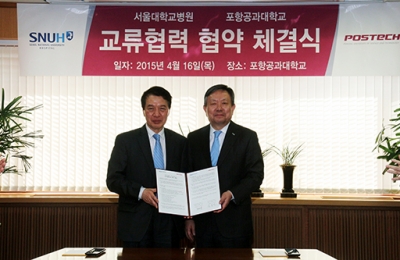
POSTECH signs MoU with Seoul National University Hospital, Korea’s leading medical center
POSTECH signs MoU with Seoul National University Hospital, Korea’s leading medical center A Memorandum of Understanding (MoU) was signed on April 16 by Yongmin Kim, the president of Pohang University of Science and Technology (POSTECH), and Byung-Hee Oh, the CEO and president of Seoul National University Hospital (SNUH). The partnership of these two institutions has attracted much attention as it is the first ever MoU of SNUH, affiliated with a university of its own, signed with a university. It is an open innovation initiative of POSTECH and SNUH who seek to create synergy by combining their respective strengths – POSTECH’s research capacity in life sciences and engineering related fields with SNUH’s competence in biomedical science. SNUH in particular expressed strong interests in POSTECH’s cutting-edge technologies including 3D printing based biomedical applications (Prof. Dong-Woo Cho, Dept. of Mechanical Engineering), Photoacoustic Tomography (Prof. Chulhong Kim, Department of Creative IT Engineering), and biomaterials for nanomedicine (Prof. Sei Kwang Hahn, Dept. of Materials Science and Engineering). “We believe that this is a win-win opportunity for both. The partnership with SNUH will enrich POSTECH’s clinical research,” also commented Jong Moon Park, Executive Director of POSTECH Research and Business Development Foundation. The MoU is intended to provide institutional support for collaborative, convergent research efforts in biomedical engineering and healthcare R&D. POSTECH and SNUH have agreed for development of translational research programs, exchange of publications and research information, access to each other’s research facilities, and opening joint seminars and conferences. A steering committee will be set up to accelerate collaborative efforts and explore further cooperation opportunities.
2015.04.23 2592 -
Study led by Prof. Jong-Seong Kug reveals ‘two faces’ of Phytoplankton
Phytoplankton, commonly known as plant plankton that remove carbon dioxide from the atmosphere through photosynthesis, are potentially a key driver of Arctic warming under greenhouse warming, a study reveals. Scientists with Pohang University of Science and Technology (POSTECH), Max Planck Institute for Meteorology (MPI-M), and Korea Institute of Ocean Science and Technology (KIOST), presented on Monday, April 20, in Proceedings of National Academy of Sciences (PNAS) Online, the geophysical impact of phytoplankton that triggers positive feedbacks in the Arctic warming when the warming-induced melting of sea ice stimulates phytoplankton growth. The paper is titled “Amplified Arctic warming by phytoplankton under greenhouse warming.” When the Arctic sea ice melts away due to greenhouse warming, the ocean surface albedo inevitably decreases, reducing the amount of solar energy reflected back from the earth and ultimately resulting in warmer ocean surface. As phytoplankton growth is subject to factors such as temperature, light, and nutrients, the explosive growth of phytoplankton follow when both the warming-induced melting and shortwave radiation penetrating the ocean increase. The new study has confirmed that it is the beginning of the geophysical feedback by which chlorophyll and the related pigments in phytoplankton absorb solar radiation and in turn raise the sea surface temperature even further. Using a coupled ocean-atmosphere model, the authors have revealed that the additional positive feedback in the Arctic can amplify Arctic warming by as much as 20%. “We believe that, given the inseparable connection of the Arctic and global climate, the positive feedback in Arctic warming triggered by phytoplankton and their biological heating is a crucial factor that must be taken into consideration when projecting future climate changes,” says Jong-Seong Kug, a professor at POSTECH’s School of Environmental Science and Engineering and one of the leaders of this study. Featured in “This Week in PNAS,” this study is drawing significant attention from the academic community as the results presented by Kug et al. overturn the previous understanding of phytoplankton and their impacts on climate systems.
2015.04.21 3114 -
Professor Joon Won Park Wins the Academic Excellence Prize of the Korean Chemical Society
Professor Joon Won Park Wins the Academic Excellence Prize of the Korean Chemical Society - M.S.-Ph.D. Integrated Course Student Jingoo Kim Wins the 2015 Dow Korea Award - Professor Joon Won Park of the Dept. of Chemistry at POSTECH was selected as the winner of the Academic Excellence Prize by the Korean Chemical Society. The Korean Chemical Society presented the Academic Excellence Prize to him in recognition of his outstanding achievements in the field of chemistry and great contribution toward advancement of chemical technology. He delivered a commemorative lecture to celebrate his prize-winning at the 115th General Meeting of the Korean Chemical Society. After receiving his Ph.D. from California Institute of Technology (Caltech), he worked at the Lucky Central Research Institute as a research scientist. He has been a professor at POSTECH since 1990 and is also the founder and CEO of the university’s first venture company named NanoSurface Biosciences POSTECH (NSB-POSTECH). He has made extraordinary achievements in medical diagnosis and single biomolecule analysis with an atomic force microscope, and in the development of a biochip containing self-assembled monolayers. At the meeting, POSTECH M.S.-Ph.D. integrated course student Jingoo Kim of the Dept. of Chemistry also received the 2015 Dow Korea Award and gave an oralpresentation as an award winner on his research for “Reversible and Cyclical Transformations between Solid and Hollow Nanostructures in Confined Reactions of Manganese Oxide and Silica within Nanosized Spheres.”
2015.04.20 2326 -
POSTECH Doctoral Student Won the Best Student Paper Award at the International Research Conference on Systems Engineering and Management Science 2015
POSTECH doctoral student Min-Jun Kim of the Dept. of Industrial and Management Engineering won the Best Student Paper Award at the International Research Conference on Systems Engineering and Management Science 2015 (IRC-SEMS 2015) that was held from March 27 to 28, 2015 at Wuhan University, China. At the conference, Mr. Kim presented his paper on ‘Identifying Service Opportunities for Enhancing the Driving Safety of Buses: A Data-driven Approach’. His research is expected to provide a basis for the systematic development of new services by using a data-driven approach and contribute to enhancing the driving safety of buses in South Korea.
2015.04.15 2496 -
Professor Dong Sung Kim’s Electrolyte-assisted Electrospinning Featured in Advanced Materials
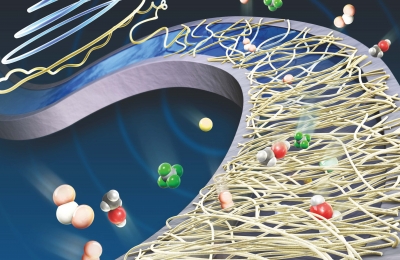
A research team comprised of Prof. Dong Sung Kim and Sang Min Park from the Department of Mechanical Engineering has developed a novel fabrication technique, called electrolyte-assisted electrospinning (ELES), for a self-assembled, free-standing nanofiber membrane. The research outcome was featured on the Inside Cover of the renowned international journal Advanced Materials. Nanofiber membranes have attracted substantial interests in recent years due to their large surface area, high surface to volume ratio, and porosity. These advantages have expanded their applications to sensors, filtration, catalysis, textiles and drug delivery. Given that their structural geometries are analogous with native extracellular matrix existing in human body, they have been employed in biomedical applications. However, electrospinning process, which is widely used for the fabrication of nanofibers, has only produced a nanofiber membrane adhered to a metal surface which limited the use of permeable property of the membrane in various fields. This is because fabricated nanofibers were collected on a metal surface, and interwoven into a membrane on the surface. The team introduced an electrolyte collector in the electrospinning process instead of a metal collector. The fluidic nature of the electrolyte collector enabled a micro-scale patterned free-standing nanofiber membrane integrated with desired substrates from a two-dimensional flat surface to three-dimensional curved geometry. They also confirmed the structural integrity and performance of the free-standing nanofiber membrane integrated with a microfluidic device, which will have a broad impact in many areas including biosensors, chemical synthesis, and clinical diagnostics. The fabricated free-standing nanofiber membrane can also show great potential in the fields of tissue scaffolds and organ-on-a-chip, given that free-standing fibrous membranes (e.g. basement membrane) play a critical role in natural systems such as human-organs. Prof. Kim emphasized “This research brought forward the fabrication of free-standing nanofiber membrane on a curved surface without complicated steps, and expected to stimulate extensive progress in the field of tissue-engineering and bio-medical applications”. This research was supported by the National Research Foundation of Korea (NRF) grant funded by the Korea government (MSIP) (No. 2014R1A2A1A01006527 and 2011-0030075), and by the convergence technology development program for Bionic Arm through the National Research Foundation of Korea(NRF) funded by the Ministry of Science, ICT & Future Planning (No. 2014M3C1B2048632).
2015.03.16 2649 -
Experts Gather in Pohang for the 2015 International Workshop on Bioengineering Innovations
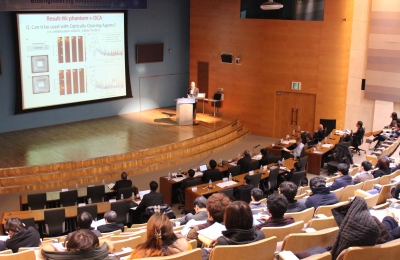
POSTECH hosted the International Workshop on Bioengineering Innovations 2015: Imaging, Devices, Agents, and Applications at the International Conference Room at POSCO International Center on February 23 – 24. The two-day conference brought together seasoned and new researchers in the field of biomedical imaging, devices, agents and applications, and provided a platform for sharing and collaborating in the bioengineering research areas. The workshop consisted of keynote speakers, presentations, socials, and a poster session, and tours of the Pohang Accelerator Laboratory and the new Creative・Collaborative・ Cultivating・ Convergence・ Center (C5) on the grounds of POSTECH. Presentation sessions covered the following areas: · Novel Imaging/Sensing Technologies and Challenges · Current Challenges in Biology and Medicine · Chemicals in Biology and Medicine · Flexible and Wearable Biomedical Devices The workshop kicked off on February 23rd with opening remarks from organizing chairmen POSTECH President Yongmin Kim and Associate Professor of POSTECH Department of Creative IT Engineering (CiTE) Chulhong Kim. Organizing chairman and Chair of CiTE, Professor Jin Soo Lee, gave an introduction to CiTE before giving the floor to the first keynote speaker, Lihong Wang, the Gene K. Beare Distinguished Professor of Biomedical Engineering at Washington University in St. Louis. Other keynote speakers included Kyongtae Bae, Professor and Chairman of Radiology at the University of Pittsburgh; Matthew O’Donnell, Professor of Bioengineering at the University of Washington; Charles Murry, Professor of Pathology, Bioengineering, and Medicine/Cardiology at the University of Washington and Director of the Center for Cardiovascular Biology and Co-Director of the Institute for Stem Cell and Regenerative Medicine; Nigel Lovell, Scientia Professor at the Graduate School of Biomedical Engineering at University of New South Wales; Kimoon Kim, Professor of Chemistry and Director of Center for Smart Supramolecules, Institute of Basic Science at POSTECH; Jonathan F Lovell, Assistant Professor in the Biomedical Engineering at State University of New York at Buffalo; Meyya Meyyappan, Chief Scientist for Exploration Technology, NASA Ames Research Center; and Sung Key Jang, Professor of Integrative Biosciences & Biotechnology at POSTECH. Through this workshop, POSTECH students were given the opportunity to better understand the Korean medical engineering industry and identify domestic and foreign research efforts. It is also expected to lead the way in the promotion and development of the global medical engineering industry. The workshop was sponsored by the Department of Creative IT Engineering (CiTE), the Future IT Innovation Laboratory (i-Lab), the POSTECH President’s Office, the Department of Mechanical Engineering’s Engineering Research Center, the Center for Self-assembly and Complexity at the Institute for Basic Science, and ALPINION Medical Systems.
2015.03.12 2393 -
Max Planck POSTECH/Korea Signs MoU with Max-Planck-Institut für Eisenforschung
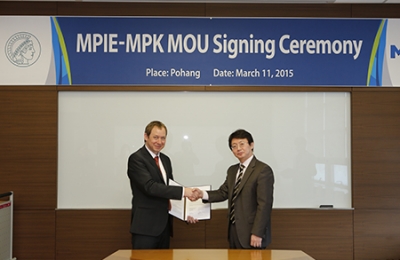
The Max Planck POSTECH/Korea (MPK, Director Jae-hoon Park, Dept. of Physics) and the Max-Planck-Institut für Eisenforschung (MPIE, Director Gerhard Dehm) signed a memorandum of understanding (MoU) on March 11, 2015. The signing ceremony took place at POSCO International Center at POSTECH with MPK Director Jae-hoon Park and MPIE Director Gerhard Dehm. MPK and MPIE agreed to engage in scientific exchange, collaborative research, and fostering new researchers. Accelerating leading research on new functional nanomaterials is expected through this MoU. Also, establishing the nation’s third MPK is anticipated to begin. The Max-Planck-Institut für Eisenforschung, established in 1917, is a legally autonomous research institution that conducts basic research on advanced materials, specifically steels and related metallic alloys. The Max Planck Society of Germany and POSTECH established two Max Planck Centers at POSTECH in 2010, the Max Planck-POSTECH Center for Attosecond Science and the Max Planck-POSTECH Center for Complex Phase Materials. Following the signing ceremony, MPIE Director Gerhard Dehm introduced recent research trends in the fields of nano-scale functional materials and their in-situ testing methods using electron microscopes at the seminar.
2015.03.12 1651 -
Professor Joon Hak Oh Develops Liquid-Phase Sensors with High Sensitivity and Selectivity
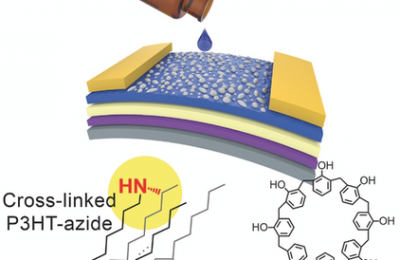
A research team consisting of Prof. Joon Hak Oh, Moo Yeol Lee (Department of Chemical Engineering, POSTECH), and Prof. Bumjoon J. Kim (Department of Chemical and Biomolecular Engineering, KAIST) has developed highly sensitive and selective liquid-phase sensors based on a solvent-resistant organic semiconducting layer. The research outcome was highlighted as the cover article in Advanced Materials which is a renowned international journal in the field of materials. Sensors based on organic field-effect transistor (OFET) platform have attracted great interest due to their use as light-weight, low-cost, flexible electronics. Although various OFET-based sensors have been demonstrated for sensing a various types of analytes, sensors for detecting liquid-phase analytes have not been reported because of the poor resistance of the organic semiconductors in common organic solvents. From this critical drawback, OFET-based sensors have only frequently been demonstrated with organic vapor- or aqueous-phase analytes. By introduction of chemically crosslinkable organic semiconductor (P3HT-azide) to the OFET-based sensors, high resistance of the devices toward liquid-phase organic solvents was achieved. Moreover, calix[8]arene which is a well-known container molecule was adopted to enhance the sensitivity and selectivity of the sensor device. Calix[8]arene molecules on the surface of the semiconducting layer facilitated the interactions with target analytes, providing selectivity of the sensors. As a result, the sensors device showed higher resistance toward toluene and methanol compared with those with uncrosslinked semiconducting layers. Moreover, the sensors with cailix[8]arene showed 1 vol% of detection limit for detecting methanol, ethanol, and n-hexane in toluene based medium. Computational study has also been conducted and the calculated results well matched with experimental results. Prof. Oh emphasized,“This research demonstratesaviable methodology for the fabrication of OFET-based sensors that can detect liquid-phase organic solvents, and extends the range ofpractical applications of OFET-based sensors.” This research was supported by the Global Frontier Research Center for Advanced Soft Electronics and Mid-Career Researcher program under the Ministry of Science, ICT & Future Planning.
2015.03.12 2619 -
GIFT Professor Bruno C. De Cooman Appointed Distinguished Member and Fellow of the Association for Iron & Steel Technology (AIST)
Prof. Bruno C. De Cooman of the Graduate Institute of Ferrous Technology (GIFT) at POSTECH was appointed as a Distinguished Member and Fellow of the Association for Iron & Steel Technology (AIST). The AIST Distinguished Member and Fellow Award, established in 1975, is awarded to an AIST member who has made outstanding contributions to the iron and steel industry as well as to the activities of the association. Prof. De Cooman is the first scholar from a Korean research institution in the last 20 years to be named an AIST Distinguished Member and Fellow. Prof. De Cooman started his academic career in ferrous metallurgy research as a director of the Laboratory for Iron and Steelmaking at Ghent University in Belgium. He leads the Materials Design Laboratory at GIFT and is responsible for leading scientific research and technology development in the field of advanced automotive electrical engineering and constructional steels. The Association for Iron & Steel Technology (AIST) is a non-profit organization with 17,000 members from more than 70 countries. The awards ceremony will be held in May at the Iron & Steel Technology Conference and Exposition 2015 (AISTech 2015) in Cleveland, Ohio, USA.
2015.03.09 2719