News & Updates
-
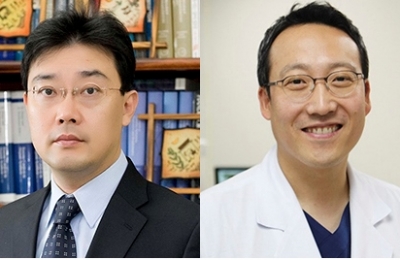
Professors Chulhong Kim and Geunbae Lim Develop High-speed Optical Resolution Photoacoustic Microscopy
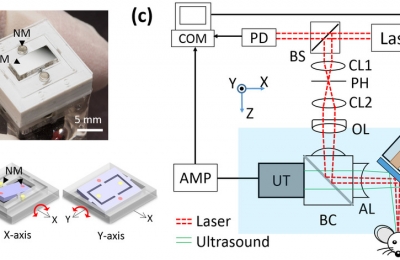
A team comprised of Profs. Chulhong Kim and Geunbae Lim, Jin Young Kim, Changho Lee, and Kyungjin Park, developed a high-speed optical-resolution photoacoustic microscopy (OR-PAM) system using 2-axis waterproofing MEMS scanner, successfully monitored the flow of carbon particles in-vitro, and imaged microvascular networks of the mouse ear in vivo. Their research findings were published in Scientific Reports journal. Photoacoustic imaging technique is a hybrid biomedical imaging technique that combines the merits of ultrasonic and optical imaging modalities. When a pulsed light illuminates and spreads into biological tissues, targeted biomolecules absorb light, and finally acoustic waves are created via thermoelastic expansion. This process is called as photoacoustic (PA) effect. Finally, a conventional ultrasonic transducer detects the generated acoustic waves and volumetric PA images can be obtained. Particularly, OR-PAM can noninvasively provide label-free microscopic images such as oxy and deoxy-hemoglobin, melanin, and DNA/RNA in cell nuclei. Thanks to the key advantages, OR-PAM has been widely used to study oncology, neuroscience, label-free histology, dermatology, ophthalmology, and cardiology. Although OR-PAM is regarded as a promising high-resolution microscopic technique, there is a pressing need to develop a compact, fast, and cost-effective OR-PAM system while maintaining high SNRs for wide spread preclinical and clinical applications. The team presents a new type of MEMS scanner, which works perfectly in water and co-axially reflects both ultrasound and laser beam to scan a 2D plane. Thus, high SNRs were achieved without sacrificing the imaging speed. The small size and simple operation of the MEMS scanner can greatly reduce the complexity of the OR-PAM system. By using this 2-axis MEMS scanner, the team expects to build a further smaller footprint of OR-PAM for endoscopy or laparoscopy. The study is a step forward for cancer research by providing high-resolution video and will enable real-time biopsy in the operating room, providing more accurate results that are expected to significantly help provide health care services.
2015.03.04 2377 -
POSTECH Welcomes New Students at the 2015 Matriculation Ceremony
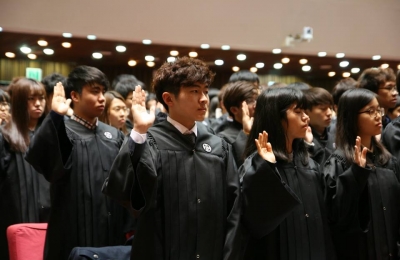
View President's Matriculation Address POSTECH held its Matriculation Ceremony for the 2015 Academic Year on Friday, February 27 at the POSTECH Auditorium. A total of 702 students entered the incoming class with 325 in undergraduate, 100 in the master’s program, 58 in doctoral programs, and 219 in MS-PhD integrated programs. The ceremony began with the pledge of allegiance and the national anthem. During the ceremony, students made a freshmen oath led by the freshmen representative. President Kim welcomed new students and encouraged them to be fearless trailblazers unafraid of failure. “At times, you may encounter hardships that seem to be very difficult, or even impossible, in the beginning. However, do not give up,” said President Kim in his matriculation address. “Face seemingly impossible challenges with confidence in yourselves. Consider that setbacks and failures are an invaluable learning opportunity for personal growth and a stepping stone to ultimate success. Dr. In Soo Ko, the Director of the PAL-XFEL Project, gave a lecture entitled “POSTECH & Pohang Accelerator Laboratory”. President Kim then presented the Domun Scholarship to Mr. Jin-ho Park in the Department of Chemical Engineering.
2015.03.03 2453 -
Professor Hu-Jong Lee’s Realization of Dream Come True Supercurrent Junction on Graphene
A research team consisting of Dr. Gil-Ho Lee, Prof. Hu-Jong Lee, Sol Kim, and Prof. Seung-Hoon Jhi of Department of Physics, reported realization of “short and ballistic” Josephson junctions based on a monolayer graphene sheet. The paper was published in the February issue of Nature Communications. Josephson junction, a nanometer-scale hybrid superconducting device, consists of two superconducting (S) electrodes weakly coupled by a normal-conducting (N) insert. It supports a resistance-free junction supercurrent along with quantum interference effects and has been utilized for realizing diverse quantum devices including quantum bits, field-effect supercurrent transistors, quantum electron pumps, etc. However, these efforts have often been hindered by non-ideal S-N contact characteristics, attributed to the short electronic mean free path (l) and/or a short superconducting coherence length (x), compared with the junction channel length (L). The team realized a vertical graphene Josephson junction (vGJJ) by attaching two superconducting electrodes on top and bottom of a monolayer graphene sheet and, for the first time, confirmed the short (L<x) and ballistic (L<l) Josephson coupling reaching the theoretically predicted limit. The atomically thin single-crystalline graphene layer serves as an ultimately short conducting channel, with highly transparent interfaces with superconductors. The vGJJ is expected to enable studies on exotic, but highly elusive to date, quantum phenomena arising from strong Josephson coupling. The vertical hybridization scheme adopted in the study is not limited to superconducting electrodes and graphene, but is readily applicable to a variety of electrodes (e.g., ferromagnets) and exotic cleavable materials, such as topological insulators, layered cuprate and iron-pnictide superconductors, or various transition-metal dichalcogenides. Professor Lee stresses that the scheme will open the pathway to a wide range of research opportunities for the fundamental sciences manifested at the atomic-scale interfaces of different materials, as well as the applications for highly coherent and scalable superconducting hybrid quantum devices. This work was supported by National Research Foundation of Korea (NRF) through the SRC Center for Topological Matter (Grant No. 2011-0030788) and the GRF Center for Advanced Soft Electronics (Grant No. 2011-0031640).
2015.03.02 2694 -
The 2014 Academic Year Commencement Ceremony at POSTECH Gymnasium
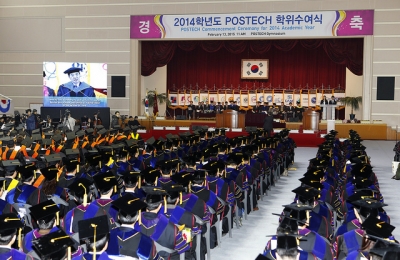
POSTECH held its Commencement Ceremony for the 2014 Academic Year on February 13, 2015 at the POSTECH Gymnasium. The graduating class included 266 undergraduates and 463 graduate students. Graduates were led into the gymnasium by department flag bearers and a performance by the POSTECH Orchestra. Ph.D degree candidates were individually called to the platform and guided to the stage by their advisors for the hooding process. Master’s and bachelor’s degree candidates were represented on stage by one student from each department and program. POSTECH President Yongmin Kim gave an inspiring address to graduates that celebrated their accomplishments and encouraged them to tackle challenges in life with creativity and boldness. President Kim reminded graduates to use their POSTECH education to become trailblazers and pursue innovation. He also stressed the importance of public service. “Use your POSTECH education, not only for your own success and glory, but also for serving others and enriching the world,” he said. “It is my sincere wish that you lead a life as intellectuals who prioritize public interest and human decency in a world that needs more love and compassion.” POSTECH Chairman Ohjoon Kwon gave a complimentary speech in which he encouraged students to keep the dreams they envisioned at POSTECH alive in their hearts as they head into the world. “People say that the size of your dream determines the size of your life,” said Chairman Kwon. “I hope that you will plan your next 50 years based on the dream you envisioned at the Nobel Garden to create innovative solutions to the grand challenges faced by the nation and humanity”. Valedictorian Mr. Hyun-Seon Seo, from the Department of Materials Science & Engineering, gave the student address. The following prizes were presented in recognition of outstanding achievement by students in the graduating class: · The Founding Chairman's Award to the top student in the graduating class: Mr. Hyun-Seon Seo (Department of Materials Science & Engineering) · The Chairman’s Award to the most outstanding student in the science class: Mr. Wan-Kee Lee (Department of Mathematics) · The Hogil Kim Prize to the student who has most raised the university’s prestige: Mr. Han-Jae Nam (Department of Materials Science & Engineering) · The Sung-Kee Chung Thesis Prize for the best doctoral graduate dissertation in science: Mr. Do-Hyung Kim (Department of Mathematics) · The Kun Soo Chang Thesis Prize for the best doctoral graduate dissertation in engineering: Mr. Tae-Hee Han (Department of Materials Science & Engineering) After the commencement ceremony, students were invited for a luncheon hosted by the Vice President of Business Affairs at the POSCO International Center Grand Ballroom. Congratulations to POSTECH’s newest graduates!
2015.02.17 2378 -
POSTECH International Community Celebrates Lunar New Year
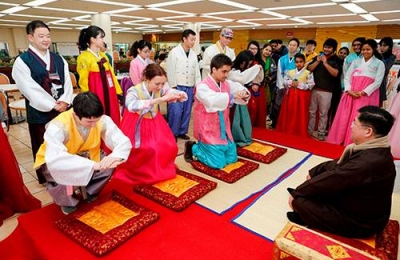
POSTECH international community members and their families rang in the Lunar New Year, also known as Seollal, in true Korean fashion with a celebration at the Student Union Building on Thursday, February 12. The event, organized by the POSTECH International Relations Office and International Student and Scholar Services (ISSS), gave the POSTECH international community the opportunity to experience the most celebrated national holiday in Korea. Participants dressed up in traditional Korean attire called hanbok and learned how to perform sebae, a deep formal bow of respect, to Vice President of External Affairs Yonge Ha who passed out sebaedon, pocket money, in traditional luck bags to participants. Rinita Guhapramanick from India came to the event with her 6-year-old daughter Sanskriti. Her husband is a post-doctoral researcher at POSTECH. “This is my second time to attend the Lunar New Year celebration at POSTECH. My daughter is a great follower of Korean culture. We enjoyed the blessing of receiving bags of ‘good luck’ money, wearing hanbok, and the food with tteokguk, traditional Korean broth with sliced pieces of rice cakes, as its signature dish.” Attendees took part in the folk game jegichagi that is similar to the game hacky sack or footbag. Tteokguk was served for dinner as it is a staple dish for Koreans on Seollal. Eating tteokguk on Seollal is thought to add a year to one’s age as well as bring a new year of good fortune in Korea. The dinner also included a variety of jeon (pancake-like dishes), tteok (rice cake), bulgogi, galbi (grilled marinated beef), sikhye (Korean fermented rice drink), and sujeonggwa (Korean traditional fruit punch). “It was a great experience to try on a hanbok,” said Marat Latypov who is from Russia and works as a postdoctoral research associate at the Center for Advanced Aerospace Materials at POSTECH. He attended the event with his wife. “My wife has dreamed of trying on a hanbok ever since she came to Korea.” Dr. Laypov was surprised by how complex tying a bow on a hanbok seemed and was glad to have learned how to do it properly at the event. He also found jegichagi to be a very fun game that is more entertaining and competitive than the traditional Korean board game yutnori. “I think this event helped us to appreciate at a new level how traditional and deep the celebration of Seollal is in Korea.”
2015.02.17 2453 -
POSTECH Scientists Create Stronger and More Lightweight Steel Alternative
In new research published in Nature, Professors Nack J. Kim and Hansoo Kim and doctoral student Sang-Heon Kim at the Graduate Institute of Ferrous Technology (GIFT) at Pohang University of Science and Technology (POSTECH) have developed a new type of steel with improved tensile strength and lightness. There is a growing demand for lightweight structural materials as an alternative to conventional steels which are heavy and impractical in developing future energy efficient vehicles. Studies on lightweight steels have shed light on the effectiveness of aluminum alloying in increasing the strength-to-weight ratio and reducing density. However, increasing aluminum content in lightweight steels results in poor ductility. The research team at GIFT has found a solution to this problem by taking unconventional alloy design approach; i.e., by uniformly dispersing nanometer-sized B2 intermetallic compounds between and within the steel’s grains. B2 has been traditionally known to be a harmful phase in steels. Besides being lightweight, this new steel possesses an excellent combination of strength and ductility, which are far superior to those of traditional steels. With this innovative approach, stronger and more ductile lightweight steels have been created, solving the long standing problem of poor ductility caused by the formation of brittle intermetallic compound particles. The team plans to work with POSCO to produce its new product later this year, ushering in a new era of high-specific-strength steels that will be lightweight and strong enough to produce fuel efficient vehicles and other transportation systems.
2015.02.05 4981 -
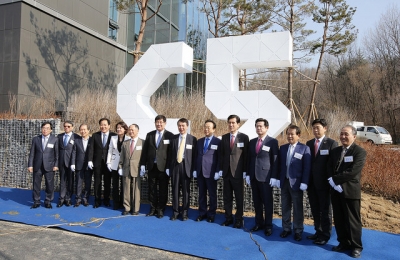
C5 and the POSCO Pohang Center for Creative Economy Open at POSTECH
The Creative・Collaborative・Cultivating・Convergence・Center (C5) held its opening ceremony on Friday, January 30th. The building will serve as the region’s new convergence research epicenter that will bring together innovative educational programs and synergistic collaboration with industry to cultivate creative global IT talent. Strategically located at Pohang University of Science and Technology (POSTECH), at 7-stories with a size of 16,000 square meters per floor, the construction of C5 came at an investment of 31.5 billion won. The first three floors of C5 will be filled by the Department of Creative IT Engineering (CiTE) and the POSETCH Future IT Innovation Laboratory (i-Lab). CiTE and i-Lab use interdisciplinary-oriented education and innovative research to train students to become future global IT leaders and perform high-impact creative research focusing on smart computing, smart devices and systems, and IT-based future healthcare. The POSCO Pohang Center for Creative Economy, which held its inauguration ceremony with President Park Geun-hye in attendance on December 17th of last year, will occupy the 5th floor of C5. The Center, led by POSCO, was established to maintain the competitiveness of the steel industry, promote source technology development, and nurture regionally-based “hidden champions” to vitalize venture businesses. The remaining three floors will house POSTECH research teams that will work for POSTECH’s strategic promotion of research areas and subjects with huge growing potential such as challenges the nation and mankind face and future market leading core tasks. A modern open-space design allows various research teams to rearrange work areas freely to facilitate and promote dynamic collaboration. The completion of C5 and the opening of the POSCO Pohang Center for Creative Economy will accelerate a bold new era of research and accelerate POSTECH’s convergence research, education, and technical commercialization. C5 also acts as a research hub that reflects Pohang’s creative economy model through the close union between industry, academia, research, and the local government. “C5 will play a critical role to foster global leaders with entrepreneurial spirit based on creative and challenging ideas, and create a vital ecosystem for the development of state-of-the-art technology, commercialization, and start-up companies. I wish for C5 to set up a solid base to contribute to POSTECH’s future as well as POSCO, the City of Pohang and its region, and the further development of the nation,” said POSTECH President Yongmin Kim. Three hundred guests, including Pohang Mayor Kang Deok Lee and Pohang City Assembly President Chil Goo Lee, attended the opening ceremony of C5 and the POSCO Pohang Center for Creative Economy which was held on the building’s first floor.
2015.02.04 2887 -
Professor Kilwon Cho Enhances Efficiency of Graphene Production by Rolls
Professor Kilwon Cho, Hyojin Bong, and Dr. Sae Byeok Jo of the Department of Chemical Engineering have developed a new synthetic method for high-throughput production of large-area conducting graphene films. The research outcome was featured on the cover page of the renowned international journal Nanoscale. Graphene is one of the core materials for the transparent electrodes in soft electronics due to its high electric conductivity, flexibility, mechanical strength and transparency. The feasibility of the commercialization of graphene films depends on the efficient “scale-up” production of high-quality graphene film. However, large scale production of graphene by conventional roll-to-roll, or one-pot process, consumes a massive amount of energy, time, and raw materials, which requires sophisticated and complicated production facilities. According to the research, the productivity of graphene synthesis could be drastically improved by simply “rolling” the catalytic foils to have a micron-scale gap between catalyst surfaces. Using the rolled catalytic geometry, the confinement of gaseous carbon source promotes highly frequent collisions between the catalyst and the gas flowing through the gap, which leads to more efficient conversion of carbon source to the graphene films even at lower usage of raw materials. Moreover, since the surface area of the catalyst is decided by the number of rolling, the synthetic area of graphene could be increased accordingly. The research team realized a 10 times larger area of synthesized graphene films at 1/10 usage of the source materials than conventional method. Prof. Cho emphasized, “This research will bring forward the commercialization of conductinggraphene films for use in wearable smart electronic devices.” This research was supported by the Global Frontier Research Center for Advanced Soft Electronics under the Ministry of Science, ICT & Future Planning.
2015.01.28 2589 -
Professor Taiho Park's Solution for Making Dye Sensitized Solar Cells Using the Ladder Concept
A research team comprised of Professor Taiho Park, Jongchul Lim, and Taewan Kim of the Department of Chemical Engineering, reported a novel way to solve both dye regeneration and electron transport problems simultaneously using a “ladder” concept. The paper was published in the December issue of Energy & Environmental Science. Next generation energy devices should be based on clean and sustainable solar energy. Among the conventional solar energy device, dye-sensitized solar cells (DSCs) have lots of advantages with higher power conversion efficiency such as chip process, easy fabrication, and transparent device. With these advantages, the DSCs are promising energy device for portable device, smart watch, room electricity, and home appliances. However, problems with DSCs exist for the commercialization of even the chip fabrication process. The first problem is the slow dye regeneration reaction by redox couple. The other is the loss in photocurrent by the electron recombination reaction between injected electron and redox couple. Therefore, the dye regeneration reaction should be very fast and the recombination should be suppressed for the higher power conversion efficiency to commercialize. At the interfaces, the team introduced a novel material (3, 4, 5-tris-butenyloxy benzoic acid) which has special functional groups. This material acts as a ladder to overcome the energy barrier for the fast electron transfer from redox couple to dye. At the same time, this material covers the interface to block the interaction between injection electron and redox couple. Previous research generally focused only on the electron transport by suppressing the recombination reaction without solving the dye regeneration issue. Professor Park believes that this study, based on fundamental nanotechnology source and interfacial electron transport, is a step toward further research for commercializing DSCs as well as flexible nano-energy device. This work was supported by grants from the Center for Advanced Soft Electronics under the Global Frontier Research Program (Code no. NRF-2012M3A6A5055225), and the National Research Foundation of Korea (NRF) funded by the Ministry of Science, ICT and Future Planning.
2015.01.19 2269 -
Professor Hyung Joon Cha on Bone Regeneration Enhanced by Use of Mussel Adhesive Proteins
POSTECH Department of Chemical Engineering Professor Hyung Joon Cha and his team’s research on bone graft material binder technology was published in the Journal of Materials Chemistry B. Mussels stick to rocks because its protein has strong adhesive properties. This protein has been used as a binder for bodily wounds and surgery. An engineered mussel glue protein, a promising functional binder for the acceleration of bone substitute-assisted bone regeneration, has been developed by the joint research team of POSTECH and Korea University Anam Hospital, which can be used in teeth implants. The research team consisting of Professor Hyung Joon Cha in the Department of Chemical Engineering at POSTECH, Professor Sang Ho Jun at Anam Hospital, and Bong-Hyuk Choi who is a postdoctoral researcher in Professor Cha’s research group. The team paid attention to the adhesive protein of mussels that maintained its adhesion in water to develop the binder. They identified that the binder not only prevented the heterologous bone graft materials to move from the grafted place, but also substantially helped bone formation. It was possible to produce adhesive proteins from mussels in small quantities, but Professor Cha’s team has opened the way to the mass production of molecular biotechnology. A dental company that specializes in dental material is studying the team’s findings for commercialization. The team plans to conduct a follow-up study of utilizing stem cells and growth factors with the adhesive proteins of mussels to restore bones that could treat patients who have facial bone defects. This research was carried forward by the Ministry of Oceans and Fisheries and supported by the Marine Biotech Supporting Centre under the Korea Institute of Marine Science & Technology Promotion (KIMST).
2015.01.19 2497