News & Updates
-
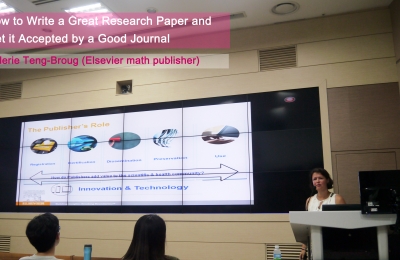
How to Write a Great Research Paper and Get it Published
Elsevier math publisher, Valerie Teng-Broug, visited POSTECH on August 12 to give tips on academic writing and publishing. Her presentation, “How to Write a Great Research Paper and Get it Accepted by a Good Journal”, sponsored in collaboration with Elsevier Korea, gave students useful advice on how to get their next paper published in a top journal. Teng-Broug shares some of her tips to help you get your next article published. 1) Choose the Right Journal – Teng-Broug recommends keeping things simple, avoiding complication, and choosing the right journal to increase your chances of getting accepted. Elsevier’s Journal Finder (http://journalfinder.elsevier.com) helps you find a journal that is the best fit for your article. 2) Identify the Right Audience – Write with your audience in mind and identify the interest of your audience. 3) Give Your Article a Strong Presence – Use strong key words in the title, heading/sub-headings, description tags, description of authors, main body text, abstract, and graphics (tables & figures). 4) Share Your Knowledge – Don’t be shy. Make people aware of you and have your paper stand out from the crowd with the help of social media. You can use a variety of media including blogs and online forums. Teng-Broug recommends ORCID (http://orcid.org) to connect with other researchers. 5) Have a Strong Manuscript – A clear manuscript has a novel, clear, useful, and exciting message. It is presented and constructed in a logical manner. Reviewers and editors should be able to grasp the scientific significance of your article easily. 6) Use Proper English – If your editor and reviewers cannot understand what you wrote, it can delay or block the publication of your article. The manuscript should be accurate, concise, and clear. Write direct and short sentences. Avoid multiple statements in one sentence. 7) Don’t Break Ethical Rules – Breaking ethical rules is the fastest way to end your academic career. Authors should consult their peers, advisors, and journal editors to learn about the specific ethical rules and responsibilities in their discipline. The most common ethical issues are fabrication (making up research data), falsification (manipulation of existing research data), and plagiarism (taking previous work and passing it off as one’s own). Always cite and quote the work of others as well as your own previous publications. 8) What Leads to Acceptance – Lastly, Teng-Broug shares the 10 rules to ACCEPTANCE from Nigel John Cook, the Editor-in-Chief of Ore Geology Reviews: Attention to details Check and double check your work Consider the reviewers’ comments English must be as good as possible Presentation is important Take your time with revision Acknowledge those who have helped you New, original and previously unpublished Critically evaluate your own manuscript Ethical rules must be obeyed Follow these rules and you will be on the path to successfully publishing your research in a top scientific journal.
2014.08.20 2907 -
New Research Shows How Cholesterol Can Lead to Cancer
POSTECH researchers have found another reason to cut down on a high-fat and cholesterol diet. Their findings show that cholesterol is crucial for Wnt signaling pathway often linked to human birth defects, cancer, and other diseases. Research groups of Prof. Jin-Kwan Han in the Department of Life Sciences at POSTECH and Prof. Wonhwa Cho from the University of Illinois at Chicago performed this study. Their research was published in the July edition of Nature Communications. Wnt signaling processes biological functions through ‘canonical’ and ‘non-canonical’ pathways. However, little is known about the exact mechanisms for differential activation of each pathway. Canonical Wnt signaling plays an important role in cell growth during embryonic development. It is when Wnt signaling is mutated or deregulated that it can cause health problems including the development of cancer. Dishevelled is a protein that plays central roles in Wnt signaling. The study found that only canonical Wnt signaling cannot occur without cholesterol in the cell membrane being bound to Dishevelled. This suggests that cholesterol serves as not only structural component of the membrane but a selecting point between canonical and non-canonical pathways. Because of its critical involvement in cancer and other diseases, the canonical Wnt pathway has been a major target for drug development. The scientists hope that these new findings will open up new possible therapeutic drugs that can suppress canonical Wnt signaling to treat or prevent cancer. This research was supported by grants from the National Institutes of Health, the World Class University program, and from the National Research Foundation of Korea.
2014.07.29 2920 -
Dongki Kim Receives IBM Ph.D. Fellowship Award
POSTECH Ph.D. student Dongki Kim (Department of Electrical Engineering) was granted a USD $20,000 stipend from the IBM Ph.D. Fellowship Awards Program. Mr. Kim has done research on the Flash Translation Layer (FTL) for Solid State Drive (SSD) reliability and high performance at IBM in America since this May. SSD has been rapidly gaining popularity as a new technology for hard drives. However, the performance and life of SSD is dependent upon FTL. Mr. Kim has received high praise from IBM for his research and five papers published at international conferences and journals.
2014.07.21 3272 -
Photoacoustic Tomography Can Safely Examine the Gut using Frozen Nanonaps
Using POSTECH Professor Chulhong Kim’s custom-built high-resolution photoacoustic imager, researchers were able to examine the combination of nanonaps and photoacoustic tomography illuminated inside the intestine of a mouse. (Credit: Chulhong Kim) Millions of people worldwide who suffer from digestive diseases may soon have a safer alternative to traditional radiological techniques when visiting the hospital for imaging of the gastrointestinal tract. Researchers from the Pohang University of Science and Technology (POSTECH), the University at Buffalo, and University of Wisconsin–Madison have discovered a new and safer way of making intestinal imaging non-invasive for patients. Their new method of imaging, photoacoustic tomography (PAT), would use nanoparticles that can withstand the harsh conditions of the stomach and intestine, avoid systemic absorption, and provide good optical contrast. The development is described in the journal Nature Nanotechnology. POSTECH Professor Chulhong Kim of the Department of Creative IT Engineering (CiTE) was a corresponding author of the study. Ultrasound, X-ray, computer tomography (CT) scan, and magnetic resonance imaging (MRI) are currently the most commonly used for diagnosing gastrointestinal conditions, but are often expensive and can be unsafe with repeated use. The small intestine is about 20 feet long which makes it difficult for doctors to pinpoint gastrointestinal diseases. “Because of these challenges, our new imaging technique, PAT, will lead to a safer and non-invasive way to diagnose and treat gut diseases,” said Professor Kim. The researchers’ new method will allow doctors to see how the small intestine operates in real-time as opposed to conventional instruments that only show images of the organ and blockages. They worked with dyes called naphthalcyanines encased in nanoparticles that move safely inside the digestive system without being absorbed into the blood. Patients would be able to drink the concoction which would provide doctors with a noninvasive, real-time view of the small intestine with the use of a safe pulsed laser light, also known as PAT. For the experiment, the researchers orally administered the frozen nanonaps on mice and used PAT. The instrumentation cost of PAT is low and it is safe, non-invasive, and non-ionizing making it an attractive alternative to existing instruments. The research was supported by grants from the Korean Ministry of Science, ICT and Future Planning (the IT Creative Consilience Program at CiTE and the Engineering Research Center at the Department of Mechanical Engineering at POSTECH), the National Institutes of Health, and the Department of Defense.
2014.07.15 3123 -
Dr. Do Kyun Kim Appointed as Professor at the Universiti Teknologi PETRONAS
Dr. Do Kyun Kim, a POSTECH senior researcher in the Graduate School of Engineering Mastership, has been appointed as a professor in the Department of Civil Engineering at the Universiti Teknologi PETRONAS (UTP). UTP was established by the Malaysian oil and gas company Petroliam Nasional Berhad (PETRONAS). His research focus is on nonlinear structural mechanics and analysis in association with limit states and risk-based approaches for ships and offshore structures. He is also interested in the structural analysis of subsea systems, floating structures, risers, and pipelines. Dr. Kim has won two best paper awards from the Royal Institute of Naval Architects (RINA) (UK, 2009 and 2013) and an ASME-OOAE best paper award at the 2013 International Conference on Ocean, Offshore and Arctic Engineering (OMAE). He received his bachelor’s, master’s, doctoral degrees, and postdoctoral research at Pusan National University. Since 2013, he has worked as a senior researcher at the Graduate School of Engineering Mastership (GET) at POSTECH founded with assistance from the Ministry of Trade, Industry and Energy. “I want to act as a bridge between Malaysia’s state oil and marine engineering companies and South Korea for the future development of our country’s shipbuilding and offshore industry,” said Dr. Kim. Dr. Kim will carry out research into marine resource development starting this fall semester at the Universiti Teknologi PETRONAS.
2014.07.14 3989 -
POSTECH Summer Classical Concert with Maestro Nanse Gum
POSTECH’s summer classical music season shifts into high gear in July. POSTECH will hold the “POSTECH Summer Classical Concert with Maestro Nanse Gum” with world-renowned Maestro Nanse Gum and the Euro-Asian Philharmonic Orchestra at 5 p.m., July 6 at the POSTECH Auditorium. Maestro Nanse Gum is known as the most beloved Korean conductor and the father of popular classic in South Korea. His easy commentary helps his audience to easily understand classical music. The orchestra will perform Sergei Rachmaninoff’s Piano Concerto No. 2 in C minor Op. 18 and Antonin Dvorak’s Symphony No. 9 in E Minor “From the New World”. Pianist Yung Wook Yoo, called the “Korean Beethoven”, will perform with the orchestra. The classical concert, sponsored by KISWIRE, is free and open to the public. Contact Information: - POSTECH Undergraduate Student Affairs (054-279-2901) - Euro-Asian Corporation (02-3473-8744)
2014.07.03 2936 -
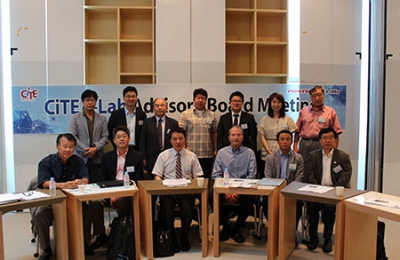
World-Renowned Scholars and CEOs Gather to Discuss CiTE and i-Lab’s Future Goals
The Department of Creative IT Engineering (CiTE) and the POSTECH Future IT Innovation Laboratory (i-Lab) held an advisory committee meeting on June 30, 2014 to discuss the direction the two departments should take in realizing its vision and goals. Some of the world’s greatest scholars and CEOs gathered for the advisory committee meeting to confer on the departments’ present condition and future development plans. The committee had an animated discussion with students and researchers. Committee members in attendance were POSTECH President Yongmin Kim, the advisory committee chairman; Daeje Chin, CEO of SkyLake (former minister and former CEO of Samsung Electronics); Bob Gove, former president of Aptina Imaging; Seong K. Mun, CEO of OSEHRA (Director of Arlington Innovation Center for Health Research at Viriginia Tech); Euisik Yoon, Director of Lurie Nanofabrication Facility at the University of Michigan; and Yuang-Ting Zhang, Director of the Key Lab for the Health Informatics of Chinese Academy of Science (Professor at the Chinese University of Hong Kong).
2014.07.02 9339 -
Mechanical Engineering Student Wins Best Paper Award at ISGMA 2014
POSTECH graduate student Dongwhi Choi (Department of Mechanical Engineering / Integrated Program) was awarded the best paper award at the 2014 International Symposium on Green Manufacturing and Applications (ISGMA 2014) in Busan. His study, Development of a Capillary-Based Preconcentration Device by Using Ion Concentration Polarization, was presented at the symposium. ISGMA 2014 accepted 420 technical papers and posters from nearly 450 participants representing 19 countries. The symposium is mainly focused on experimental, theoretical, and computational aspects of green manufacturing technologies and its applications.
2014.07.02 1958 -
POSTECH Students Participate in Korea Rural Community Service Program
POSTECH was selected as a 2014 "Sharing Talents with Rural Community Program" university by the Korea Rural Community Corporation (KRC). POSTECH students will do their volunteer work from July 3 to 6 in Goheung County, Jeollanam-Do Province. The volunteer team consists of 40 excellent science and engineering students who participated in the POSTECH Overseas Volunteering Program. The students will use their experiences in science camp management and years of educational services to open a science class at Geumsan Elementary School and Geumsan Middle School, volunteer at a nursing home, and offer a helping hand to the rural community at large.
2014.07.02 2720 -
POSTECH Scientists Develop a New Treatment for Rheumatoid Arthritis
A research team, led by Department of Materials Science and Engineering Associate Professor Sei Kwang Hahn and graduate student Hwiwon Lee, has published research on a new rheumatoid arthritis treatment. The article “Hyaluronate – Gold Nanoparticle/Tocilizumab Complex for the Treatment of Rheumatoid Arthritis” was published in the April 2014 edition of the ACS Nano, a monthly scientific journal published by the American Chemical Society. Rheumatoid arthritis (RA) is a chronic inflammatory immune disease that affects 0.5 to 1 percent of the adult population worldwide and can damage joints and organs. Lee and Hahn along with scientists from Seoul National University, the Catholic University of America, and the Wellman Center for Photomedicine at the Massachusetts General Hospital developed a new rheumatoid arthritis treatment using a hyaluronate – gold nanoparticle/tocilizumab complex. Gold nanoparticles (AuNPs) have been widely used for various biomedical applications and are a potential antioxidant. Tocilizumab (TCZ) has gained popularity for rapidly suppressing inflammation and preventing joint destruction. TCZ is also the first monoclonal therapeutic antibody against interleukin 6 (IL-6) signaling by binding IL-6 receptor (IL-6R), which antagonizes the interaction of IL-6 with IL-6 receptor (IL-6R). IL-6 is a pleiotropic cytokine that is overexpressed in the synovial tissue of RA patient. Vascular endothelial growth factor (VEGF) and IL-6 aggravate and sustain joint inflammation. In this new research, the research team used hyaluronate (HA) on the surface to improve the HA-AuNP/TCZ complex and reduce its nonspecific binding to serum proteins in the body and simultaneously target VEGF and IL-6R. Collagen-induced arthritis (CIA) animal models with an arthritic ankle treated with the HA-AuNP/TCZ complex were shown to have the most improvements in the reduction of swelling. The results indicate that the HA-AuNP/TCZ complex has a better therapeutic effect than those of TCZ as well as HA-AuNP, possibly because of the long-term synergistic dual effect of the HA-AuNP/ TCZ complex. These findings might lead to the HA-AuNP/TZ complex to be developed as a dual targeting drug candidate to VEGF and IL-6R and can be used for various therapeutic applications.
2014.06.19 2587