Research Highlights
“No Need for Repeat Shots” — “Just Once Is Enough” A Mussel-Inspired Vaccine Aims to Close the Immunization Gap
- Convergence Chemical Engineering
- Date2026.06.30
- Views450
[POSTECH and Incheon National University develop mussel adhesive protein to achieve “sustained immunity,”
offering a technology that could ease the burden of repeat vaccination]
A research team in Korea has developed a vaccine technology that delivers long-lasting immune protection from a single dose by applying the powerful underwater adhesion mechanism of mussels. The work is drawing attention not only for reducing the burden of repeat vaccination, but also for its potential to reach people in countries where vaccine access is difficult.
The study was carried out by the team of Professor Hyung Joon Cha of the Department of Chemical Engineering and the School of Convergence Science and Technology at POSTECH, doctoral candidate Sukwon Jung of the Division of Interdisciplinary Bioscience & Bioengineering and doctoral candidate Hyun Tack Woo of the Department of Chemical Engineering, in collaboration with the team of Professor Byeong Hee Hwang of the Division of Bioengineering, Incheon National University. It was recently published in the online edition of Biomaterials, an international journal in the field of biomaterials.
Vaccines against infectious diseases such as influenza and COVID-19 are not finished with a single shot. To achieve sufficient immune protection, several booster doses must be administered at set intervals. This translates into a burden of time and cost, and in many countries with insufficient medical infrastructure, vaccination itself is often difficult to carry out. Why are repeat doses needed? Most current vaccines use only a portion of the viral components, which makes them safe but less effective at eliciting an immune response. In addition, vaccine components disappear quickly inside the body, limiting the body’s ability to sustain an adequate immune response.
To solve this, the team turned its attention to the mussel, which clings firmly to rocks even against rough waves. By combining the adhesive properties of mussel with a special peptide that strengthens immune function, the team succeeded in creating an “adhesive adjuvant protein (AAP)” capable of anchoring vaccine components at a specific location inside the body. Simply put, they created a “glue for vaccines.”
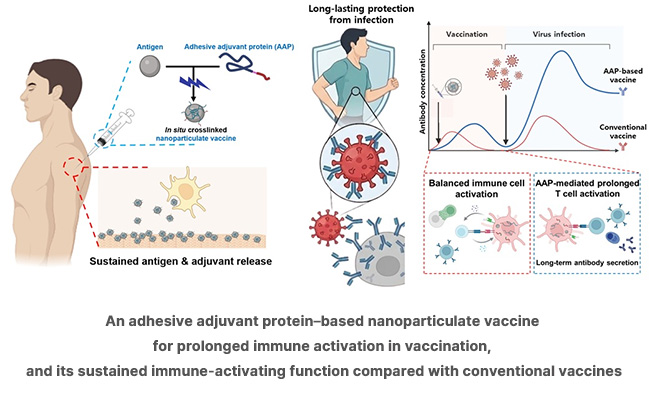
This adhesive adjuvant protein assembles with the antigen, the core component of the vaccine, into nanoparticles and slowly releases both the antigen and the immune-boosting adjuvant itself. Just as a natural infection continuously trains the immune system, the protein stimulates immune cells over a long period to induce a strong and sustained immune response. As a result, the vaccine components remained in the body longer than with conventional aluminum-based adjuvants, and a single dose was confirmed to produce an immune effect lasting more than three times as long than the conventional approach.
This protein was designed by combining the original mussel adhesive protein with an adjuvant peptide called “PADRE1)” to enhance the immune response. PADRE is a universal immune-enhancing substance that works broadly regardless of an individual’s immune type; thus, its effect is not limited to specific individuals. By activating a key immune-response pathway (MHC Class II), the team confirmed a balanced increase in the numbers of helper T cells, which assist antibody production. Interestingly, the activity of cytotoxic T cells, which directly attack viruses and even cancer cells, was also significantly elevated. The immune response was maintained even six weeks after vaccination, contributing to the formation of distinct memory T cellsthat support long-term immune memory. Notably, the team confirmed that a healthy immune state was sustained over a long period without “immune exhaustion”, the phenomenon in which immune cells become exhausted and lose their function.
If a single dose can produce sufficient immune protection, this technology could become a practical answer for many people. The team plans to develop it into a vaccine for intractable cancers, such as “cold tumors2)” for which immunotherapy has shown limited efficacy. Professor Hyung Joon Cha said, “A functional mussel adhesive protein–based vaccine delivery system has excellent biocompatibility and can be mass-produced, making its potential for practical application is very high,” adding, “We expect it to reduce the burden of repeat vaccination and to contribute to solving global disparities in vaccine access.”
This research was supported by the National Research Foundation of Korea’s Global Research Network program and the National Research Laboratory (NRL) 2.0 program.
▶️ DOI: https://doi.org/10.1016/j.biomaterials.2026.124253
1. PADRE : Short for “Pan HLA-DR binding Epitope,” meaning an epitope capable of binding to a universal HLA-DR. It is an artificially synthesized immune-enhancing peptide designed to act broadly across most people, regardless of the differing immune types of individuals.
2. Cold tumor : A tumor in which immune cells (T cells) cannot penetrate into the tumor interior, or in which the immunosuppressive environment surrounding the cancer cells results in a low response rate to immune checkpoint–based cancer therapies.
Researcher
-

Cha Hyung Joon Professor
Dept. of Chemical Eng.
View Profile -

Sukwon Jung
Doctoral program
-

Hyuntack Woo
Doctoral program
Related News
-

Mussel Adhesion Meets Conductivity: New Bioglue for Bioelectronic Implants
2026.03.11 -

“A spray shield that adheres to transplant organs” reduces the burden on patients taking lifelong immunosuppressants
2026.03.05 -

“A New Security Technology That Locks Information with Light Color and Distance” — Unhackable Metasurface Holograms
2026.01.30