Research Highlights
Focusing Underwater Sound with a Lens 40% Lighter Than Conventional Designs
- Mechanical Engineering Convergence Electrical Engineering Chemical Engineering
- Date2026.07.01
- Views567
[POSTECH-KRISO team develops an ultra-light underwater lens for broadband low-frequency sound focusing]
In the underwater world, sound is the primary means of communication, as light quickly fades. A Korean research team has developed an underwater acoustic lens capable of focusing sound precisely at a desired point while reducing weight by about 40% compared with conventional designs.
The research was led by Professor Junsuk Rho of Pohang University of Science and Technology, together with Ph.D. candidate Beomseok Oh, in collaboration with Dr. Sea-Moon Kim of the Korea Research Institute of Ships and Ocean Engineering. The findings, expected to open new possibilities for underwater communication, marine environmental monitoring, and acoustic energy transfer, were recently published in the international journal, Journal of Sound and Vibration.
In movies, submarine operators are often seen wearing headphones, listening carefully to the sounds of the ocean. This is not far from reality. Light disappears rapidly after traveling only a few hundred meters underwater, whereas sound can propagate over thousands of kilometers. In the ocean, sound is not merely a wave— it is virtually the only language available.
The challenge is that focusing underwater sound at a desired location is far more difficult than it may seem. Conventional acoustic lenses use bulky solid structures to bend and concentrate sound. However, low-frequency sound has long wavelengths, meaning that lenses designed to control low-frequency sound must become excessively large and heavy.
To overcome this limitation, the research team replaced fully solid scatterers with cavity-based metamaterial structures that allow water to pass through. Each cavity functions like a resonator, strongly interacting with sound at specific frequencies. By strategically arranging these “sound resonance chambers,” the team created a lens capable of focusing underwater sound into a single focal point.
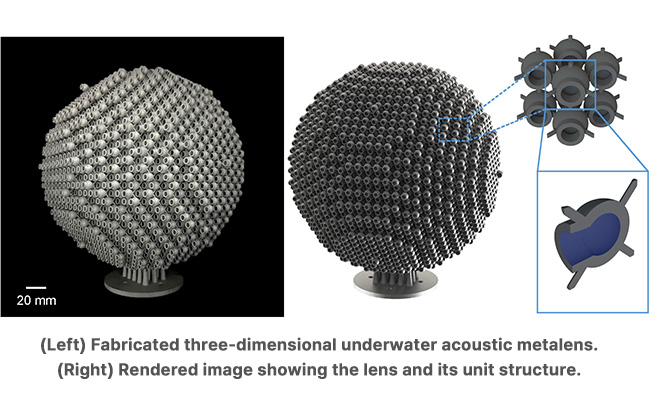
The team fabricated a 240 mm-diameter lens using metal 3D printing and demonstrated stable broadband focusing of low-frequency underwater sound in the 20-35 kHz range. Under the same 280 mm-diameter design condition, the proposed cavity-based lens reduced the weight from 27.5 kg to 17.2 kg, achieving a reduction of approximately 40% compared with a conventional solid lens.
The researchers also observed a phenomenon known as Willis coupling1), which caused sound to reflect differently depending on its incident direction. This asymmetric response suggests that the lens can do more than simply focus sound; it may also enable precise control over the directionality of acoustic waves.
The team expects this technology to be applied to a wide range of applications, including underwater sensor networks, underwater communication systems, and wireless acoustic energy transfer. In future underwater Internet of Things (IoT) environments, where distributed sensors exchange information through sound, this lens could serve as a key component for enhancing signal clarity and reliability.
Professor Junsuk Rho, who led the study, said, “This work addresses three major challenges in underwater acoustic devices at once: low-frequency operation, broadband performance, and lightweight design.” Dr. Sea-Moon Kim added, “This study is significant because it presents a new design paradigm for three-dimensional low-frequency underwater acoustic lenses.”
▶️ DOI: https://doi.org/10.1016/j.jsv.2026.119919
1. Willis coupling: An acoustic coupling phenomenon in which sound pressure and particle velocity are interlinked, causing acoustic waves to reflect or transmit differently depending on the forward or backward propagation direction.
Researcher
-

Rho Junsuk Professor
Dept. of Mechanical Eng.
View Profile -

Beomseok Oh
Doctoral program
Related News
-
Prof. Junsuk Rho’s Research Team Publishes Two Papers in a Single Issue of Nature - A First in Korea
2026.04.28 -

“A New Security Technology That Locks Information with Light Color and Distance” — Unhackable Metasurface Holograms
2026.01.30 -

A Single Plate Captures Multiple Frequencies at Once
2026.01.26