Research Highlights
Development of High-Performance, Air- and Thermally-Stable Tin Perovskite Transistors through Volatile Surface Coordinat
- Chemical Engineering
- Date2026.07.06
- Views148
[Professor Yong-Young Noh's team solves one of the semiconductor industry's "10 Future Grand Challenges"
by achieving record-breaking performance and stability in p-type perovskite transistors]
[First-ever study on perovskite transistors published in Nature]
Air is absolutely essential for human life, but for certain semiconductors, it is a deadly poison. The moment these materials come into contact with air, unreacted tin ions on their surface oxidize, creating defects that destroy the device. Now, a research team led by Professor Yong-Young Noh at POSTECH has solved this long-standing problem and published a next-generation semiconductor with enhanced performance and stability in Nature.
The study, led by Professor Yong-Young Noh's team at POSTECH (Dr. Geonwoong Park, PhD candidate Dong-Hyun Lee, and Dr. Youjin Reo), in collaboration with Professor Ji-Sang Park's team at Sungkyunkwan University and the teams of Professor Ao Liu and Professor Huihui Zhu at the University of Electronic Science and Technology of China (UESTC), was published on July 1 (local time). It is the world's first paper on perovskite transistors to appear in Nature, a milestone that effectively inaugurates a new field of research.
Smartphones contain countless transistors. A "transistor" is a tiny switch that turns electrical signals on and off, and comes in two types: "n-type," which carries electrons, and "p-type," which carries holes (the vacancies left behind when electrons leave). Building a high-performance, low-power semiconductor requires a balance between the two types — but improving p-type transistor performance has proven especially difficult, so much so that Korea's Ministry of Science and ICT named it one of the "10 Future Grand Challenges in Semiconductors.“
Tin-based perovskites have drawn attention as a strong candidate for solving this challenge. Holes flow smoothly through the material, and its performance can rival that of low-temperature polycrystalline silicon (LTPS) or oxide semiconductors, which currently drive memory chips and high-performance displays. The problem is that it is extremely vulnerable to air: unreacted tin ions (Sn2+) left on the surface oxidize on contact with air, generating a host of defects that block charge flow — causing the semiconductor's performance to collapse almost instantly.
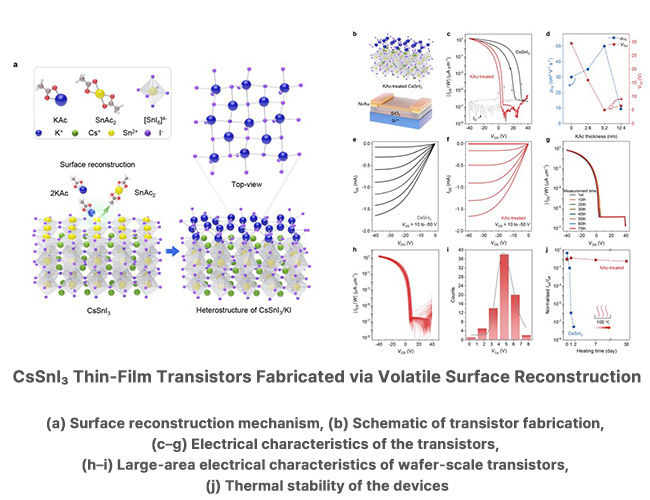
The research team's solution is a strategy called "Volatile Surface Reconstruction." When the surface of a cesium-tin-iodide (CsSnI3) semiconductor was treated with potassium acetate (KAc), the unreacted tin ions responsible for the performance loss were converted into a volatile compound, tin acetate (Sn(Ac)2), which simply volatilized. What's more, potassium iodide (KI) naturally formed in the spots left behind by the departing tin ions, creating a "self-protective layer" that shields the semiconductor from the outside environment. It was a killing two birds –with one stone solution: the troublemaker was evaporated away, and the gap it left behind was sealed with a protective layer.
As a result, the threshold voltage needed to switch the device on was lowered, hole mobility exceeded 50 cm2/V·s, and the on/off current ratio — which reflects the difference between the on and off states — reached over 100 million (108), achieving world-class performance for a p-type perovskite transistor. What stands out most is its air stability. While conventional devices broke down within minutes in open air, the new device held up for more than four hours. It also retained its initial performance for over a month even under accelerated thermal degradation testing at 100 °C.
The high environmental and thermal stability the team achieved is expected to serve as a foundational technology for processes that stack devices in multiple layers and fabricate them over large areas. Professor Yong-Young Noh said, "Thanks to Samsung Display and the Ministry of Science and ICT, who believed in a topic many considered impossible and provided steady support over the past six years, we were able to achieve the world's first report on perovskite transistors in Nature." He added, "Going forward, this technology is expected to serve as a core technology across a wide range of future electronics applications — including vertically stacked DRAM memory devices for AI-driven computation, next-generation display driver circuits, wearable devices, and highly integrated semiconductor devices."
Researcher
-

Noh Yong Young Professor
Dept. of Chemical Eng.
View Profile -

Youjin Reo
Dr.
-
Geonwoong Park
Dr.
-

Donghyun Lee
MS/PhD integrated program