Research Highlights
Put the Spectrometer Away: A Tiny Sensor That Detects Disease with a Single Camera
- Mechanical Engineering Convergence Electrical Engineering Chemical Engineering
- Date2026.09.16
- Views143
[POSTECH Researchers Develop Portable, Imaging-Based Metasurface Biosensor for Spectrometer-Free Molecular Detection]
What if signs of disease could be detected using nothing more than a tiny chip that fits in the palm of your hand and a camera, without ever visiting a hospital? A scene that once seemed possible only in science fiction has now moved one step closer to reality.
A research team led by Professor Junsuk Rho of the Departments of Mechanical Engineering, Chemical Engineering, Electrical Engineering, and the Graduate School of Convergence Science and Technology at POSTECH, together with Dr. Hongyoon Kim of the Department of Mechanical Engineering and Heechang Yun and Sebin Jeong of the Department of Chemical Engineering, has developed a metasurface biosensor capable of precisely detecting biomolecules through imaging without the need for an expensive spectrometer.
The research was conducted in collaboration with Professor Hyomin Lee’s group in the Department of Chemical Engineering at POSTECH and Professor Yong-Sang Ryu’s group in the Department of Biomedical Engineering at Korea University. The study was published in Nature Communications.
Biosensors are essential tools in healthcare, with applications ranging from disease diagnosis and infectious disease testing to cancer biomarker detection and genetic analysis. Among them, optical biosensors offer a particularly important advantage. They can directly detect biomolecules without fluorescent labels by measuring subtle optical changes that occur when target molecules bind to the sensor surface.
The challenge, however, has been the size and complexity of conventional systems. Detecting such minute optical changes typically requires a high-resolution spectrometer together with a broadband light source. Because these instruments are bulky and expensive, it has been difficult to bring high-performance optical biosensing beyond laboratories and hospitals.
The POSTECH-led team approached the problem from a different perspective. Instead of measuring a spectrum with a spectrometer, they designed the sensor to convert spectral information into spatial information that can be directly read through imaging.
At the heart of the technology is a specially engineered continuous geometric-gradient metasurface. The nanoscale structures that make up the metasurface gradually change in geometry along one direction of the chip, causing different positions to respond to different wavelengths of light. Just as the keys of a piano produce different notes depending on their position, different locations on the metasurface resonate with different wavelengths.
When the metasurface is illuminated with a compact single-wavelength laser, a dark line appears in the captured image at the position where the local optical resonance matches the laser wavelength. At this location, light transmission is strongly suppressed.
When biomolecules bind to the sensor surface, they slightly alter the surrounding refractive index. This shifts the optical resonance and causes the dark line to move. By tracking this spatial displacement through imaging, the researchers were able to accurately measure molecular binding signals.
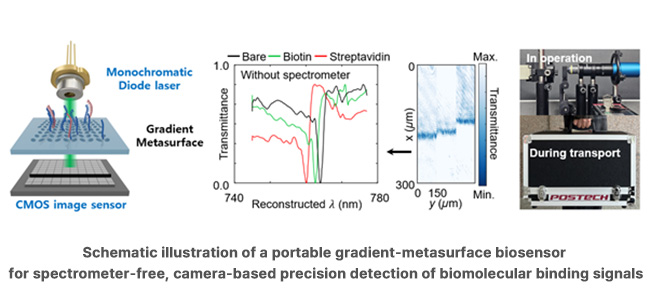
In other words, the system converts an extremely small spectral shift into a spatial displacement that can be directly measured through imaging, eliminating the need for conventional spectral measurements.
Despite its simple imaging-based readout scheme, the sensor demonstrated high performance. Within an area only about 300 micrometers (μm) across, roughly comparable to the width of several human hairs, the device simultaneously achieved a broad sensing range and fine spectral readout resolution of approximately 0.1 nanometers (nm).
Experiments involving proteins and DNA further demonstrated that the platform could detect biomolecules at concentrations down to the hundreds-of-picomolar (pM) range. The researchers also showed that the sensor could selectively recognize specific DNA sequences, demonstrating its potential for molecular diagnostics and genetic testing.
One of the greatest advantages of this technology is its simplicity. Instead of relying on a bulky, costly spectrometer and a broadband light source, the system requires only a compact single-wavelength laser and an imaging sensor. This approach could pave the way for miniaturizing precision optical biosensing systems traditionally confined to laboratories, into compact and portable diagnostic devices.
The researchers expect the platform to have broad potential for point-of-care diagnostics, including infectious disease testing, cancer biomarker detection, genetic analysis, and liquid biopsy.
Professor Junsuk Rho of POSTECH said, “This work demonstrates how the high optical sensitivity of metasurfaces can be combined with the simplicity of imaging-based readout to overcome key limitations of conventional spectrometer-based biosensors. The platform has strong potential to evolve into a compact, low-cost biosensing technology for point-of-care diagnostics.”
The research was supported by a grant from the Korean ARPA-H Project through the Korea Health Industry Development Institute (KHIDI), funded by the Ministry of Health & Welfare, Republic of Korea, and by a National Research Foundation grant funded by the Ministry of Science and ICT of the Korean government.
Researcher
-

Rho Junsuk Professor
Dept. of Mechanical Eng.
View Profile -

Hongyoon Kim
Dr.
-

Heechang Yun
MS/PhD integrated program
-

Sebin Jeong
MS/PhD integrated program