Research Highlights
Greener Living? It’s All in the Scheduling
- Computer Science & Engineering
- Date2026.11.16
- Views76
[POSTECH researchers develop EcoTailor, a personalized planning system that makes low-carbon choices more practical in everyday life]
A research team led by Professor Inseok Hwang of the Department of Computer Science and Engineering at POSTECH, including integrated MS-PhD students Jeongwon Choi and Donghyeon Kang, has developed EcoTailor1), a mobile planning system that suggests actionable low-carbon daily schedules tailored to users' commitments, transportation options, and personal preferences. The research was published in PACM IMWUT2) and was presented at ACM UbiComp/ISWC 2026, a leading international conference in ubiquitous computing.
We know how to reduce carbon. But can we fit it into our day?
Although many people are concerned about climate change and recognize the need to reduce carbon emissions, making environmentally friendly choices every day is not always easy. Taking the bus may be impractical when there is little time before the next appointment, while walking may feel too demanding on a particularly tiring day.
Existing sustainability technologies have largely focused on raising awareness of carbon emissions or encouraging greener behaviors, such as taking public transportation instead of driving. In everyday life, however, people's decisions are shaped by multiple interconnected factors, including time, cost, physical effort, appointments, and weather. Even the greenest option is unlikely to be put into practice if it does not fit into a person's daily schedule.
The research team focused on the fact that the flexibility people have in their daily schedules varies not only from person to person but also from day to day. While some commitments, such as classes and appointments, are difficult to change, other activities, such as writing reports or exercising, can be rescheduled or moved to a different location. Available choices may also shift depending on daily circumstances, such as weather or fatigue.
To reflect these differences, the researchers developed EcoTailor, a mobile system that generates multiple low-carbon daily schedule options based on users' individual circumstances. Rather than prescribing a single "best" schedule that minimizes carbon emissions, EcoTailor offers several alternatives, allowing users to choose the one that best fits their day.
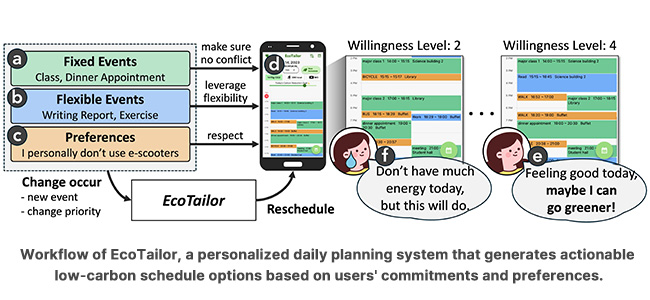
EcoTailor's key innovation lies in flexibly reorganizing the daily schedule itself. Moving an activity to a slightly different time may create enough room to walk instead of driving, while changing where an activity takes place may eliminate unnecessary travel altogether. In other words, rather than simply trying to fit greener choices into an already fixed day, EcoTailor helps users make room for them by adjusting the flexible parts of their schedule.
The researchers evaluated EcoTailor through a four-week real-world study in which participants used the system in their daily lives. The results showed an average reduction of 5.48% and a maximum reduction of 22.4% in estimated daily carbon emissions associated with occupying places and using transportation. Throughout the study, participants explored multiple schedule options suggested by EcoTailor, selected those that best suited their daily conditions and personal needs, and made further adjustments when necessary. In doing so, they incorporated actionable low-carbon plans into their everyday routines.
These findings suggest that helping users strike their own balance between carbon reduction and everyday convenience can make sustainable choices more practical in real-life settings.
Jeongwon Choi, the paper's first author, explained, "EcoTailor helps people put the environmentally friendly behaviors they already know into practice. Rather than prescribing the greenest possible solution, it offers actionable alternatives that fit each person's schedule and circumstances."
Professor Inseok Hwang, the corresponding author, commented, "This research goes beyond simply encouraging sustainable behavior. It presents an approach that takes users' real-world constraints into account and creates options people can actually act on." He added, "In the future, personalized planning technologies like EcoTailor could help people naturally integrate a wider range of values beyond the environment, including health and well-being, into their everyday lives."
This research was supported by the National Research Foundation of Korea(NRF) grant funded by the Korea government (MSIT). This research was also partly supported by the Institute of Information & Communications Technology Planning & Evaluation(IITP)-ITRC(Information Technology Research Center) grants funded by the Korea government(Ministry of Science and ICT) and the Korea Institute for Advancement of Technology (KIAT) grant funded by the Korea government(MOTIE).
▶️ DOI: https://doi.org/10.1145/3831644
1)EcoTailor : The name combines "Eco," referring to environmental sustainability, and "Tailor," meaning to customize something to individual needs. It reflects the system's goal of creating low-carbon schedules tailored to users' daily commitments and circumstances.
2)PACM IMWUT : Abbreviation for Proceedings of the ACM on Interactive, Mobile, Wearable and Ubiquitous Technologies.
Researcher
-

Hwang Inseok Associate Professor
Dept. of Computer Science & Eng.
View Profile -

Jeongwon Choi
MS/PhD integrated program
-

Donghyeon Kang
MS/PhD integrated program