Research Highlights
Turning Every Step into a Circulation Check
- Computer Science & Engineering
- Date2026.11.16
- Views81
[POSTECH develops CapWear, a smart footwear system that assesses peripheral circulation during everyday walking.]
Press firmly on your skin and release it, and the pale patch quickly regains its color. In hospitals, clinicians measure how long this takes to assess whether blood is reaching the body’s extremities. Now, a smart shoe system could make this assessment possible simply by walking.
A research team comprising Professor Inseok Hwang, Kyoosik Lee (M.S.), and Integrated M.S.-Ph.D. student Donghyeon Kang of the Department of Computer Science and Engineering at POSTECH has developed CapWear, a smart footwear system that repeatedly assesses peripheral perfusion during everyday walking. The findings will be presented at ACM ISWC 2026 (International Symposium on Wearable Computers), an international conference on wearable computing.
The time it takes for blood to refill the small vessels in the skin and for the skin to regain its original color after pressure is released is called capillary refill time (CRT). It is an indicator of how well blood reaches the body’s extremities. Although the procedure is simple, it requires someone to press on the skin and watch the color return. As a result, while a single measurement is easy, taking regular measurements throughout daily life has been difficult.
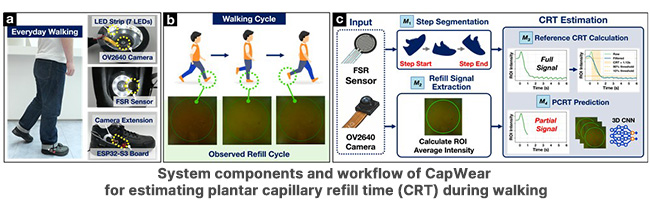
The researchers found inspiration in walking. With each step, body weight presses down on the sole of the foot and is then lifted away—a process that closely resembles the pressing and releasing involved in a CRT assessment. Each step could therefore serve as an opportunity to measure CRT. The idea was to repeat the assessment automatically during ordinary walking, without requiring people to perform a separate measurement procedure.
CapWear builds this idea into a shoe. A compact optical module beneath the heel contains a light source, a miniature camera, and a pressure sensor. The cramped, dark interior of a shoe makes imaging challenging, but the module illuminates the skin at a consistent brightness, allowing it to reliably capture even subtle changes in skin color. The pressure sensor detects when the foot touches the ground and lifts off. As the wearer steps down, pressure causes the skin on the heel to briefly turn pale. When the foot lifts, blood returns and the skin regains its color. CapWear analyzes this change to estimate CRT.
One challenge, however, was that the foot quickly returns to the ground during walking, leaving only about one second to capture the recovery process. This is often too short to observe the skin color fully return. To address this, the researchers conducted separate measurement sessions that allowed enough time to observe the full recovery. They then used the CRT values obtained in these sessions to train personalized models. By accounting for individual differences in skin and blood flow, these models can estimate CRT from the short video clips available during walking.
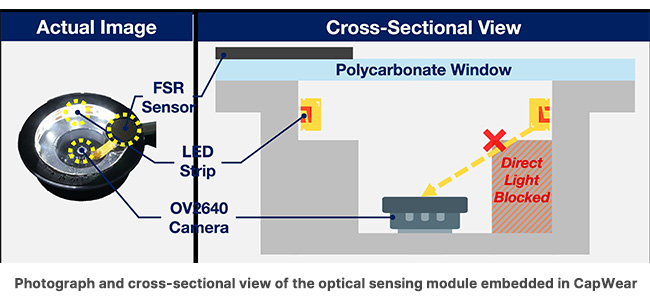
The team also evaluated the system using clinician-measured CRT values as a reference. They compared CapWear’s CRT estimates with measurements made manually by an emergency medicine physician who reviewed videos of the heel. The two sets of measurements showed a strong correlation, with a correlation coefficient of 0.71. Just as a pedometer counts steps, the results show that a shoe could check circulation with every step.
“This study demonstrates the potential to measure capillary refill time naturally and repeatedly during walking, without requiring a separate measurement procedure,” said Professor Hwang. “We hope to develop this approach into a healthcare technology that can unobtrusively and continuously track changes in peripheral perfusion associated with various diseases and health conditions during everyday life.”
This research was supported by the National Research Foundation of Korea(NRF) grant funded by the Korea government (MSIT). This research was also partly supported by the Institute of Information & Communications Technology Planning & Evaluation (IITP)-ITRC (Information Technology Research Center) grants funded by the Korea government (Ministry of Science and ICT).
Researcher
-

Hwang Inseok Associate Professor
Dept. of Computer Science & Eng.
View Profile -

Kyoosik Lee
Master
-

Donghyeon Kang
MS/PhD integrated program