Research Highlights
Once Annoying Screen Reflections Now Keep Your Screen Secure
- Computer Science & Engineering
- Date2026.11.18
- Views255
[POSTECH·KAIST joint research team uses inter-screen reflection on foldable smartphones to create a “for-your-eyes-only” display]
Have you ever felt uncomfortable entering your banking app password on the subway, worried that someone sitting next to you might be watching? Researchers in South Korea have developed a technology that uses the reflections created when a foldable smartphone is partially folded to make screen content clearly visible to the intended user while rendering it unintelligible to nearby observers. The technology transforms screen reflections, traditionally considered a nuisance that interferes with display readability, into a shield for protecting personal information.
A joint research team led by Professor Inseok Hwang and researcher Kyoosik Lee from the Department of Computer Science and Engineering at POSTECH, in collaboration with Professor Jun Han from the School of Computing at KAIST, has developed Fold2Unfold, a technology that prevents shoulder-surfing attacks by leveraging reflections between the two screens of a foldable smartphone. The research will be presented on November 5 at ACM UIST 2026, one of the most prestigious international conferences in the field of user interfaces, held in Detroit, USA.
Shoulder surfing is the act of looking over someone’s shoulder at their screen to steal passwords or personal information. The risk grows in places where people are packed closely together, such as public transit. Common privacy screen protectors narrow the angle from which a screen is visible, but they cannot block someone sitting right next to or behind the user. The researchers set out to create a screen that only the user can read, even when others are close by.
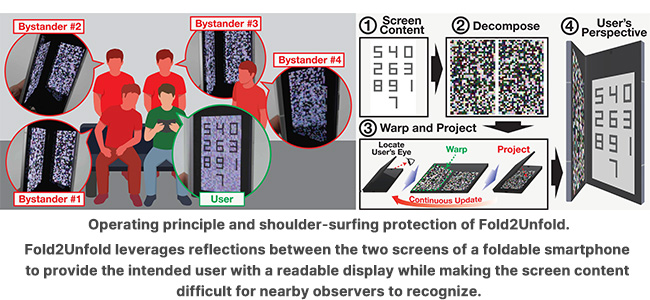
The answer was already inside the foldable smartphone. When a foldable smartphone is partially folded like a laptop, light from one screen reflects onto the opposing screen, much like a mirror. The researchers exploited this inter-screen reflection to convey visual information that only the intended user can perceive. Fold2Unfold divides the original digits into two image shares, each of which is unintelligible when viewed separately, and displays them across the two screens. Much like two pieces of a torn treasure map that reveal their meaning only when perfectly aligned, the directly displayed image and the reflected image overlap from the user's viewpoint to reconstruct the original digits. From other viewing angles, however, the two image shares become misaligned, appearing only as meaningless visual patterns.
The system also adapts when the user moves their head. Using the smartphone's front-facing camera, Fold2Unfold tracks the user's eye position in real time and accounts for the device's folding angle to continuously adjust the position and shape of the two images. It also compensates for brightness differences between the directly displayed and reflected images, allowing the user to perceive a coherent, readable display. Another advantage is that the technology can be implemented on commercially available foldable smartphones without additional hardware.
Experimental results showed that the digits became nearly unrecognizable from viewpoints just 7.5 degrees away from the intended user's viewing direction. At a typical smartphone viewing distance of 35 cm, this corresponds to a lateral displacement of approximately 4.6 cm, indicating that the content would be difficult to read without looking from a position extremely close to the user's own viewpoint. In contrast, most digits remained readable through conventional privacy screen protectors even at viewing angles of 30 degrees to either side. In a PIN entry experiment, nearby observers correctly identified an average of only 0.65 out of the 10 digits on the keypad.
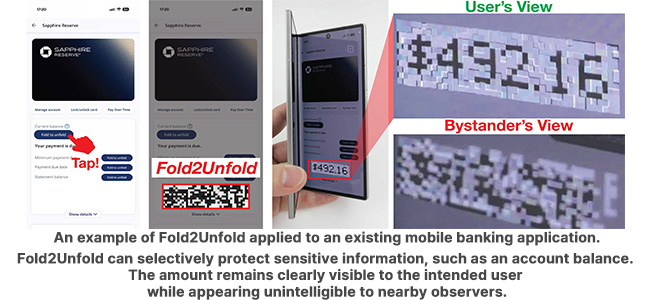
Fold2Unfold could be particularly useful when users handle sensitive information, such as entering mobile banking passwords or checking private messages. Because it operates entirely through software without requiring additional components, the technology also holds promise as a new privacy protection feature for future foldable smartphones.
"Our goal was to ensure that users could read their screens normally while making the content difficult for nearby observers to recognize," said Kyoosik Lee. "We focused on maintaining a natural viewing experience even as the user's eye position or the device's folding angle changes."
Professor Inseok Hwang added, "The significance of this work lies in transforming screen reflections, which have traditionally been regarded as a nuisance, into a means of protecting user information. We hope this research will encourage further exploration of privacy protection technologies that leverage the physical characteristics of devices."
This research was supported by the National Research Foundation of Korea(NRF) grants funded by the Korea government (MSIT).
Researcher
-

Hwang Inseok Associate Professor
Dept. of Computer Science & Eng.
View Profile -

Kyoosik Lee
Master