Research Highlights
Thin Lenses, Clear Images in Bright Daylight: A Step Toward Everyday AR Glasses
- Mechanical Engineering Convergence Electrical Engineering Chemical Engineering
- Date2026.11.18
- Views1049
[POSTECH–Samsung Research team builds a 1.5-mm-thick AR optical system, published in Nature]
[Sharp digital images even in bright outdoor settings expected to give momentum to the commercialization of AR glasses]
A new technology could make augmented reality (AR) glasses—which overlay information such as directions or text onto the scene in front of the wearer—more practical for everyday use. By reducing light loss inside a thin lens, a Korean research team has built prototype glasses that display legible text even in bright outdoor conditions.
The Ministry of Science and ICT announced that a research team led by Professor Junsuk Rho of POSTECH, in collaboration with Samsung Research of Samsung Electronics, has developed an optical technology that dramatically reduces light loss inside a metasurface1) waveguide2), producing bright images even as the position of the eye changes.
The research was supported by MSIT and the National Research Foundation of Korea (NRF) through the Individual Basic Research Program, the Future-Pioneering Convergence Science and Technology Development Program, the Core Technology Development Program for Immersive Content, the Nano & Material Technology Development Program, the Future Display Strategic Research Laboratory Program and the N.EX.T Impact Award, as well as by the Samsung Future Technology Incubation Program. The findings were published in Nature, one of the world's most prestigious scientific journals, on November 12 (16:00 GMT on November 11).3)
For AR glasses to be used in daily life, they must be as thin and light as ordinary eyeglasses while keeping images clearly visible in bright environments. The image should also remain visible when the wearer moves their eyes or when the glasses slip slightly down the nose. With existing technologies, however, it has been difficult to achieve thinness, brightness and ease of use at the same time.
Conventional AR glasses send light from a tiny display into a thin waveguide, where microstructures on its surface redirect the light toward the eye. In the process, however, some of the light escapes in unintended directions, dimming the image. In particular, the wider the range over which the image remains visible as the eye moves, the greater the light loss.
Producing natural color images posed another challenge. Even when red, green and blue light pass through the same microstructures, they travel in different directions and are delivered with different efficiencies, causing distortions in which certain colors appear too bright or too dim.
The researchers focused on the path light takes through the entire waveguide. They demonstrated, both theoretically and experimentally, that precisely designing the full path of light at the nanoscale can dramatically reduce unwanted light loss while keeping images bright and sharp even as the position of the eye changes.
The team also added a design for displaying color images. By stacking a layer that mainly transmits blue and green light on top of a layer that mainly transmits red and green light, they reduced differences in light-delivery efficiency across colors.
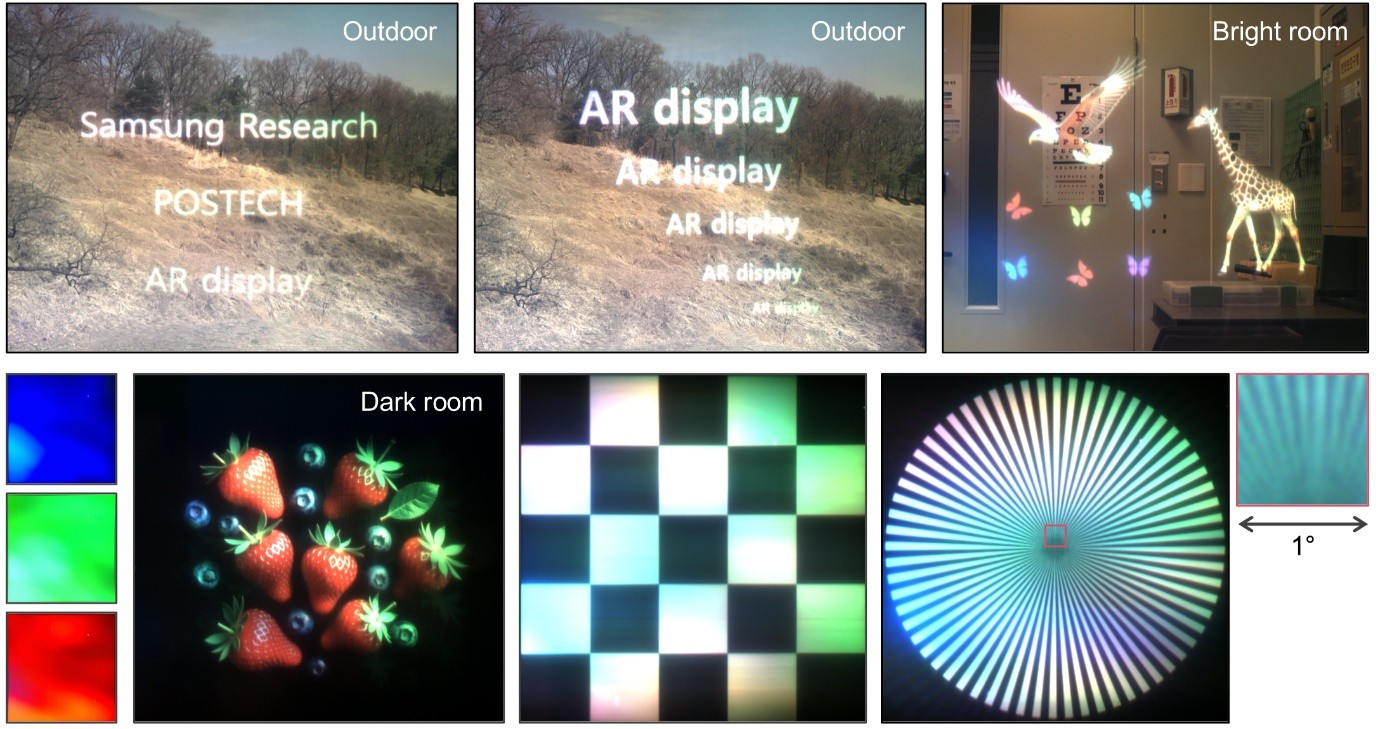
Combining the two layers, the team built a metasurface-based waveguide with a total thickness of 1.5 mm that delivers light to the eye. Prototype glasses incorporating the waveguide overlaid white text on real-world scenery in bright outdoor conditions and color images indoors. The images remained visible even when the eye position shifted within a certain range.
The significance of this work lies in demonstrating that reducing light loss inside a metasurface waveguide makes it possible to produce bright images even with thin optics. The technology is expected to be used in everyday glasses that display directions or work-related information in front of the user's eyes. Using light more efficiently could also help reduce power consumption while maintaining screen brightness.
Before the technology can be put to practical use, its average luminance will need to be improved further to meet the brightness standards required by industry, and follow-up research is needed to achieve the same performance with a single waveguide instead of two. Rainbow-like artifacts that appear when external light interacts with the waveguide's microstructures must also be reduced, and variations in color and brightness depending on eye position and image region must be addressed. Improving image quality so that small text is easier to read in bright outdoor conditions is another challenge for future work.
"This study shows that by precisely controlling the path of light inside a lens, even a thin lens can produce bright, sharp images outdoors," said Professor Junsuk Rho of POSTECH. "Going forward, we will reduce the rainbow artifacts caused by light and secure mass-production technologies, while combining the technology with AI-based personalized image processing to develop AR glasses that people can wear comfortably in everyday life."
▶️ DOI: https://doi.org/10.1038/s41586-026-11277-x
1)Metasurface: An optical structure in which nanostructures smaller than the wavelength of light are arranged to control properties of light such as its phase and direction of propagation.
2)Waveguide: An optical structure that guides light along a specific path without letting it escape.
3)Paper title: Metasurface waveguides for all-day augmented reality glasses
Researcher
-

Rho Junsuk Professor
Dept. of Mechanical Eng.
View Profile -

Hyunjung Kang
MS/PhD integrated program