Research Highlights
"The Protein Factory Worker Became a Switch" New Gene Circuit Technology Enables Cells to Make Their Own Decisions
- Life Sciences
- Date2026.07.06
- Views136
[POSTECH research team led by Prof. Jongmin Kim develops 'RATEX,' an RNA circuit capable of complex computation inside living cells]
The molecular machinery that normally works on building proteins inside cells has now taken on a new role as a "switch." A research team at POSTECH has developed a new 'RNA-based smart gene circuit' platform that can simultaneously read multiple signals inside a cell, make its own decisions, and autonomously generate programmed responses. This represents a step beyond simple genetic manipulation toward an era in which cells themselves function as "living computers."
The technology, named 'RATEX' (Ribosome-Assisted Transcriptional EXpression controller), was developed by Prof. Jongmin Kim, Dr. Hansol Kang, and graduate students Hyunseop Goh and Chaeri Kim from the Department of Life Sciences at POSTECH. The results were recently published in the international chemistry journal Angewandte Chemie.
Cells use genetic information to build proteins and elicit cellular responses in two major steps. First, the information encoded in DNA is copied into RNA in a process called "transcription." Then, that RNA is read to build proteins in a process called "translation." Synthetic RNA-based gene circuits have focused on control strategy at one or the other stage of signal processing, where signal sensing and processing were largely confined to a single level. In reality, however, cells must integrate numerous molecular signals at multiple regulatory levels to make decisions much like a vehicle at a complex intersection where multiple traffic lights flash simultaneously, Current genetic circuit designs often faced challenges to handle this increased level of computational complexity.
To address this bottleneck, the research team turned their attention to ribosome, the molecular machine responsible for building proteins. Ribosomes normally read RNA and produce proteins, but also respond to molecular signatures encoded within RNA transcript. By co-opting and enhancing the signal processing capability of ribosome in combination with specific RNA motifs, the team engineered a system where ribosomes “pause” at specific locations on a gene when certain conditions are met, which in turn determines whether gene expression proceeds. In effect, the ribosome has been promoted from a mere production machine to a "switch." This architecture, where the computational result at the translation stage immediately dictates whether transcription occurs, termed Translation-to-Transcription Converter (TTC), forms the basic building block for the RATEX platform. This design strategy enables repurposing available library of synthetic translational logic switches to directly control the transcription process.
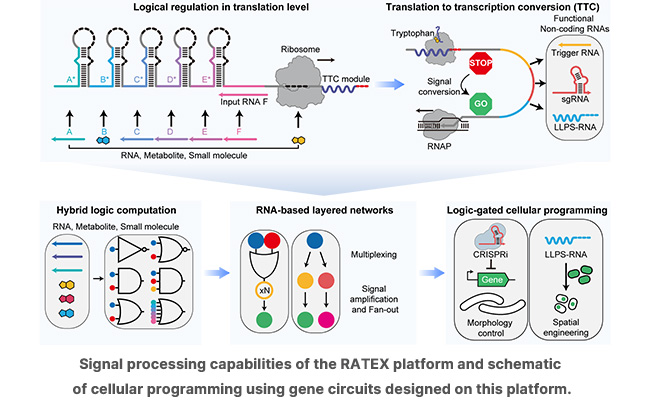
This novel approach allowed to overcome the previous design limitations and dramatically improved scalability. The research team demonstrated gene regulatory capacity of up to 1,492-fold and implemented complex logic circuits capable of simultaneously processing up to six RNA signals. The team also created diverse hybrid logic circuits capable of simultaneously recognizing both RNA signals and metabolites such as amino acids and vitamins. Cells now possess advanced signal processing capability where they can "compute" multiple types of molecular information at once.
Beyond simple logical control of gene expression, the team combined the RATEX platform with CRISPR gene regulation and synthetic membraneless organelles, thereby altering cell morphology and reorganizing intracellular structures only when all specified conditions were satisfied. This flexibility in design further demonstrated that cells can be precisely "programmed."
This platform technology promises to provide a novel design paradigm for applications in diverse fields. For instance, RATEX could provide a framework to develop smart therapeutics that detect cancer-specific molecular signatures and produce treatment compounds in situ, and environmental biosensors that respond only upon encountering particular combinations of pollutants. Prof. Jongmin Kim stated, "The key contribution of this research is seamlessly integrating the sophisticated cellular decision-making at the translation stage for transcriptional control." He added, "The ability to integrate and process different types of signals -- such as RNA and metabolites -- within a single RNA transcript represents a new design paradigm to further scale up synthetic biological circuits."
This research was supported by the National Research Foundation of Korea (NRF) Basic Research Program funded by the Ministry of Science and ICT; the POSTECH Basic Science Research Institute; the National Research Facilities and Equipment Center of the Korea Basic Science Institute; the Gyeongbuk Technopark FoodTech R&D Center Development and Support Program; the High Value-added Food Technology Development Program funded by the Ministry of Agriculture, Food and Rural Affairs; the Korea Health Industry Development Institute (KHIDI) Health Technology R&D Project funded by the Ministry of Health and Welfare; and the Basic Science Research Program of the NRF funded by the Ministry of Education.
Researcher
-

Kim Jongmin Associate Professor
Dept. of Life Sciences
View Profile -

Hansol Kang
Dr.
-

Hyunseop Goh
MS/PhD integrated program
-

Chaeri Kim
MS/PhD integrated program