Research Highlights
For Longer-Lasting Batteries, When You Add Oxygen Matters More Than How Much
- Ferrous & Eco Materials Technology
- Date2026.11.17
- Views27
[A POSTECH team led by Professor Kyoungdoc Kim extends the life of single-crystal cathodes
by baking them in air first and switching to oxygen partway through]
Anyone who has grilled a steak knows that when you flip it matters as much as how hot the grill is. The same turns out to be true for electric vehicle(EV) batteries. Researchers have found that battery life has more to do with when oxygen is introduced during cathode baking than with how much oxygen is used.
The finding comes from a team led by Professor Kyoungdoc Kim of the Graduate Institute of Ferrous & Eco Materials Technology at Pohang University of Science and Technology. By changing the oxygen level in stages during the bake, the team was able to control how large the particles grow and make the battery last longer. The team worked with Professor Youngjin Kim’s group in the Department of Battery Convergence Engineering at Kangwon National University, POSCO Holdings, and researchers at the Indian Institute of Technology Bombay. The results were published online in the journal Advanced Science.
An EV battery’s performance and lifespan depend on its cathode, the core material that determines how much energy the battery can store and how long it can be used. Conventional cathodes are polycrystalline, meaning each particle is a cluster of many small grains. As the battery is charged and discharged over and over, cracks open up between those grains and performance declines. That is why single-crystal cathodes, in which each particle is one large crystal from the start, are drawing interest as an alternative.
Single crystals, however, are tricky to make. During baking at around 950°C (about 1,740°F), the particles pack tightly together and grow larger at the same time. If those two processes fall even slightly out of balance, pores get trapped inside the particles like air bubbles in ice, or the particles grow too large. What is more, striking that balance has so far depended largely on experience and intuition.
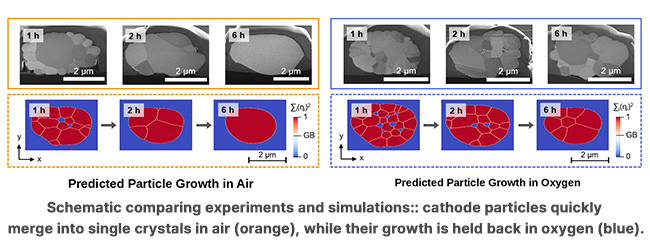
The researchers turned their attention to the oxygen level inside the furnace. They baked a nickel-cobalt-manganese cathode called NCM613 in the lab and paired those experiments with computer simulations. The key to particle growth, they found, is how fast the boundaries between grains move, a property known as grain-boundary mobility. If the boundaries move too quickly, the grains merge before the pores can escape, and the pores end up trapped inside. If they move too slowly, the grains do not grow enough to become a single crystal.
It turned out that the more oxygen there was, the slower those boundaries moved. After six hours in the furnace, particles baked in air had grown to 2.75 micrometers (μm), while those baked in oxygen reached only 1.04 μm, a roughly 2.6-fold difference. The model the team developed reproduced these results closely. Based on these findings, the team devised a recipe that starts the bake in air and finishes it in oxygen. Of the six hours at 950°C, the first four are spent in air, letting the particles pack together quickly. For the remaining two hours, the atmosphere is switched to oxygen, which keeps the particles from growing any larger.
The resulting cathode consisted of dense, pore-free single crystals and kept 83.04% of its original capacity after 100 charge-discharge cycles at 45°C (113°F). Cathodes baked entirely in air or entirely in oxygen kept only about 77%. When the team flipped the order, starting with oxygen and finishing with air, pores remained in the particles and the cathode held on to just 80.89% of its capacity. The material and the baking time were identical; the order alone made the difference.
By bringing calculation-based design to cathode manufacturing, which has long relied on guesswork, the work is expected to help produce longer-lasting EV batteries. “Diffusion and grain-boundary migration are hard to tell apart using experiments alone, so we used simulations to separate their roles,” said Professor Kyoungdoc Kim, who led the study. “We then went back to the lab and confirmed the best switching point the model had predicted. When calculations guide the experiments, we can improve on cathode manufacturing methods that have long relied on trial and error.”
The research was supported by POSCO Holdings and by the Korea Institute for Advancement of Technology (KIAT) with 2026 funding from the Korean government’s Ministry of Trade, Industry and Resources.
Researcher
-

Kim Kyoungdoc Assistant Professor
Dept. of Ferrous Technology
View Profile -

Sushil Kumar
Post-doctoral Research Associate
-

Hyeonho Park
Doctoral program
Related News
-

Self-Regenerating Catalyst Overcomes Key Durability Challenge in Hydrogen Energy
2026.06.11 -

"Reading the Invisible": POSTECH-Led Team Develops AI Framework Accounting for Hidden Defects in Metal 3D Printing
2026.05.14 -

Breakthrough Nano-Spring Technology Boosts Battery Durability and Energy Density
2025.03.13